

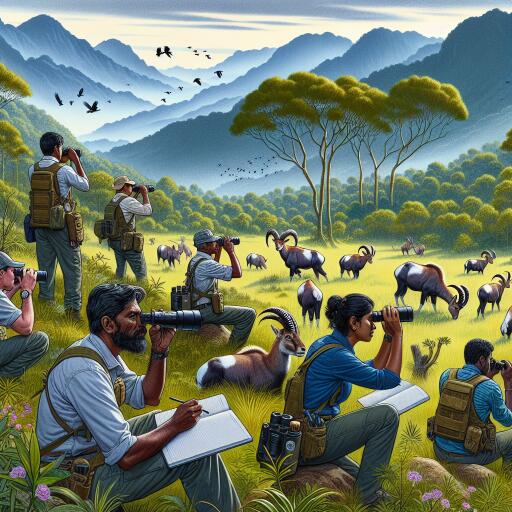
TN rolls out 3rd Synchronized survey of Nilgiri Tahr
Tamil Nadu has launched the third synchronized census of the Nilgiri tahr, scaling up a science-driven effort to understand and protect the sure-footed icon of the Western Ghats. The four-day operation, coordinated with Kerala, is designed to count herds that move across state borders at the same time, delivering a clearer picture of the population without double counting.
Why a synchronized count matters
The Nilgiri tahr roams steep, high-altitude grasslands and shola forests along the spine of the Ghats, often crossing administrative boundaries. By aligning survey schedules and methods across Tamil Nadu and Kerala, wildlife managers can generate more accurate estimates, track breeding success after the winter calving season, and detect changes in distribution. This approach has become a pillar of long-term conservation planning for Tamil Nadu’s State Animal.
Project Nilgiri Tahr: technology meets ecology
Launched in October 2023, Project Nilgiri Tahr is a focused, multi-year program that blends rigorous protection and habitat management with modern monitoring tools and expert collaboration. Core elements include:
- Enhanced protection and patrols in key habitats
- Active habitat restoration and management in grassland–shola mosaics
- Standardized population monitoring at landscape scale
- Adoption of international survey standards, supported by advanced tech and external scientific review
What we learned from the first two counts
The inaugural synchronized survey in 2024 set the baseline for Tamil Nadu, estimating 1,031 individuals. Teams covered 140 survey blocks across 13 forest divisions over 1,862 km, refining methods through pilots and deploying bounded count and double-observer techniques to match the terrain.
The second survey in 2025 expanded to 177 blocks in 14 divisions, with nearly 800 personnel traversing close to 2,000 km. Field assessments and historical records added 36 habitats to the map. The result was an estimated 1,303 tahrs and encouraging signs of recruitment, with herds frequently seen with young. The species continued using newly recolonized areas such as Pasumalai and returned to places where it had been absent for more than a decade. Notably, several landscapes matched locations celebrated in Sangam-era literature, underscoring the animal’s deep cultural and ecological roots. Alongside counts, teams collected pellet and carnivore scat samples to assess parasite loads and predator–prey dynamics, feeding into more nuanced conservation plans.
2026 survey: bigger canvas, smarter tools
This year’s exercise grows in both scope and sophistication. The synchronized count spans 14 forest divisions, 43 ranges, 124 beats, and 177 survey blocks, covering more than 3,100 km from Ashambu Mottai in Kanyakumari (about 902 m MSL) to Tavalamalai in Gudalur (about 986 m MSL). Nearly 800 trained frontline staff are on the ground.
For the first time, a dedicated mobile app—Varudai—is streamlining real-time data collection with GPS tagging and standardized forms. A web-based backend allows near-instant integration and oversight, sharpening quality control and response. Survey teams continue to match methods to landscape: bounded counts in fragmented patches, and a mix of bounded count and double-observer techniques in large contiguous tracts such as Mukurthi and Grass Hills.
Independent experts from leading institutions, including global conservation bodies, veterinary and botanical institutes, and national wildlife organizations, are embedded as third-party observers. Their combined expertise in ungulate behavior, disease surveillance, and habitat assessment helps maintain methodological consistency and scientific rigor across years.
Beyond headcounts: movement, habitats, and climate relevance
Under Project Nilgiri Tahr, radio-collaring began after the initial assessments—reportedly a first for the species in India. The tracking data illuminate seasonal movements, habitat preferences, and connectivity between herds, all vital for shaping corridors and mitigating fragmentation.
Each survey also documents the condition of habitats: vegetation composition, terrain features, and disturbance signs are recorded so that numbers can be interpreted in context. The Nilgiri tahr’s stronghold—the montane grassland–shola ecosystem—is among the Western Ghats’ most distinctive biomes. Sheer cliffs and rolling high-altitude grasslands shelter a suite of endemic species, from native grasses and shola trees to the Nilgiri pipit and black-and-orange flycatcher, while sharing space with larger fauna like gaur and leopard. Safeguarding the tahr uplifts these fragile systems that buttress regional water security and buffer climate risks.
What’s next
With three consecutive synchronized surveys, Tamil Nadu is assembling a comparable, multi-year dataset to track trends, refine threat assessments, and target interventions. Findings from this round will inform habitat restoration priorities, site-specific protection, and long-term management plans. The program’s formula—persistent field presence, standardized science, and inter-state coordination—positions the Nilgiri tahr for a steadier future across its native range.



Leave a Reply