

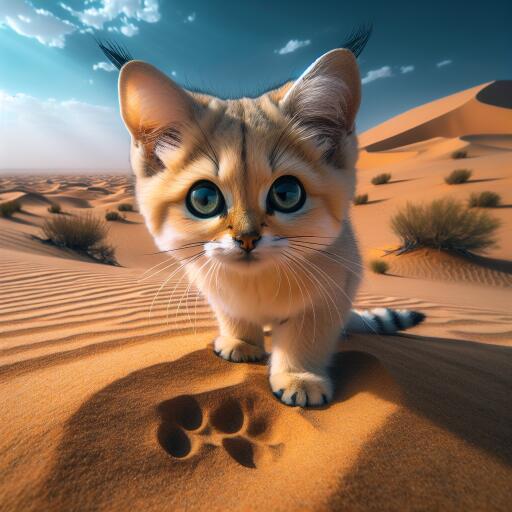
The elusive Arabian sand cat
When the heat lifts off Oman’s dunes and the horizon blurs into starlight, a small, pale hunter slips out of the sand’s embrace. Hardly anyone sees it, and most who do aren’t sure they’ve seen anything at all. The Arabian sand cat moves like a mirage—present, vital, and almost impossible to pin down.
Built for a landscape of extremes
This compact feline is a specialist forged by aridity. Dense fur on the undersides of its paws acts like natural desert boots, muffling footsteps and insulating against scorching ground. A sandy-beige coat scatters light and shadow so effectively that the animal often vanishes at a glance. Low-set ears and a broad face help it listen for faint rustles beneath the crust of soil—signals of rodents, reptiles, or insects hiding just out of sight.
In central and southern Oman, where wind sculpts shifting corridors between towering dunes and gravel plains, the sand cat persists in pockets of suitable habitat. No one can say how many remain. Globally, the species is assessed as Least Concern, yet in parts of the Arabian Peninsula numbers are suspected to be falling—a mix of real pressure and the simple truth that it is extraordinarily hard to study what you rarely see.
The desert’s quiet regulator
Despite the sparse setting, the food web here is intricate. By preying on small mammals, reptiles, and large insects, the sand cat helps steady populations that fluctuate with desert blooms and busts. Individuals can roam several kilometers in a single night, using keen hearing to locate prey and digging swiftly when needed. Like many desert carnivores, it can derive much of its moisture from what it eats, reducing dependence on permanent water sources that are few and far between.
These behaviors make it both resilient and elusive: tracks blur quickly in the wind, and a creature that moves mostly in darkness leaves little trace for scientists to follow.
Pressure on a delicate system
Across Oman’s interior, human footprints are spreading in subtle and not-so-subtle ways. Off-road travel, energy and transport infrastructure, and the hum of expanding settlements carve through once-quiet corridors. Vehicle collisions, habitat fragmentation, and competition with other carnivores—including feral cats—add to the pressure. On their own, these factors may seem minor; together, they chip away at an animal that depends on wide, undisturbed spaces.
Technology meets the dunes
New tools are finally prying open this mystery. Networks of motion-triggered cameras set low to the ground are capturing rare, telling frames. Machine-learning models trained to sift thousands of night images can spot a cat’s silhouette hidden amid flickering shadows, accelerating what used to take months of expert review. Lightweight collars—carefully fitted and designed to drop off—can log movements across nights and seasons, while satellite data reveals when and where desert vegetation pulses after rain, hinting at boom times for prey.
Researchers are also testing noninvasive methods, such as analyzing hair or scat for genetic clues, to map where sand cats persist without ever needing to see them. Piece by piece, a picture forms: which dunes are used as highways, which hollows shelter day beds, and how these patterns shift with the weather.
Protecting what most people never witness
In Oman, broad conservation efforts aimed at safeguarding desert landscapes benefit species like the sand cat even when they remain hidden from view. The challenge is keeping those habitats connected and intact—ensuring that a cat can pass from one hunting ground to the next without crossing a gauntlet of roads and fences.
Simple measures help. Slower night driving on desert tracks lowers collision risk. Limiting off-road travel in sensitive areas protects burrows and prey communities. Managing waste reduces the draw for feral animals that compete with or transmit disease to native wildlife. None of these actions require seeing the cat; they simply require acknowledging that the desert is alive, even when we can’t see what lives there.
A symbol of resilience—and restraint
The Arabian sand cat is a reminder that some of the most remarkable creatures are the ones we rarely encounter. Its survival rests on finely tuned adaptations and on our willingness to leave the desert’s quieter stories intact. For scientists, every verified sighting and each data point chipped from the night closes a gap in knowledge that has lingered for decades. For the rest of us, awareness matters: appreciating that the silence of a dune field is not emptiness—it is an ecosystem at work.
In a country often celebrated for coastal cliffs and high mountains, the interior sands hold a different kind of drama—subtle, precise, and resilient. Somewhere out there, padded feet are already tracing the cool side of a ridge, and a pale shape is melting back into the earth-toned light. Whether we glimpse it or not, the desert’s small ghost remains, carrying on its ancient routine beneath the stars.



Leave a Reply