

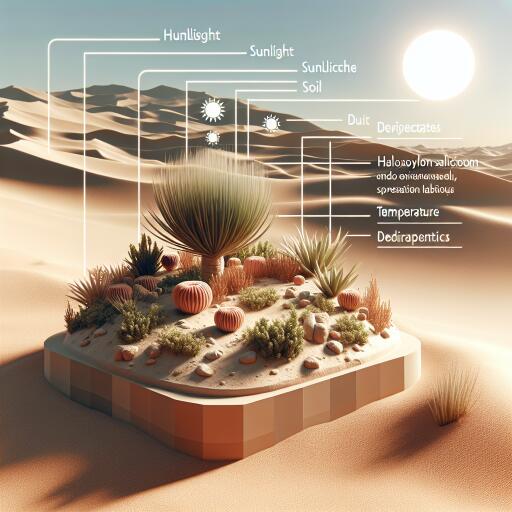
Evaluating Haloxylon salicornicum Habitat Suitability Using Modeling
As heatwaves intensify and rainfall patterns shift, understanding how hardy desert plants respond to change has moved from ecological curiosity to practical necessity. A recent modeling effort examines where Haloxylon salicornicum—often called saltbush—can survive now and in the future, combining ecological data with decision-support tools to map suitable habitats across a range of climatic and non-climatic scenarios.
Rather than relying on a single predictive engine, the study blends multiple species distribution models into an ensemble, then uses the analytic hierarchy process (AHP) to weigh the relative importance of environmental drivers. This marriage of ecology and decision science doesn’t just draw a map; it clarifies which conditions matter most, and where management could make the biggest difference.
Why this shrub matters
Haloxylon salicornicum is a standout of arid and semi-arid landscapes. It tolerates drought, endures saline soils, and anchors fragile terrain. Those traits make it a promising ally for dryland restoration, sand-dune stabilization, and reclamation of degraded or saline-affected lands. Its resilience is not an anecdote—it’s a strategy that can be mapped, tested, and planned for.
From data to decisions: the modeling approach
The research team integrated two pillars:
- Ensemble species distribution modeling to predict habitat suitability by aggregating outputs from multiple algorithms, reducing the bias of any single method and quantifying uncertainty.
- The analytic hierarchy process to prioritize predictors—separating what is important from what is merely correlated—by systematically comparing climatic and non-climatic factors.
Climatic variables such as temperature means and extremes, precipitation totals and seasonality, and moisture balance were paired with non-climatic layers, including soil texture and salinity, terrain features, and land use. Through cross-validation and consensus mapping, the workflow delivers stable suitability surfaces and scenario-based projections.
Key signals from the projections
Several patterns emerge:
- Resilience across extremes: The shrub demonstrates a broad tolerance envelope, maintaining suitability across harsh thermal and moisture regimes, especially where soils are coarse and drainage is good.
- Sensitivity thresholds: Suitability declines sharply under compounded stress—intense heat combined with prolonged dry-season deficits—particularly when soils are heavy or salinity exceeds physiological limits.
- Role of non-climatic factors: Soil texture and salinity mediate climate exposure; in sandy or loamy substrates with moderate salinity, otherwise marginal climates can become viable. Land-use pressures and fragmentation can erode suitability even where climate appears favorable.
- Shifting opportunity zones: Projections point to emerging corridors for establishment under certain warming and rainfall scenarios, alongside potential contractions in areas where evaporative demand outpaces recharge and salts accumulate.
Applications for restoration and resource management
Because Haloxylon salicornicum tolerates drought and salinity, it’s well placed for projects that seek to stabilize soils, conserve scarce water through low-input vegetation cover, and rehabilitate saline-affected lands. Suitability maps can guide:
- Site selection for planting efforts that minimize irrigation needs.
- Buffer design around agricultural areas prone to wind erosion or salinization.
- Prioritization of intervention in landscapes where the species can act as a nurse plant, facilitating broader community recovery.
These use cases align with climate adaptation planning: choosing species that deliver ecosystem services while withstanding a hotter, drier future.
Weighing what matters: insights from AHP
One challenge in ecological modeling is untangling intertwined drivers. By applying AHP, the study assigns transparent weights to variables, clarifying trade-offs between, say, precipitation seasonality and soil conductivity. This helps identify actionable levers—like focusing on sites with supportive soil texture when climate margins are tight—and exposes tipping points where small environmental changes produce outsized effects on suitability.
Navigating uncertainty
All models carry uncertainty, and this framework treats it as information. Ensemble outputs provide agreement scores, showing where predictions are robust and where field validation is essential. Scenario analyses further illustrate how alternate climate trajectories alter habitat patterns, supporting risk-aware planning rather than single-map prescriptions.
Tech meets ecology: a path forward
Emerging tools can sharpen these maps. High-resolution remote sensing can track vegetation performance and soil crust dynamics; soil and microclimate sensors can ground-truth thresholds; and updated land-use data can capture rapid changes at the human–ecosystem interface. Integrating these data streams with iterative modeling cycles would improve forecasts and help managers adapt strategies in near real time.
Limitations and ethical considerations
Species distribution models infer potential, not guaranteed, presence. Establishment depends on seed availability, grazing pressure, and site preparation—factors that may fall outside environmental layers. Ethical deployment also matters: while introducing hardy species can restore function, it should respect local biodiversity, cultural practices, and long-term ecosystem trajectories.
What this means for a drying world
The big takeaway is pragmatic optimism. Haloxylon salicornicum’s tolerance profile, viewed through a lens that blends climate, soil, and land use, reveals strategic opportunities to restore degraded lands and build resilience in water-stressed regions. By clarifying where the species can thrive and why, the modeling supports smarter investments, fewer failed plantings, and landscapes better prepared for climatic volatility.
Most importantly, the approach is transferable. The same ensemble-plus-AHP framework can be adapted to other restoration candidates, expanding the toolkit for biodiversity conservation and climate adaptation. In the convergence of ecology and technology, desert plants like Haloxylon salicornicum aren’t just survivors—they are guides to designing with resilience in mind.



Leave a Reply