

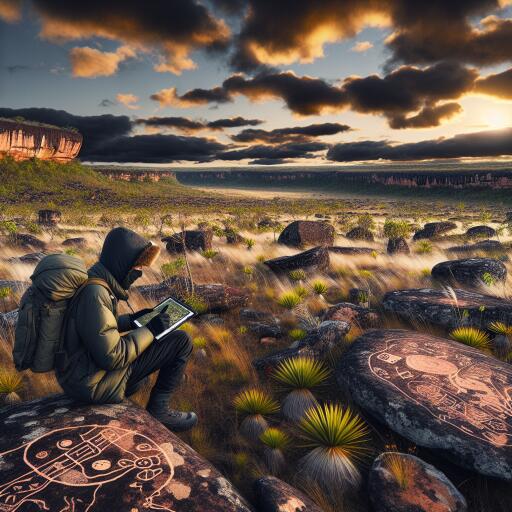
Surviving Harsh Conditions of Carajás Rupestrian Grasslands
Perched on ironstone plateaus in Brazil’s Eastern Amazon, the Carajás rupestrian grasslands endure blistering heat and capricious water cycles—offering rare insight into how life adapts when the environment pushes past conventional limits.
A heat-and-drought crucible on ironstone
Across the canga outcrops—hard, iron-rich surfaces also known as ferricrete—life contends with a punishing microclimate. Thin soils over dark rock magnify solar radiation, elevating surface temperatures far above those in surrounding forests. When rain falls, it can vanish as quickly as it came, shedding off rock slabs or evaporating before plants can capitalize on it. The result is a landscape defined by extremes: scorching days, abrupt wet–dry swings, and moisture that is both scarce and unreliable.
These conditions do more than test survival. They sculpt a distinctive community of plants and animals whose life cycles are synchronized to rapid changes in heat and water. The grasslands function as a living stress laboratory, revealing how ecosystems reorganize under climatic pressure and what it takes to persist in a world growing hotter and drier.
Measuring the unmeasurable
In recent field campaigns, researchers instrumented the grasslands with high-precision sensors, embedding microclimate loggers and soil moisture probes directly into contrasting microsites—shallow soil pockets, exposed rock, shaded crevices, and seasonally wet depressions. Continuous monitoring captured temperature spikes, nocturnal cooling, dew formation, and the timing of soil drying after rainfall. These fine-grained datasets illuminate just how quickly conditions flip from survivable to stressful, and how the timing and intensity of heat and water pulses vary across the rocky mosaic.
The approach blends ecology and technology: ruggedized instrumentation, remote data retrieval, and analytics that connect microclimate records to plant performance. The payoff is a high-resolution picture of stress that satellites or regional weather stations can’t see—data essential for both conservation planning and climate-risk forecasting.
Blueprints of resilience
The flora of canga grasslands showcase survival strategies that read like a manual for life on the edge. Many species deploy a combination of traits to cope with heat and water scarcity:
- Waxy, reflective leaves and compact growth forms that limit overheating and water loss
- Deep or wide-ranging root networks to exploit fleeting moisture in cracks and soil patches
- Physiological adjustments that maintain cell function during desiccation and temperature spikes
- Seeds and clonal structures primed to lie dormant through harsh periods and burst into growth when rain arrives
These tactics don’t simply add up; they interact. For instance, a plant’s architecture can create its own microclimate, buffering tissues from the hottest boundary layers while directing precious water to roots. Such integrative adaptations help explain why endemic species can thrive in places where generalists falter.
Fragile by design—and under pressure
Despite their toughness, these ecosystems are vulnerable. Industrial expansion, infrastructure, fire, and invasive species can disrupt the delicate balance that allows canga biota to persist. Disturbances that strip or compact the already thin soils, alter drainage, or change fire regimes can erase microhabitats that took millennia to form. Protecting them demands more than broad conservation zones; it requires management tailored to the fine-scale variability that defines the grasslands’ resilience.
Why the world should care
The lessons from Carajás reach far beyond one corner of the Amazon. As climate extremes intensify, the same kinds of stress—short, fierce heatwaves and erratic water availability—are appearing in unexpected places, from croplands to cityscapes. Understanding how life persists on canga can inform:
- Crop and rangeland strategies that harness heat- and drought-resilient traits
- Urban design that leverages microtopography, shading, and reflective materials to blunt thermal extremes
- Restoration practices that prioritize microsite diversity, ensuring refuges during climatic shocks
In essence, these grasslands act as prototypes for adaptation, demonstrating the value of heterogeneity, stress-tolerant physiology, and timing in resource use—principles transferable across sectors and regions.
From data to action
To translate insight into durable protection, a few priorities stand out:
- Map microhabitats at high resolution and prioritize the most thermally and hydrologically extreme sites for strict protection
- Integrate microclimate metrics into environmental impact assessments, not just regional climate averages
- Maintain natural hydrology by avoiding surface leveling, excessive drainage, and soil sealing on canga surfaces
- Invest in long-term monitoring networks that track heat, moisture, and biotic responses through wet and dry seasons
These measures recognize that resilience in canga is a property of place, not only of species—disrupt the fine-scale template and the system’s unique adaptations lose their footing.
A signal from the future
The Carajás rupestrian grasslands remind us that ecological endurance is built where physics and biology meet. On ironstone, life negotiates every degree and drop; success depends on exploiting brief windows and surviving long spells of scarcity. As communities worldwide prepare for a century of climate volatility, the canga’s message is both cautionary and hopeful: environments can be unforgiving, yet evolution offers a deep toolkit for persistence. Our task is to safeguard the conditions that allow those tools to work—and to learn from them before they are lost.



Leave a Reply