

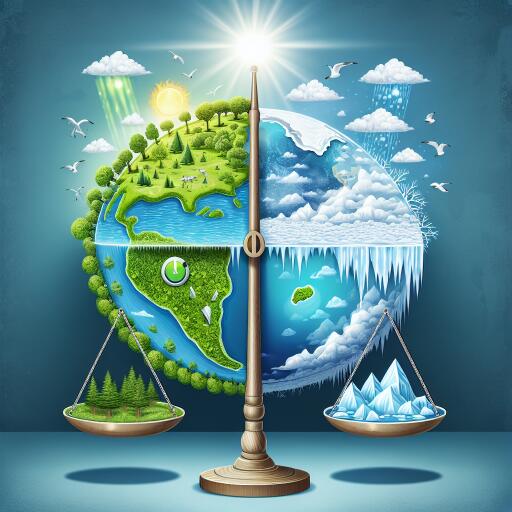
What are climate tipping points? They sound scary, especially for ice sheets and oceans, but there’s still room for optimism
As the world heats up, parts of Earth’s climate system risk being pushed past thresholds where change becomes rapid, self-perpetuating and hard to reverse. These “tipping points” involve big players like ice sheets, ocean currents and rain forests. A decade ago nearly every nation pledged to keep warming close to 1.5 C above preindustrial levels to lower those risks. Yet by 2024, global temperatures briefly hovered near or above that line, sharpening the focus on what tipping points are—and how to avoid them.
Tipping points: not a single cliff, but rising odds
A tipping point isn’t a magic number where everything collapses at once. It’s better understood as a zone where the chance of runaway change grows with every fraction of a degree of warming. Cross the threshold, and feedbacks kick in: warming drives more warming, drying drives more drying, and ice loss begets even faster ice loss. That’s why a few tenths of a degree matter enormously.
How scientists probe the thresholds
Researchers use sophisticated models to explore when and how different parts of the climate might tip. These virtual experiments gradually increase temperatures and track responses in air, ocean, land and ice. The results don’t agree on a single “break point,” but they consistently show rising risk for several large-scale systems: ice sheets in Greenland and Antarctica, the Atlantic overturning circulation, tropical forests, coral reefs and permafrost.
Ice sheets: slow-motion giants with long memories
The Greenland ice sheet is among the most vulnerable major tipping elements. If it began an irreversible retreat, it could ultimately raise global sea levels by about 7 meters. Some simulations suggest parts of Greenland could commit to long-term decline a little above 1.5 C of warming; others point to higher thresholds nearer 2.5–3 C. The precise number is uncertain, but the direction is clear: more warming, more risk.
East Antarctica presents a different picture. Its sheer size and geometry make it more stable, with many studies placing its potential tipping zone at much higher levels of warming—likely beyond 5 C. That doesn’t mean it’s immune to change, but it is less likely to tip soon if we limit warming.
Forests on the edge: the Amazon’s delicate balance
The Amazon rain forest helps regulate rainfall across South America and stores vast amounts of carbon. Heat, drought and fire can push the forest toward a drier state where trees die back and the ecosystem releases more carbon, amplifying warming and drying further. By mid-century, large swaths could face overlapping stresses. In the worst case, parts of the basin could shift toward a savanna-like landscape for centuries. The details vary across models and regions, but the feedbacks are real—and concerning.
Coral reefs: the frontline of ocean heat
Warm-water corals rely on a partnership with algae that breaks down during marine heatwaves, causing bleaching. Repeated or prolonged heat stress can lead to widespread coral mortality, eroding biodiversity and the fisheries and tourism many communities depend on. Low-latitude reefs are at particular risk, with research indicating that sustained warming of around 1.5 C can push many beyond their capacity to recover. Even so, local protection from pollution and overfishing can help surviving reefs hang on.
Oceans in motion: the Atlantic conveyor’s warning signs
The Atlantic Meridional Overturning Circulation (AMOC) acts like a heat engine, carrying warm surface waters north and returning cold, dense waters south at depth. Freshwater from melting Greenland ice reduces surface salinity and density, hindering that sinking branch. If the circulation weakens enough, feedbacks could drive a rapid slide toward a much slower state, with profound consequences: shifting storm tracks, cooler North Atlantic regions, disrupted fisheries and potential knock-on effects for the Amazon and Antarctic ice.
How close is a tipping point? Observations and models show vulnerability, but there’s active debate about trends and timing. Some studies suggest a collapse could occur within a century once critical thresholds are crossed; others see a slower, less dramatic change. The prudent takeaway: it’s risky, and faster emissions cuts reduce the odds.
Not every threshold is forever—and uncertainty cuts both ways
Some warming-driven changes could partially reverse if temperatures fall. For example, permafrost that thaws can refreeze, though repeated thaw can damage soils and infrastructure and release greenhouse gases along the way. Uncertainty doesn’t mean safety; it means the range of outcomes includes both slower changes and faster, more abrupt ones. In risk management terms, that argues for caution.
Reasons for determined optimism
Here’s the hopeful part: tipping risks rise gradually, not instantly. Every tenth of a degree we avoid lowers the chance that critical systems run away from us. Rapid cuts to greenhouse gas emissions, accelerating clean energy, conserving and restoring ecosystems, and reducing non-CO2 pollutants like methane all slow the approach to dangerous thresholds. Smart adaptation—cooling cities, safeguarding coasts, managing fire and water—buys time and saves lives.
Tipping points underscore the stakes, but they also highlight agency. We are not passengers on a runaway train. The faster we bend emissions down and strengthen resilience, the more we keep Earth’s big systems within their stable ranges—and the better the odds that ice sheets, oceans and rain forests continue to support a thriving, livable planet.



Leave a Reply