

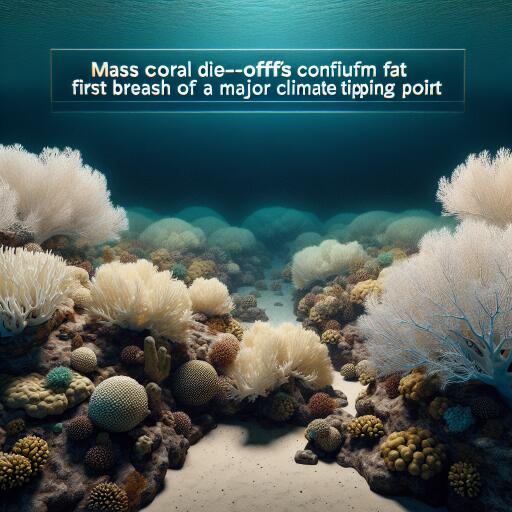
Mass Coral Die-Offs Confirm First Breach of a Major Climate Tipping Point
Warm-water coral reefs are now struggling to survive in a world that has become too hot for them. A growing body of evidence indicates that we have crossed a critical climate threshold, with mass coral die-offs confirming the first breach of a major Earth system tipping point.
The 2025 Global Tipping Points Report, compiled by an international team of researchers, concludes that the temperature limit at which widespread coral mortality is triggered—around 1.2 degrees Celsius above preindustrial levels—has been surpassed. As marine heatwaves intensify, reefs from the Great Barrier Reef to the Caribbean have suffered repeated, severe bleaching at a pace that outstrips their capacity to recover.
Recent years hovering around 1.5 degrees Celsius of global warming have unleashed unprecedented ocean heat. Multiple global bleaching events have already been recorded, several in just the last decade, with vast swaths of coral turning ghostly white as heat-stressed symbiotic algae are expelled. Reports suggest roughly 80 percent of the world’s reefs have experienced bleaching during the latest episode, a scale that would have been unthinkable only a generation ago.
This is not only an ecological crisis—it is a human one. Coral reefs underpin coastal fisheries, draw tourism, buffer shorelines from storms, and sustain cultural traditions. An estimated half a billion people depend on them, and their global economic value has been estimated in the trillions of dollars annually. As die-offs accelerate, food security, livelihoods, and coastal protection rapidly erode.
Restoration projects and selective breeding for heat-tolerant corals are often showcased as solutions. Yet these efforts cannot succeed at scale unless ocean temperatures fall back within the bounds corals can tolerate. Without rapid and sustained cuts in greenhouse gas emissions, the intervals between extreme heat events will remain too short for meaningful recovery.
Current policy trajectories still point toward 2.5 to 3 degrees Celsius of warming this century. That path risks pushing other Earth systems past their own points of no return. Among the most concerning are the West Antarctic and Greenland ice sheets, where irreversible ice loss could be set into motion, accelerating sea-level rise in the near term and locking in multiple meters of sea-level rise over the long term. The cascading consequences would transform coastlines, displace communities, and reshape economies worldwide.
Coral collapse is the early warning. With every fraction of a degree of additional heating, the likelihood increases of losing other vital systems—rainforests that generate their own rainfall, ocean currents that regulate climate, and cryosphere regions that stabilize sea levels. The risks are not abstract: people are already losing homes, harvests, and lives to the impacts of a warming planet. The more these systems unravel, the more difficult and costly it becomes to restore stability.
The report also flags a crucial counterpoint: positive tipping points. These occur when cleaner, cheaper technologies and practices become self-reinforcing. Renewable electricity from solar and wind, bolstered by battery storage, has reached cost competitiveness in many regions. Electric vehicles and heat pumps are scaling rapidly. Nature-based solutions—from restoring mangroves to rewilding degraded landscapes—can lock away carbon while rebuilding resilience. With the right policies, finance, and public support, these shifts can snowball faster than expected.
To steer away from catastrophic tipping cascades and towards regenerative ones, governments, businesses, and communities must accelerate the transition already underway. Upcoming international climate negotiations offer a moment to commit to deeper emission cuts, phase out fossil fuels, and invest in adaptation that protects the most vulnerable.
There is still agency in this moment. Actions that matter now include:
- Adopting and enforcing policies that rapidly reduce emissions across power, transport, buildings, and industry.
- Scaling nature-based solutions that protect coasts, restore ecosystems, and enhance biodiversity.
- Redirecting finance from fossil fuels into clean energy, resilient infrastructure, and community-led adaptation.
- Shifting consumption patterns—such as reducing food waste and high-emissions diets—to lower pressure on land and oceans.
- Supporting research, monitoring, and local stewardship of reefs and other climate-sensitive systems.
- Engaging civically to demand ambitious targets, transparent timelines, and accountability from decision-makers.
The message is clear: coral reefs can rebound, but only if the heat relents. That demands choices made this decade—choices that can still prevent the loss of irreplaceable ecosystems and the freedoms and futures they safeguard. The first tipping point has been breached; whether it triggers a domino of collapse or a surge of transformative action depends on how quickly we change course.



Leave a Reply