

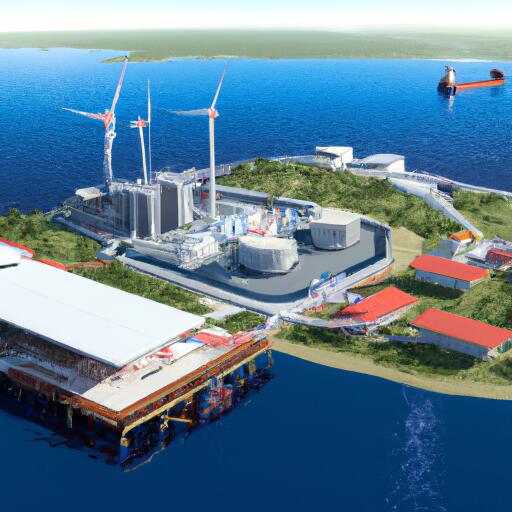
JERA Corporation plans to develop $2.2 billion Nghi Son LNG Power Plant
Japan’s JERA Corporation has signaled renewed intent to advance the Nghi Son liquefied natural gas (LNG) power project in Vietnam’s Thanh Hoa province, outlining ambitions to bring the plant online before the end of the decade even as procedural and market hurdles linger.
Key developments from provincial talks
During a working session on September 8 with the leadership of the Thanh Hoa People’s Committee, JERA representatives, led by general director Masashi Tsujimura, reiterated a commitment to pursue the project and engage closely with local authorities on permitting, construction logistics, and power price negotiations.
Standing Vice Chairman Nguyen Van Thi directed provincial departments and the Nghi Son Economic Zone Management Board to coordinate with JERA Vietnam to finalize documentation and craft proposals for central government consideration. The meeting followed JERA Vietnam Energy Co., Ltd.’s July notification to the province expressing interest in studying and investing in the Nghi Son LNG Power Plant.
JERA had previously joined a consortium with Sovico Group and submitted pre-qualification materials in 2024 but did not advance to the formal bidding stage at that time.
Project at a glance
- Total investment: more than VND 57 trillion (approximately $2.2 billion)
- Planned capacity: 1,500 MW using combined-cycle gas turbine technology
- Fuel infrastructure: onshore regasification terminal rated at 1.2 million tonnes of LNG per year, dedicated LNG storage, and an import berth with an estimated 1 km breakwater
- Site: nearly 68 hectares within Nghi Son town, integrated into the national power development strategy
- Target timeline: commercial operation before 2030
JERA, a joint venture between Tokyo Electric Power Company and Chubu Electric Power, oversees more than 80 GW of installed capacity globally and manages one of the world’s most extensive LNG supply chains—from upstream procurement and shipping to power generation. In Vietnam, the company operates through JERA Vietnam, with activities spanning gas and renewable energy initiatives.
Bidding setbacks and shifting terms
The investor selection process for Nghi Son has been complicated by changing regulations and market conditions. A first tender process in July 2024 was paused to align with the 2023 Bidding Law and Decree No. 115/2024/ND-CP. A second round opened in April 2025 with a bid deadline set for June 10, later extended to June 19 and July 17. Despite the extra time, the round attracted no submissions.
To improve participation, authorities adjusted key bidding parameters. Bid security was reduced from more than VND 580 billion to VND 275 billion. The minimum equity requirement was also lowered, and the ceiling power tariff was increased to 3,303.88 VND per kWh. Experience criteria were updated in line with the revised total investment framework.
Why this project matters for Vietnam’s energy transition
Vietnam’s power demand is rising rapidly, while coal additions face financing and environmental headwinds. A modern combined-cycle gas plant like Nghi Son could help stabilize the grid as more solar and wind projects come online, thanks to faster ramping and lower local air pollutant emissions compared with coal-fired units. LNG also offers supply diversity, enhancing energy security if managed through robust contracting and infrastructure planning.
At the same time, LNG is still a fossil fuel, and lifecycle greenhouse gas emissions remain a critical concern—particularly methane leakage along the supply chain. Policymakers and investors will watch how the project addresses emissions management, including opportunities to improve efficiency, curb methane intensity, and design systems that can accommodate lower-carbon fuels such as hydrogen or ammonia blends in the future.
What to watch next
- Investor selection: Whether the revised bidding terms draw qualified participants or spur direct negotiations.
- Power price framework: Finalization of a bankable tariff structure will be pivotal for financing a large-scale LNG-to-power complex.
- Fuel sourcing: Clarity on long-term LNG procurement strategy and regas logistics, including storage and port operations.
- Grid integration: Coordination with transmission upgrades to ensure timely evacuation of 1,500 MW and compatibility with variable renewables.
- Environmental safeguards: Measures to minimize local impacts and manage lifecycle emissions, aligned with national climate targets.
If JERA and provincial leaders can navigate the remaining procedural steps and lock in a viable commercial framework, the Nghi Son LNG Power Plant could become a cornerstone of Vietnam’s near-term power mix—providing firm capacity to backstop renewables while the country accelerates investment in lower-carbon technologies.



Leave a Reply