

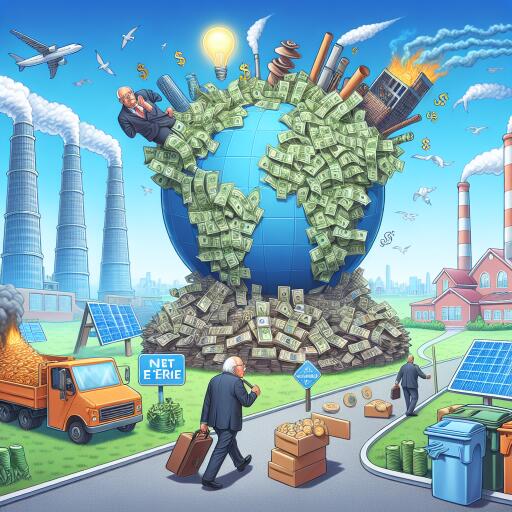
The Amount of Money Wasted on Net-Zero Green Policies is Staggering! – Conservative Angle
In the journey towards a sustainable future, a significant oversight has been the assumption that renewable sources like wind and solar can entirely supplant fossil fuels. Yet, a crucial distinction exists: while renewables primarily generate electricity, they do not contribute to the production of goods or transportation fuels crucial for our modern way of life.
Historically, from the 16th to the 19th centuries, whale oil was utilized for lightning, lubrication, and manufacturing various products, leading to widespread hunting nearly to the point of extinction. Fast forward to today, the ambitious “Green” and “Net Zero” initiatives face similar misunderstandings, as they expect renewables to replace fossil fuels without addressing the gap in product creation.
The materials we rely upon in our daily lives, numbering over 6,000, alongside fuels for our cars, ships, planes, and other transportation, are derived from petrochemicals and fossil fuels. These are essential for devices that require electricity, including smartphones, computers, and medical equipment. The fallacy here lies in thinking that going green with intermittent electricity from solar and wind is financially feasible or sustainable in the long run without substantial subsidies.
Renewables provide electricity, dependent on adequate weather conditions, whereas refined crude oil delivers a plethora of products and fuels crucial to global economies. Infrastructure advancements made over the past 200 years demonstrate that societies are increasingly demanding these fossil-fuel-derived goods and services.
Some of the key sectors relying on fossil fuels include:
- Hospitals and Medical Equipment
- Airports and the Military
- Communications and Telecommunications
- Space Exploration
- Appliances and Electronics
- Transportation and Construction
- Sanitation, Heating, and Ventilating
It’s not an addiction to fossil fuels; it’s a dependency on the myriad products they facilitate. Without a viable alternative, policymakers advocating for a departure from fossil fuels must offer plans to maintain the supply of both products and fuels to these sectors. As of yet, no such comprehensive backup exists.
In wealthier nations, there is often a lack of awareness about the reality that a significant portion of the world’s population subsists on less than $10 a day. This financial inability to subsidize greener energy systems questions the viability of strictly renewable energy sources without assistance. The homeless in affluent countries illustrate a glimpse of life with limited fossil fuel use—an unsavory reality.
For the billions living in developing regions, a path to industrialization necessitates access to products and continuous electricity. Consideration of nuclear power as a means to provide reliable energy should be evaluated as part of the broader strategy.
It’s essential for those making “Green” and “Net Zero” policies to acknowledge the historical context: electricity came after the advent of oil. Current electric generation methods, including hydro, coal, natural gas, nuclear, wind, and solar, are built using products stemming from refined crude oil. Likewise, the manufacture of electric vehicles, solar panels, and wind turbines relies heavily on these components.
The misconception that renewable products like electric vehicles are wholly green is misleading, as their production often depends on coal-generated electricity. This creates a paradox where these items, intended to reduce fossil fuel dependency, still lean on it during their manufacturing.
In essence, all modes of transportation, from cars to military aircraft, require fuels refined from crude oil. Eliminating these would collapse transportation and hinder the production of essential products.
In summary, policymakers should shift their focus from the broad term “energy” to consider the specifics of economic demands for:
- Products derived from oil-based manufacturing.
- Transportation fuels to support vehicles and aircraft.
- Stable and economical electricity supply.
This approach would align more closely with proven scientific research indicating minimal impact of carbon dioxide on climate change, thus questioning the necessity of worldwide Net Zero goals. The financial implications of these green policies are indeed monumental.
In conclusion, “Green” and “Net Zero” strategies, while well-intentioned, often lack an understanding of energy’s multifaceted nature. Tackling energy literacy is essential to crafting policies that bridge the gap between aspiration and practicality.
Please consider sharing this insight to foster discussions on energy literacy and sustainable development.



Leave a Reply