

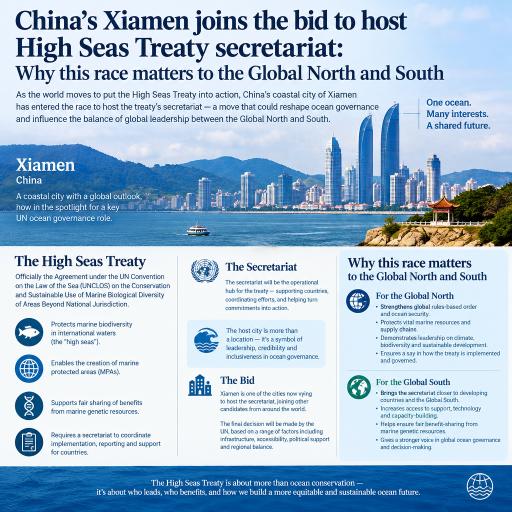
China’s Xiamen joins the bid to host High Seas Treaty secretariat: Why this race matters to the Global North and South
A coastal tower facing the sea in Xiamen has been readied for a potentially historic role: housing the future secretariat of the UN High Seas Treaty, formally known as the agreement on marine biodiversity beyond national jurisdiction. With the treaty now in force, the contest to host its permanent administrative hub has become a test of who will help shape the next phase of global ocean governance.
Xiamen is competing with Brussels and Valparaiso to host the secretariat, a body that will support the treaty’s day-to-day work once governments begin implementing its rules. The decision may sound technical, but it carries real geopolitical and ecological weight. At stake is how the world will manage waters that lie outside national borders, covering most of the ocean and holding immense biodiversity, genetic resources and mineral wealth.
A turning point for the high seas
The high seas account for around 60% of the world’s oceans, yet for decades they have remained poorly governed in practical terms. Existing maritime law set broad principles, but it did not fully answer newer questions raised by technological advances, industrial expansion and the race for access to deep-sea resources.
The High Seas Treaty was designed to close those gaps. It creates a framework around four central issues: sharing benefits from marine genetic resources, establishing marine protected areas, requiring environmental impact assessments, and helping poorer countries build scientific and technical capacity.
These are not abstract concerns. Deep-sea organisms may hold clues for future medicines, industrial enzymes or new materials. At the same time, pressure is growing to mine the seabed for metals needed in batteries and electronics. Conservationists warn that rushing into extraction before ecosystems are understood could cause irreversible harm in one of Earth’s least explored environments.
The treaty is therefore about more than biodiversity. It is also about fairness: who gets to study the ocean, who can profit from discoveries, and who has a say over protecting fragile ecosystems far from shore.
Why the secretariat matters
The secretariat will not govern the high seas on its own, nor will it override national governments. But it will be a crucial nerve center. It will organize meetings of member states, manage information-sharing systems, support negotiations on protected areas and environmental reviews, and help coordinate technical assistance for developing countries.
In practice, where the secretariat is based could influence who participates most easily in the treaty’s work, which scientific networks grow around it, and how accessible the system feels to governments with fewer diplomatic and research resources. That is why the host-city race has drawn attention well beyond the three candidates.
For many countries in the Global South, the treaty’s credibility will depend on whether it avoids reproducing the same imbalances long seen in environmental governance, where powerful states and institutions often dominate expertise, financing and agenda-setting. Locating the secretariat in a region outside the traditional European concentration of global marine institutions would carry symbolic and practical significance.
Why Xiamen is in the running
China is presenting Xiamen as a strong base for a new era of ocean cooperation. The city already hosts major marine science institutions, policy platforms and regional cooperation centers. Its coastal setting, transport links and formal host facilities are being highlighted as assets for an organization expected to serve governments, scientists and civil society from around the world.
Supporters of the bid also point to China’s growing marine research capacity. Over the past two decades, the country has expanded its ocean observing systems, research fleets and deep-sea technology, including advanced submersibles capable of exploring remote habitats. Those capabilities could matter as the treaty moves from legal text to implementation, especially in identifying ecologically important areas and improving biodiversity monitoring.
China is also emphasizing its record in ecological restoration and marine conservation. Officials and researchers involved in the bid argue that this experience, together with training programs and scientific partnerships with developing countries, would allow Xiamen to become a platform for broader participation rather than a narrow national showcase.
Why this matters to North and South
The competition over the secretariat reflects a larger debate about the balance of power in global environmental governance. For the Global North, the treaty is a way to strengthen rules for conservation, scientific coordination and environmental oversight in waters beyond national control. Many wealthier states also see it as a necessary framework for managing emerging industries before disputes deepen.
For the Global South, the stakes are sharper. Developing countries have long argued that marine science and ocean industries are dominated by states with money, ships, laboratories and legal expertise. Without stronger safeguards, they fear that benefits from deep-sea genetic resources or other high-seas activities could flow mainly to a small group of technologically advanced nations.
The treaty tries to answer those concerns through benefit-sharing, capacity-building and technology transfer. But whether those commitments become reality will depend heavily on institutions. A secretariat that actively supports training, transparency and access for less-resourced states could help narrow longstanding inequalities. A weak or distant one could leave many promises on paper.
That is why the host decision matters beyond diplomacy. It will send a message about whether the high seas are truly being treated as a shared global space, or whether old hierarchies will continue under a new legal framework.
The bigger contest over the ocean’s future
The secretariat race is unfolding against a backdrop of intensifying disagreement over how fast humanity should exploit the open ocean. Some governments and companies want to move quickly on seabed mining and commercial use of marine genetic resources. Others insist science is still too incomplete and the risks too high.
The High Seas Treaty will not settle every dispute, but it gives countries a platform to negotiate rules around use, protection and accountability. Its success will depend on trust between developed and developing countries, and on the willingness of major powers to accept multilateral guardrails.
Xiamen’s candidacy is therefore about more than office space. It is part of a broader struggle over representation, scientific access and the future geography of global governance. Whether the secretariat ends up in Asia, Europe or South America, the choice will shape how this landmark treaty is experienced by the countries expected to bring it to life.
For a world facing accelerating marine biodiversity loss, that choice matters. The high seas may seem remote, but the rules written for them will influence conservation, equity and resource politics for decades to come.



Leave a Reply