

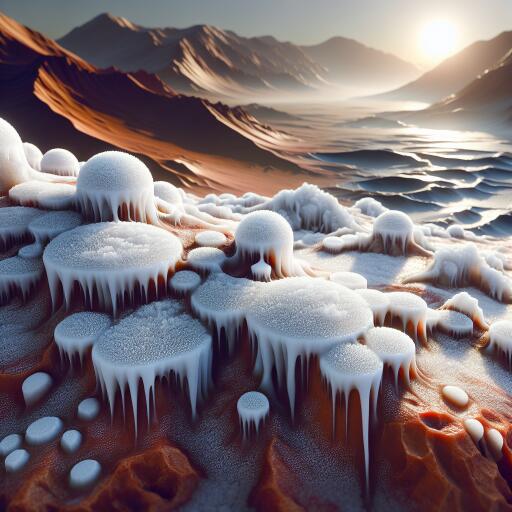
Brines may form from seasonal frost on Mars study finds
In a fascinating development concerning Mars’ environmental conditions, a recent study has suggested that transient liquid brines might emerge on the Martian surface through the seasonal cycle of frost. This hypothesis stems from an analysis of observational data from past Mars missions paired with computer simulations. Such findings shine a light on potentially habitable niches on Mars, at least for organisms keenly adapted to cold and arid conditions.
The seminal insights come from the Viking 2 mission, which is the only mission so far to have observed and analyzed frost on the Martian surface. By integrating this rare dataset with the comprehensive Mars Climate Database, the researchers pinpointed a seasonal timeframe at the cusp between late winter and early spring as conducive for brine formation. During this time, conditions might allow for brine formation twice each Martian day, specifically in the early morning and late afternoon.
These brines are hypothesized to form primarily from calcium perchlorate, a salt with a notably low eutectic point of minus 75 degrees Celsius. Mars, with an average equatorial temperature hovering around minus 50 degrees Celsius, presents a slim thermal window where calcium perchlorate could fleetingly appear in liquid form. This is particularly intriguing given that typical Martian frost tends to evaporate swiftly, sidestepping the liquid stage altogether. However, certain diurnal temperature cycles might briefly align surface conditions into the optimal range for brine formation.
Despite this tantalizing possibility, any resultant liquid would likely be minimal. The Martian frost layers are known to be exceedingly thin, often less than a millimeter thick, and calcium perchlorate concentrations in the Martian soil are relatively low, likely around 1%. Thus, the quantity of transient liquid would be scant.
While the findings do not provide definitive proof of brines on Mars, they stand as a testament to the possibility of transient liquid water in small quantities on the Red Planet. The implications extend into the realm of astrobiology, suggesting the episodic presence of microenvironments that could support lifeforms adapted to Mars’ harsh climate.
Looking to the future, there is a strong advocacy for deploying robotic landers that could explore these seasonal windows with tools like in situ hygrometers and chemical sensors. The marked correlation between the formation of brines and the seasonal frost cycles pinpoints specific periods where transient water activity might peak, offering a potent guide for planning upcoming astrobiological missions.
As research endeavors progress, these findings may refine our understanding of Martian habitability, potentially steering future exploration and shedding light on the enduring question of life’s possibility beyond Earth.



Leave a Reply