

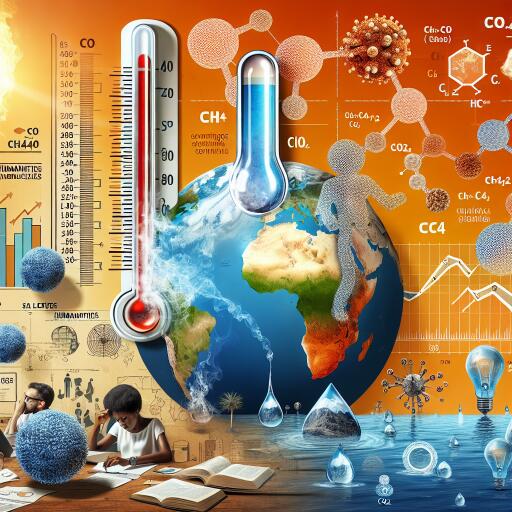
Unmasking Climate Vulnerability in Africa: The Role of CO2 and CH4 Emissions on Rising Temperatures and Sea Levels – Humanities and Social Sciences Communications
Analyzing climate change impacts requires robust statistical techniques. In this context, several methodologies were employed to analyze panel data models and ascertain the relationship between greenhouse gas (GHG) emissions and climate change indicators over time across Africa. Methods included Pooled Ordinary Least Squares (POLS), Random Effect (RE), and Fixed Effect (FE) estimations, evaluated through statistical tests to determine suitability. Descriptive statistics reveal that Africa’s CO2 and CH4 emissions exhibited extensive variability from 1993 to 2020, with significant environmental consequences.
The African continent emitted an average of 18,978 kt of CO2. Similarly, CH4 emissions were significant, with an average of 17,939 ktCO2e during the same period. In terms of regional impacts, the average mean surface temperature (MST) changed by approximately 0.87°C, and the mean sea level (MSL) rose by 22 mm, signaling noteworthy environmental changes over the analyzed years. Key contributors of GHGs include South Africa, Nigeria, Egypt, Algeria, and Libya, which collectively make up around 60% of Africa’s total emissions.
Rising sea levels presented a stark challenge, particularly in the Indian and Atlantic Oceans, which recorded approximately 67.99 mm and 70 mm increases, respectively, by 2020. Such data indicate both a significant rise and fluctuations attributed to various natural and anthropogenic factors. As Africa comprises many coastal and island nations, collaborative regional and local strategies are necessary to address the escalating threats of climate change.
Regional analysis over two decades showed a marked increase in CO emissions. East Africa notably experienced a 110% increase. In contrast, North Africa accounted for over 41% of the continent’s emissions, paralleling an 91% rise over time. These patterns illuminate a broader warming trend across Africa, necessitating further detailed, country-specific examinations of emissions sources.
CO emissions were predominantly associated with energy production sectors, namely electricity generation through coal, natural gas, and oil combustion. South Africa remains a leading emitter with a staggering 51% increase, primarily due to coal dependency. Similarly, Egypt’s emissions surged by 107%, largely fueled by natural gas usage in energy-intensive sectors.
Transportation likewise emerged as a substantial CO emitter, driven by fossil fuel combustion across various transport modes. Noteworthy is Benin, witnessing a 457% increase in emissions between the analyzed periods due to escalating trade and transportation reliance. In comparison, CH4 emissions are predominantly traceable to agricultural practices, such as rice cultivation and livestock production. Nigeria and Ethiopia have become particularly critical observers of these trends.
Assessment of mean surface temperature (MST) across African regions further elucidates severe warming trends. Regions such as the Western Indian Ocean have been exposed to substantial temperature increases, linking to more frequent and intense climatic episodes like extreme weather events.
Analyzing empirical data, the research suggests a significant association between rising CO2 and CH4 emissions and MST increases, which directly correlates with MSL changes. Specifically, a 1% increase in CO2 and CH4 can result in temperature rises of 0.43°C and 0.58°C, respectively. Subsequently, each 1°C increase in temperature is linked to a 3.05 mm rise in MSL. Such findings underscore the need for urgent policy measures and environmental strategies to mitigate these contemporary climate challenges.
Projected climate scenarios predict a potential warming of 2.7°C in Africa by 2040, with consequential MSL rises. Consequently, Africa’s coastal areas face severe flooding risks and heightened vulnerabilities. Data show that increased CO2 emissions contribute significantly to localized MST changes, exerting cascading impacts on regional sea levels. Effective mitigation and regional adaptation strategies are paramount not only on a global scale but also for local resilience, addressing African climate vulnerabilities comprehensively.
Within specific national contexts, fragility to climate impacts becomes palpable. Coastal nations, including Somalia, Liberia, and Madagascar, face severe threats to their agricultural bases and communities. Increased CH4 emissions from inadequate waste management and rising agricultural demand further exacerbate MST and MSL changes, heightening these countries’ climate risks.
In conclusion, concerted efforts to curtail GHG emissions could significantly alleviate the adverse implications of climate warming, sea level rises, and environmental degradation in Africa. Promoting sustainable agricultural systems, reducing reliance on fossil fuels, and facilitating environmentally conscious development, are imperative. African nations, both collectively and individually, must navigate these climatic transformations through strategic planning and practical implementation of nuanced adaptation measures.



Leave a Reply