

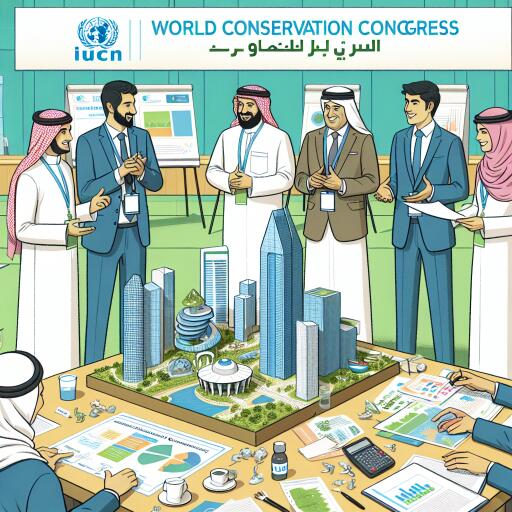
UAE companies drive sustainability at IUCN World Conservation Congress
At the IUCN World Conservation Congress, a cohort of UAE-based organisations revealed a slate of ecology-meets-technology initiatives, signalling how the country’s private and academic sectors are accelerating practical solutions for climate resilience, habitat restoration, and biodiversity in harsh environments. From art-driven carbon finance to AI-guided conservation, the showcase underscored a shift toward scalable, science-backed projects with clear community benefits.
Art, culture, and carbon finance converge
Future Culture, working with French digital artist Yacin Ait Kaci and the ELYX Foundation, introduced “Archipel,” a narrative universe that uses imaginative island stories to illuminate local environmental challenges and fund verified climate action. By weaving storytelling into the mechanics of carbon markets, the project seeks to channel finance into real conservation efforts. The team plans to scale across the Gulf, with a strong emphasis on UAE ecosystems, building partnerships with non-profits to protect habitats while engaging the public through accessible cultural formats.
Tech-powered mangrove recovery
Climate-tech venture Nabat spotlighted tools designed to restore and monitor blue carbon ecosystems. An interactive installation with living mangrove specimens demonstrated how sensors, data platforms, and spatial analytics can optimize restoration at scale. The company is working on large-area mangrove rehabilitation within the UAE and regionally, in strategic collaboration with the Environment Agency – Abu Dhabi. The long-term alliance aims to rebuild coastal forests that buffer shorelines, nurture marine life, and lock away carbon.
Expanding its marine focus, Nabat announced a collaboration with Yas SeaWorld Research & Rescue Centre to track wildlife and map seagrass meadows—critical nurseries for fish and significant carbon sinks. The monitoring effort will integrate field observations with advanced imaging and machine learning, helping conservation teams pinpoint where protection and restoration will yield the highest ecological return.
Rewilding the desert city
Terra, the Sustainability Pavilion at Expo City Dubai, presented urban nature strategies tailored to arid climates—turning hot, dry spaces into living laboratories for biodiversity. The approach blends native planting, water-smart design, and citizen participation to create microhabitats that support pollinators, birds, and soil life within dense urban districts.
- Hundred Hives: A first-of-its-kind school beekeeping programme in the UAE that equips students and educators with training, equipment, and curricula to champion pollinator health and diversify urban ecology.
- Fungi-focused conservation: The region’s first Centre for Species Survival dedicated to fungi under the IUCN umbrella, aiming to assess more than 1,300 at-risk species. Research priorities include carbon storage potential, ecological restoration, and promising avenues for health and biotechnology.
By embedding education and research into everyday urban environments, Terra’s model shows how desert cities can become engines of ecological knowledge and biodiversity gains rather than passive consumers of resources.
Science, policy, and the next generation
Sorbonne University Abu Dhabi brought academic perspectives to the Congress with a panel on the science-policy interface for climate action. The discussion highlighted mangrove forests as a linchpin of the UAE’s climate strategy—combining coastal protection, biodiversity support, and blue carbon sequestration—and explored how remote sensing, AI, and robotics can accelerate restoration timelines while lowering costs.
The university also co-led a workshop on biodiversity monitoring that examined practical deployments of autonomous systems for surveying wildlife and habitats. Emphasis was placed on engaging young researchers and students, equipping them with the tools to collect high-quality data, interpret ecological signals, and translate findings into policy-ready insights.
Private sector momentum with public value
Across the board, the UAE’s contributions at the Congress reflected a pragmatic blend of creativity, engineering, and community engagement. Art-led carbon initiatives are lowering entry barriers for climate participation; sensor-rich mangrove projects are turning coastlines into measurable climate assets; urban biodiversity pilots are reframing desert cities as ecological partners; and academia is anchoring it all with rigorous methods and training.
The throughline is clear: when culture, technology, and conservation align, the result is not just awareness—but durable impact. With partnerships spanning NGOs, research centres, and public agencies, UAE-based teams are positioning the region as a testbed for solutions that can be replicated in climate-stressed landscapes worldwide.



Leave a Reply