

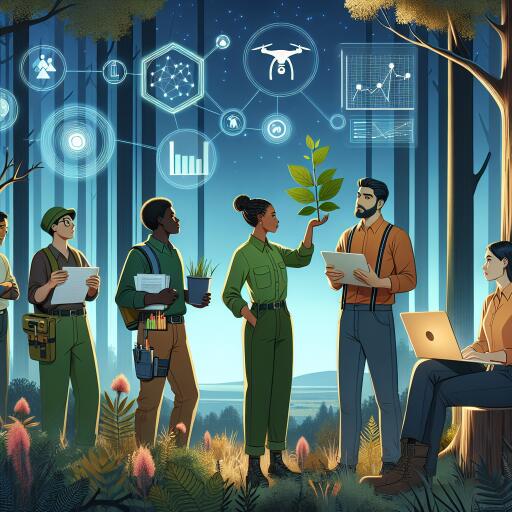
Why Experts Advocated Digital Management of Forest –
Nigeria’s forests hold far more value than the public balance sheet reveals. From medicinal resources and timber to climate regulation and rural livelihoods, the country’s woodlands could power a greener economy—if they are managed with precision. At a national forestry conference in Akure on October 23, 2025, researchers, university leaders, and policymakers converged around one message: digital tools can transform forest governance from reactive to resilient.
What “going digital” means for forests
Digital forest management combines satellites, drones, geospatial portals, field data apps, and transparent permitting systems to track what’s happening in the forest in near real time. This approach enables authorities, communities, and businesses to:
- Map forest cover and biodiversity hotspots with consistent accuracy
- Detect illegal felling and encroachment early through alerts
- Maintain continuous forest inventories for smarter harvesting limits
- Trace timber from stump to market to curb illicit trade
- Assess carbon stocks and climate impacts with clear baselines
- Guide restoration by pinpointing degraded areas that can rebound fastest
Specialists from Europe and Nigeria emphasized that digital oversight is not a luxury—it’s the only scalable way to keep remaining forests alive and productive. With robust data, the country can align ecological health with economic outcomes, turning forests into long-term assets instead of short-term extraction points.
The stakes: economy, ecology, and social well-being
Forests already underpin a spectrum of value chains: timber for construction and furniture, panels and paper, fibers, non-timber forest products, and traditional medicines. They regulate water, stabilize soils, buffer local climates, store carbon, and anchor cultural identity. When the ecosystem thrives, rural economies follow.
Yet delegates warned that multiple pressures are shrinking these benefits: agricultural expansion, urban sprawl, illicit logging, fuelwood dependence, outdated management plans, weak enforcement, and underinvestment in mill technology and logistics. Without a reset, degradation will outpace regeneration, eroding both biodiversity and jobs.
From extraction to stewardship
Experts called for a national pivot from volume-focused extraction to data-led stewardship. Core recommendations included:
- Continuous national forest inventory using standardized digital tools
- Public dashboards for transparency on permits, harvests, and regeneration
- Private-sector participation under clear, enforceable sustainability rules
- Community-inclusive governance that shares benefits and responsibilities
- Policies that prioritize natural forest protection alongside well-managed plantations
- Targets linking forest management with measurable social and economic outcomes
Universities and states signal readiness
Academic leaders stressed the importance of inter-institutional collaboration to accelerate research, training, and technology transfer. Hosting universities underscored that the conference was more than a scholarly exercise—it was a platform to convert knowledge into policy and practice that can lift local and national economies.
State representatives highlighted the urgency of reversing degradation driven by human activity and affirmed commitments to align with evolving global standards on deforestation-free supply chains. The message was clear: compliance isn’t merely about exports; it’s a pathway to restore forests, open markets, and attract green investment.
Professional societies and organizers: from ideas to action
Forest professionals reiterated that woodlands are the planet’s lungs and rural anchors, and that Nigeria’s forests are under intense pressure. But within these constraints lies a chance to reinvent the sector—through innovation, reforestation, and green entrepreneurship that redefines national development.
The local organizing committee framed the gathering as a working forum: learn, innovate, collaborate. Participants were urged to share field experiences and build networks that lead to deployable solutions, not just declarations.
A practical roadmap for the next 18 months
- Launch a national geospatial forest portal with open, regularly updated maps
- Digitize and enforce e-permits, linked to chain-of-custody systems and roadside checks
- Deploy drone and satellite alerting in high-risk zones with rapid response protocols
- Update state-level management plans using standardized data and performance metrics
- Kickstart restoration of degraded reserves with native species and community co-management
- Support mills to upgrade technology for better yield, lower waste, and certified products
The bottom line
Digital forest management is not a gadget or a trend—it is the governance backbone for keeping Nigeria’s forests healthy and economically productive. With transparent data, consistent enforcement, and inclusive partnerships, the country can protect biodiversity, stabilize the climate, and build resilient rural economies. The technology exists. The expertise is present. What remains is coordinated action to turn pixels and datasets into living, growing forests—and lasting prosperity.



Leave a Reply