

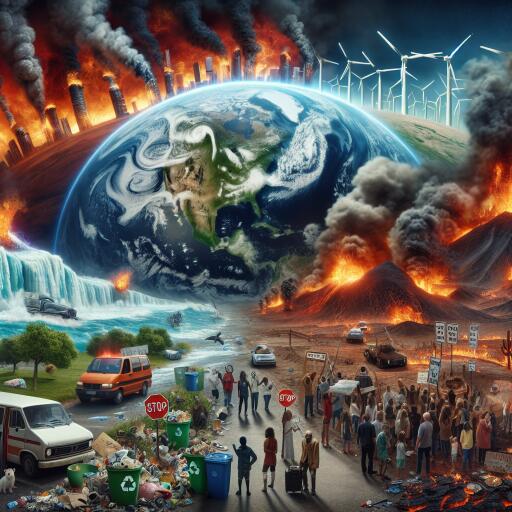
Earth’s climate is approaching irreversible tipping points
Feedback loops are pushing critical Earth systems to the brink
When forests thin, rains falter. Drier conditions feed heat and fire, which in turn kill more trees. In the Amazon, that vicious cycle risks becoming self-reinforcing: once forest cover drops below a critical threshold, large swathes could shift toward a drier, savannah-like state. The consequences would be global. The region stores tens of billions of tonnes of carbon dioxide; a major dieback would release much of it, accelerating planetary warming.
What counts as a tipping point?
Tipping points are thresholds beyond which internal dynamics propel part of the climate system into a new, often irreversible state. Scientists warn of several looming candidates. The Greenland ice sheet, for example, could cross into long-term decline, ultimately lifting sea levels by more than seven meters. Another concern is a disruption of the Atlantic Meridional Overturning Circulation (AMOC), the network of ocean currents that redistributes heat and helps keep northern Europe comparatively mild. A weakened or collapsed AMOC would chill parts of the continent, strip moisture from the atmosphere, and undermine food production.
Interconnected risks, uncertain thresholds
Pinpointing exact trigger points is difficult. Earth’s climate is a web of interacting processes, from cloud formation and ocean mixing to wildfire dynamics and ice-sheet physics—many imperfectly captured in global models. Crucially, one tipping element can shove another toward failure. Freshwater from a rapidly melting Greenland ice sheet would dilute the North Atlantic, making it harder for dense water to sink and thus threatening the AMOC; a weakened AMOC, in turn, could reduce rainfall over the Amazon, amplifying forest stress.
What the models say—and don’t
Estimates vary. Some simulations suggest the Greenland ice sheet could have entered long-term decline at roughly 0.8°C of warming above pre-industrial levels; others place its threshold closer to 3°C. For the Amazon, model ranges for an irreversible transition span about 2°C to 6°C of warming. Human choices matter: ongoing deforestation and fire can hasten a tipping point, while robust forest protection can delay it.
Global temperatures are already about 1.2°C higher than in pre-industrial times, with projections indicating a breach of 2°C later this century unless emissions fall steeply. That raises the stakes for detecting early warnings and reducing risks before they cascade.
Building an early-warning system
To move from theory to foresight, a new UK program is funding tools to detect tipping points before they are crossed. Over five years, with an initial budget of £81 million, dozens of teams are focusing on sensitive systems in the North Atlantic and the Greenland ice sheet. The aim: create data streams that reveal subtle shifts—changes in salinity, temperature, currents, and ice dynamics—that precede rapid change.
One research effort will send small underwater vehicles to map ice fronts and measure ocean properties at the ice–ocean interface, where warm, salty water can accelerate melting. Robots roaming the ice surface and embedded sensors will track conditions over time. In the surrounding seas, fleets of solar-powered, self-sailing robots are planned to collect air–sea data—temperature, wind, waves—across the subpolar gyre, a key region influencing the AMOC. Aerial drones are being developed to monitor iceberg drift, glacier-front position, and ice-sheet elevation, all vital for predicting melt rates.
Much of this is enabled by low-cost sensors, open-source software, and ubiquitous mobile connectivity. Technologies refined by smartphones and modern telecom networks now make it feasible to blanket harsh environments with autonomous instruments and stream back the results in near real-time.
From data to decisions
Early warning only helps if societies know how to respond. Climate-risk experts argue that governments must plan for high-impact scenarios—such as rapid ice loss or a circulation slowdown—with the seriousness given to pandemics or financial crises. That means stress-testing food systems, infrastructure, and emergency services against abrupt climate shifts, not just gradual warming.
Yet preparedness remains patchy. While some countries are beginning to assess tipping-point risks, most have not integrated these possibilities into routine planning. Emergency responders and humanitarian groups are taking more interest, as are insurers and pension funds, which are exposed to cascading economic shocks.
A debate, and growing momentum
Some scholars caution that emphasizing tipping points could distract from the fundamentals: cutting emissions and adapting to change that is already locked in. Others worry that talk of inevitability breeds fatalism. But acknowledging tipping risks need not paralyze action—it can focus it. The topic is gaining traction across research, finance, and policy circles, and major climate gatherings are expected to spotlight it, especially in regions directly affected by forest dieback and ocean-current shifts.
What we can do now
- Protect and restore forests to maintain rainfall patterns and carbon storage, especially in the Amazon.
- Cut greenhouse-gas emissions swiftly to keep warming and associated thresholds as far away as possible.
- Invest in monitoring networks and data-sharing to detect early signs of destabilization.
- Prepare contingency plans for food, energy, and water systems in the event of abrupt regional climate shifts.
- Support communities at the front lines—indigenous peoples, farmers, fishers—whose knowledge and stewardship are critical.
Tipping points are not a distant abstraction; they are the edge effects of a warming world. The closer we get, the narrower the path to avoid them—and the more valuable early warning and decisive prevention become. We still have agency. The sooner we use it, the less likely Earth’s vital systems are to tip beyond repair.



Leave a Reply