

Macroalgae morphological complexity affects the functional diversity of epifaunal annelid assemblages – Hydrobiologia
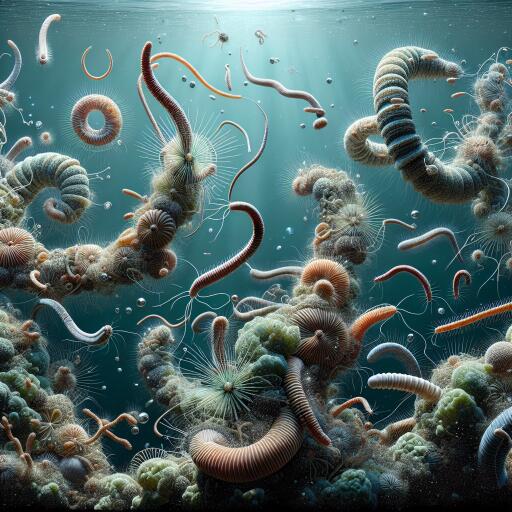
How seaweeds are built—their tangles of filaments, blades, and holdfasts—shapes the lives of the tiny worms that live on them. Moving beyond simple species counts, new trait-based analyses show that the three-dimensional architecture of macroalgae helps determine which functions epifaunal annelids perform in reef systems, from filtering particles to reworking sediments. In short: form fuels function beneath the waves.
Why shape matters underwater
Macroalgae are not just passive backdrops. Their structural features—branch density, blade width, surface roughness, canopy height, and porosity—engineer microclimates at millimeter to centimeter scales. These traits alter local water flow, trap or shed sediments, modulate light and oxygen, and multiply the number of niches available. Dense, branching thalli create refuges from predators and waves; flat, sheet-like forms offer broad grazing surfaces; turf mats behave like living baffles that slow currents and retain organic particles.
Because hydrodynamics and shelter are decisive near the seafloor, even small differences in algal morphology can drive strong contrasts in the invertebrates that settle, forage, and reproduce on them. That is particularly true for annelids (polychaete worms), which include tube builders, mobile predators, and a spectrum of detritivores and suspension feeders.
From names to functions: a trait-based lens
Trait ecology translates biological characteristics into ecosystem roles. For epifaunal annelids, key traits include:
- Feeding mode: deposit feeding, suspension feeding, grazing, predation, omnivory.
- Mobility: sessile tube builders versus mobile crawlers or swimmers.
- Body size: which influences resource use, vulnerability, and flow interactions.
- Life-history strategies: reproduction type, larval development, and dispersal capacity.
- Bioturbation and tube construction: how organisms modify substrates and local conditions.
By summarizing communities as distributions of these traits—using metrics like community-weighted means and multidimensional functional diversity—researchers can detect habitat filtering (when environments favor similar traits) or overdispersion (when varied strategies coexist, often in structurally complex habitats).
What the study examined
A recent analysis compared epifaunal annelid assemblages across macroalgae spanning a gradient of architectures, from low-profile crusts and turf to foliose blades and intricately branched canopies. Structural complexity was quantified with two- and three-dimensional descriptors—branching frequency, surface area per volume, canopy height, and measures of rugosity and porosity derived from image-based workflows. Environmental covariates such as wave exposure and sediment load were considered to separate the effects of algal form from background conditions.
Trait–environment relationships were explored with multivariate ordinations and trait-linking frameworks, complemented by information-theoretic model selection to identify the most plausible drivers. Analyses emphasized functional richness (how many trait combinations occur), divergence (how different the strategies are), and evenness (how traits are distributed), allowing a nuanced readout of community assembly processes.
What emerged from the patterns
- Complex canopies promote functional overdispersion. Highly branched or voluminous algae tended to support broader and more divergent sets of traits, consistent with an expansion of microhabitats and reduced direct competition. In these settings, suspension feeders, predators, and detritivores co-occurred with fewer trade-offs.
- Simple forms act as filters. Low-profile or planar algae hosted functionally clustered assemblages. Traits that tolerate shear stress or limited refuge—such as small body sizes and tube-building behaviors—were overrepresented, pointing to environmental filtering by flow and exposure.
- Vertical zoning within thalli matters. Holdfasts and basal regions, often sediment-rich and low-flow, concentrated deposit feeders and tube builders. Distal tips and elevated branches favored suspension feeders and active foragers benefiting from faster currents.
- Hydrodynamics modulates architecture effects. Where waves or currents were intense, even complex algae functioned as partial filters, selecting for streamlined forms and robust attachment. In calmer waters, the same architectures yielded greater trait diversification.
- Seasonal resets reshape trait spectra. Storms and heat events that trim canopies or shift algal dominance cascaded into functional reassembly, with turf-dominated phases favoring small-bodied, refuge-seeking taxa and recovery phases restoring a fuller range of strategies.
Implications for biodiversity and ecosystem functioning
Functional diversity underpins resilience. When multiple strategies coexist, ecosystems better sustain nutrient cycling, secondary production, and resistance to disturbance. Structural simplification—through harvesting, coastal development, or heat-driven die-backs—erodes that functional insurance. Conversely, protecting a mosaic of algal architectures can stabilize food webs, bolster carbon storage in vegetated meadows, and enhance nursery value for higher trophic levels.
These insights also refine how we monitor change. Trait-based indicators, coupled with structural metrics, can reveal early functional erosion before species extirpations become obvious. That diagnostic power is timely as marine heatwaves and invasive species alter nearshore vegetation at accelerating rates.
Technology meets tidepools
Quantifying “habitat shape” has leapt forward. Photogrammetry, computer vision, and image-analysis pipelines now extract canopy height profiles, surface complexity, and void spaces from field imagery. Combined with open trait databases and reproducible statistical workflows, ecologists can link structural features to community functions with unprecedented resolution. This integration of sensors, software, and synthesis is redefining how we see organism–habitat feedbacks in the shallow sea.
To foster reuse and synthesis, the trait dataset supporting this study will be deposited in a public repository following peer review.
Design and management takeaways
- Conserve structural diversity: manage for a mix of turf, foliose, and branched forms rather than a single dominant morphology.
- Time harvests and restoration to phenology: avoid periods when canopy loss would cause pronounced functional clustering.
- Use structure as a lever: in nature-inclusive coastal designs, incorporate textures and cavities that emulate branched and rugose macroalgae.
- Monitor traits, not just taxa: add functional metrics to routine surveys to detect subtle shifts in ecosystem performance.
- Plan for flow: match restoration targets to local hydrodynamics to ensure that intended functions (e.g., filtration, refuge) are realized.
The bigger picture
Community assembly is not only about who arrives, but where they can live and how they make a living once there. Macroalgae sculpt that playing field. By treating seaweed architecture as a measurable, designable property, we gain a practical handle on maintaining the breadth of ecological jobs performed by epifaunal annelids—and, by extension, the health and stability of coastal reefs.



Leave a Reply