

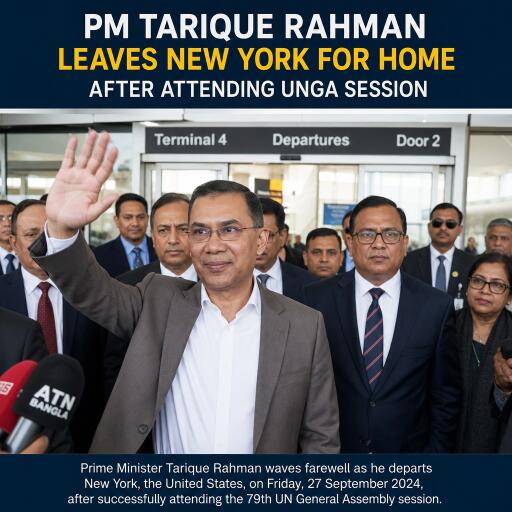
PM Tarique Rahman leaves New York for home after attending UNGA session
Prime Minister Tarique Rahman has departed New York after a five-day schedule of diplomacy and development outreach centered on his first address to the United Nations General Assembly. The visit spotlighted Bangladesh’s priorities on peace, climate resilience, economic cooperation, and humanitarian responsibility, while mapping out an agenda for recovery and inclusive growth at home.
Homeward bound via Dubai
The Prime Minister, accompanied by his spouse and delegation members, left John F. Kennedy International Airport late Saturday night local time. The itinerary includes a transit in Dubai before continuing to Dhaka, where arrival is expected on the morning of 27 September.
A debut UNGA address with a strategic blueprint
In his speech to the General Debate of the 81st UN General Assembly on 24 September, Tarique Rahman emphasized resolving conflicts through dialogue, diplomacy, and cooperation under the UN’s umbrella. He reiterated Bangladesh’s support for global efforts to safeguard human dignity and collective security, and set out a domestic roadmap grounded in a three-pillar approach—Recovery, Restoration, and Reconstruction—aimed at building a more self-reliant, welfare-oriented, and democratic society where opportunities are shared widely.
Climate action at the forefront
With Bangladesh among the countries most vulnerable to climate shocks, the Prime Minister used multiple high-level platforms to press for deeper emissions cuts from major economies, predictable and accessible climate finance, and equitable access to climate-smart technologies. He warned that sea-level rise poses an existential threat to low-lying nations, calling for accelerated global adaptation and stronger international cooperation to protect people and ecosystems. In a session on “Climate Action and the Just Transition,” he argued that ambitious mitigation must go hand-in-hand with a fair transformation of energy and economic systems so that climate solutions lift communities rather than leave them behind.
Humanitarian priorities and the Rohingya crisis
On forced displacement, the Prime Minister underscored that the only durable solution to the protracted Rohingya crisis lies in safe, dignified, and voluntary repatriation to their homeland. He urged the international community to help create conditions on the ground that make return both possible and sustainable. Discussions with senior UN officials focused on coordinating support for refugees and for host communities shouldering the burden, as well as on broader regional stability.
Health and social protection: toward a “Healthy Bangladesh”
At a Bangladesh–Sweden–UNFPA high-level event on midwifery, Tarique Rahman outlined plans to reinforce primary care and maternal health as the backbone of national health reform. The government’s intent, he said, is to recruit 100,000 additional health workers—including 80,000 women—and 25,000 professional midwives, while advancing an integrated digital health system to expand access, improve outcomes, and build community-based resilience against future shocks.
Economic diplomacy and development partnerships
The visit featured a broad slate of bilateral meetings aimed at expanding trade, investment, and sectoral cooperation. Talks with leaders from Türkiye, Bhutan, the Maldives, Pakistan, Thailand, Haiti, and Croatia explored opportunities spanning economic partnerships, skilled workforce mobility, education, and technology, as well as closer coordination in multilateral forums.
Engagements with development and philanthropy partners underscored a shared focus on inclusive growth and social protection. In a breakfast discussion with representatives from leading foundations and humanitarian organizations, Bangladesh highlighted priorities on humanitarian response, climate resilience, sustainable development, and innovative financing. A separate meeting with global health partners centered on public health, child immunization, affordable vaccines, and preventive care—areas seen as pivotal for safeguarding human capital in a warming world.
Finance, aviation, and private-sector outreach
Economic cooperation with international financial institutions remained a key theme, with discussions on sustaining growth momentum and exploring new avenues of partnership. In parallel, a session with Wall Street stakeholders focused on investment prospects tied to Bangladesh’s evolving infrastructure, manufacturing, and services landscape.
On the aviation front, the visit coincided with Biman Bangladesh Airlines signing an agreement with Boeing to purchase 11 aircraft, a move aligned with the country’s plans to expand air connectivity and open new routes to support trade, tourism, and diaspora links.
UN engagement and recognition
Throughout the week, the Prime Minister engaged with the UN leadership on peacekeeping, climate resilience, and refugee protection. Bangladesh’s long-standing role in UN peace operations and its frontline experience in climate adaptation drew recognition, alongside the country’s commitment to multilateral solutions.
Looking ahead
As he returns home, Tarique Rahman’s New York agenda leaves a clear imprint: a push for practical climate ambition, a rights-based approach to displacement, and a widened circle of economic partnerships. The test now shifts to implementation—turning pledges on just transition, health system strengthening, and regional cooperation into measurable gains for communities across Bangladesh.



Leave a Reply