

Meet the ‘croc docs’ who track gators, pythons in Florida Everglades
Long after most of South Florida goes quiet, a different kind of rush hour begins across the glades. Airboats skim blackwater sloughs, spotlights slice through fog, and a tight-knit team of conservation scientists works against the clock to safeguard one of North America’s most imperiled ecosystems.
Night shift in the sawgrass
On moonlit runs through chest-deep marsh, researchers with the University of Florida’s Croc Docs lab wrangle alligators to collect health data that act like vital signs for the Everglades. A coordinated crew lassos and secures each animal, records measurements in minutes, and returns it to the exact capture site. The pace is relentless—sometimes a dozen animals before sunrise—because every datapoint helps calibrate how water, habitat and food webs are changing.
For field leaders like Alexis Pupo and Bryna Daykin, the work is equal parts strength, precision and choreography. Their nights reveal what daylight hides: how apex predators respond to water levels, how body condition fluctuates with prey availability, and how restoration projects ripple through the food chain. It’s rough-and-ready field biology backed by rigorous protocols—where duct tape meets digital datasets.
High-tech hunts for an elusive invader
With daylight, attention often pivots to the Everglades’ most infamous intruder: the Burmese python. These snakes are stealth incarnate—heat-sensing, cryptically colored, and powerful enough to reshape entire wildlife communities. To outthink them, the team blends animal behavior with modern sensing tools.
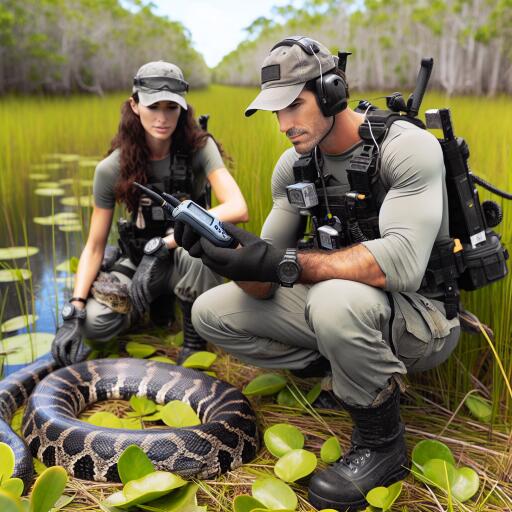
Wildlife ecologist Melissa Miller and biologist Michelle Bassis coordinate a program that relies on “scout snakes”—radio- and GPS-tagged males that naturally home in on breeding females during the reproductive season. By following these scouts with handheld antennas, drones and thermal cameras, crews can locate clusters of snakes and remove multiple animals at once. It’s targeted, data-led and vastly more efficient than random searching.
Telemetry logs reveal the snakes’ preferred microhabitats, seasonal corridors and breeding hot spots. These insights feed directly into management strategies—pinpointing when and where to deploy teams, how to optimize search routes, and which habitats demand the most vigilance. The result is a living map of an invasion front, updated in real time.
Roadside biosurveillance
In a region crisscrossed by levee tops and backroads, headlights double as scientific tools. Under the Croc Docs’ Everglades Invasive Reptile and Amphibian Monitoring Program, field biologist Patricia Rodriguez-Gonzalez and intern Gabriella De La Fe log hundreds of miles in a single night, recording every snake, frog and lizard they encounter. Each observation helps chart population trends and detect new arrivals early, before they explode across the landscape.
Their notebooks and GPS units capture a pulse of the Everglades that’s often missed by day: juvenile pythons dispersing after hatching, nonnative amphibians expanding into canals, and tegus—omnivorous lizards that raid nests—pushing into sensitive areas. When detections spike, teams adjust on the fly, adding traps or shifting search grids. Biosurveillance, done right, is both immediate and predictive.
Measuring ecosystem change
To gauge the broader impacts of invaders, Bassis also helps lead comprehensive wildlife inventories at Arthur R. Marshall Loxahatchee National Wildlife Refuge in Palm Beach County. The surveys span mammals, birds and reptiles, building a multi-year record that reveals how native communities respond to pressures like predation, climate swings and water management. It’s ecosystem diagnostics: not just what species are present, but how they’re faring over time.
Beyond Florida’s borders
The lab’s work extends internationally, where wildlife ecologist Venetia Briggs-Gonzalez supports research and conservation for crocodiles, wildcats and the critically endangered Central American river turtle in Belize. The projects connect field science with local communities and future researchers, broadening the pipeline of talent and knowledge across borders.
Innovation meets grit
The Croc Docs’ bench stretches beyond the marsh. Biologist Taylor Brotons evaluates whether falconry—using trained raptors—can reduce human–wildlife conflicts and deter problem species in specific contexts. And biologist and filmmaker Jen Brueggen turns fieldwork into compelling visuals, capturing behaviors few people ever see. Together, they close a crucial loop: collect the data, test the tools, and translate the science for the public and decision-makers.
Redefining who does the work
Half of the lab’s scientists are women—a fact that still raises eyebrows in a fieldwork-heavy discipline. Yet inside the team, the equation is simple: hire for skill, knowledge, experience and drive. Field leads talk less about glass ceilings and more about logistics, safety and scientific rigor. The most persuasive argument for inclusion is the work itself—and the results it delivers for wildlife and ecosystems.
Many on the team found their calling not through a straight path, but by pairing curiosity with field opportunities. Early mentors, classroom breakthroughs and first jobs in the mud all converged into careers where passion meets purpose. Their presence in leadership and on the front lines expands what young scientists can imagine for themselves, especially in roles that demand both technical savvy and physical toughness.
Why it matters now
The Everglades is a system of extremes—flood and fire, drought and deluge—and it’s changing fast. Invasive species accelerate those shifts by unraveling food webs and outcompeting native wildlife. Combating that trend requires more than muscle. It calls for adaptive science: telemetry-guided searches, drone-assisted surveys, real-time data dashboards and long-term monitoring that separates signal from noise.
That’s the daily reality for the Croc Docs: wrestling gators to read the ecosystem’s vital signs, turning snake behavior into a management edge, and translating millions of datapoints into on-the-ground action. It’s a blueprint for modern conservation—equal parts tech and tenacity—written one night survey, one telemetry ping, and one carefully released alligator at a time.



Leave a Reply