

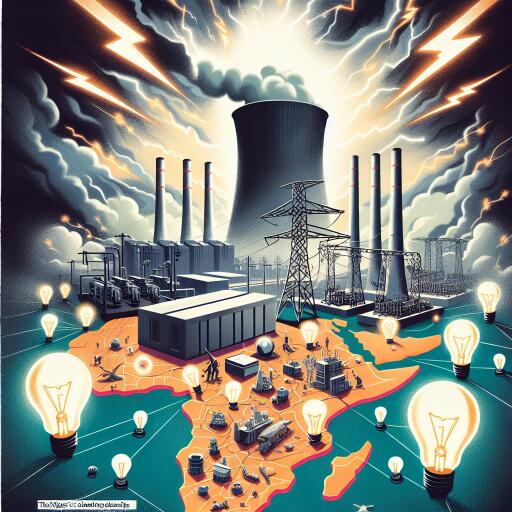
The Economist: Nigeria Must Fix Power Sector to Realise African Leadership Role
Nigeria, often seen as a contender for the title of Africa’s economic giant, faces a formidable challenge. With an inefficient electricity supply system that fails to meet the nation’s demands, the country struggles to realise its potential as a leading economic force on the continent.
The sound of generators is a constant backdrop to urban life in Nigeria, providing more power than the national grid can supply. This predicament stems from decades of inadequate investment, leading to an electricity infrastructure that has not evolved alongside Nigeria’s substantial growth. Currently, over 90 million Nigerians, out of a population of 230 million, live without access to basic electricity services.
The problem is entrenched within the power sector, worsened by financial shortfalls, and prospects for improvement remain dim, despite governmental promises to boost electricity supply. As service quality declines and costs rise, many prefer to seek alternative solutions. The government’s strategies appear inconsistent—while there is a push for integrating more solar power into the grid, there’s also contemplation of restricting the import of solar panels.
Nigeria’s ambition to transform its economic landscape hinges critically on resolving its electricity woes. Without this, the country’s economy will continue to lag, unable to fully harness its potential.
Describing the extent of deprivation, nearly half of Nigeria’s population lacks connection to the national grid, which has never carried more than 6 gigawatts (GW). In stark contrast, South Africa, despite its own energy challenges, manages to supply 48GW to its 63 million people, whereas Bangladesh, with a smaller landmass and lower income level, generates about 16GW for its 170 million inhabitants.
When Nigeria briefly hit a production capacity of over 5GW in March, the grid couldn’t handle the surge, resulting in a collapse. This limited availability of grid power adversely affects the economy and the quality of life. Frequent electricity cuts in healthcare facilities lead to dire outcomes, air-conditioning is a privilege few can afford, and tech entrepreneurs are compelled to construct their own power plants to sustain data centers. More than half of the country’s manufacturers have stopped trying to connect to the faltering grid.
In 2023, Nigerians spent a staggering N16.5 trillion ($10.3 billion) on off-grid power generation, nearly 60 percent of the government’s entire budget for the succeeding year. This adds up to a total power supply of around 20GW, which falls significantly short of the national demand.
The complexity of issues besetting the power infrastructure makes it challenging to address effectively. The government’s management of the grid is antiquated and susceptible to breakdowns, hampering regulated transactions between power generation entities and electricity distribution companies.
Although Nigeria’s gas plants provide most of the grid power, maintenance issues and inadequate financial compensation complicate their operations. Gas suppliers face the dilemma of either flaring gas or receiving minimal payments from power plants, which undermines production incentives.
The distribution companies, most of which were privatized, often fail to recoup their operating costs due to a pervasive pattern of unpaid bills, with the government being the largest defaulter. The Abuja distribution company, for instance, threatened to disconnect significant governmental facilities over unpaid debts amounting to several billion naira.
Moreover, government-led power initiatives remain in stagnation. An ambitious project between Nigeria and Germany aimed at boosting grid capacity by 12GW has seen minimal progress. The privatization efforts that transformed sectors like telecommunications and banking have yet to replicate similar success in the power sector, as evidenced by the financial instability of privatized electricity distribution businesses.
Despite efforts to elevate electricity tariffs, with prices soaring for wealthier households, revenue collection still only covers about 65 percent of the costs involved in power provision. Consequently, most advancements in the power landscape have emerged outside the grid.
Locally financed solar ventures have seen progress, such as a 12MW solar hybrid project supporting a university in Maiduguri. In addition, a coalition launched a $500 million fund to support expansive renewable-energy initiatives across Nigeria earlier this year.
Nevertheless, these off-grid projects alone are insufficient to meet the vast electricity deficit. Enhancing the grid remains crucial, albeit complicated. The spread of dependable solar alternatives and private power facilities, similar to models in South Africa and Pakistan, increases maintenance and improvement costs for a decreasing number of grid users.



Leave a Reply