

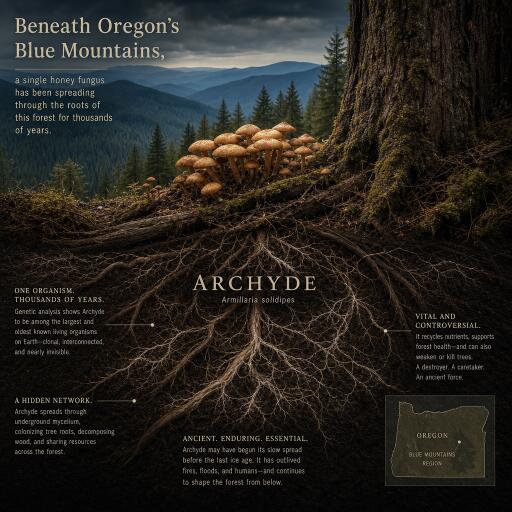
Beneath Oregon’s Blue Mountains, a single honey fungus has been spreading through the roots of – Archyde
Deep under the conifer stands of Oregon’s Blue Mountains, a single clonal organism of honey fungus (Armillaria solidipes) quietly knits the forest together—and sometimes pulls it apart. Recent mapping by forest scientists indicates this underground titan now occupies roughly 9.7 square kilometers (about 3.8 square miles), making it the largest known individual of its kind. Estimated to be more than two millennia old, the colony is expanding in an era of warmer, drier summers and stressed trees, with profound implications for how the forest lives, dies, and recycles itself.
An underground giant, hiding in plain sight
First recognized in the 1990s during surveys in the Malheur National Forest, this Armillaria colony has since been delineated with genetic and spatial analyses that confirm it is a single organism connected by dark, cord-like rhizomorphs. These subterranean strands snake through soil, bridge gaps between roots, and allow the fungus to spread, feed, and persist. The scale is difficult to grasp: what appears to be a patchwork of stands at the surface is, belowground, one sprawling individual.
Life and death under the pines
Armillaria specializes in exploiting weakness. It invades living roots—especially of drought-stressed or otherwise compromised trees—then girdles them, ultimately causing decline and death. The aftermath can resemble “tree graveyards,” with clusters of dead Douglas fir and ponderosa pine outlining the fungus’s advance. Biologists caution that not every dead tree is the fungus’s doing; heat, water scarcity, insects, and past management all play roles. But patterns of mortality and thinning understories in affected pockets point to an active, opportunistic pathogen shaping the forest from below.
Climate is tilting the balance
In the past few decades, the balance between trees and Armillaria appears to have shifted. Warmer temperatures and prolonged summer dryness leave trees metabolically strapped, their defenses down. Under those conditions, the honey fungus thrives. Research teams working in the region and across the Pacific Northwest have linked drought stress to heightened infection risk and faster underground spread. Legacies of management—such as dense, even-aged stands and extensive root contact—can further grease the skids for expansion. Climate stress doesn’t create Armillaria, but it can turn a chronic, largely background player into a more forceful agent of change.
Not just a destroyer: the recycler-in-chief
Despite the grim optics of dying trees, Armillaria is also a master decomposer. It breaks down wood, returns carbon and nutrients to the soil, and feeds microbial communities that underpin forest recovery. In healthy mosaics, patches thinned by the fungus can open space for new cohorts of trees and sun-loving plants. The ecological tension lies in pace and scale: if die-offs outstrip regeneration, structure and biodiversity can skew, and whole landscapes may reorganize faster than species can adapt.
Tracking a moving target
Forest managers have launched multi-year monitoring to understand how quickly this colony spreads and what it means for biodiversity and carbon storage. Crews are quantifying tree mortality, soil chemistry, and the fungus’s genetic footprint to inform responses. Approaches under discussion emphasize prevention and resilience over eradication: thinning to reduce root-to-root transmission, diversifying species and age classes to limit host continuity, and easing water stress where feasible. Heavy-handed removal can backfire, disturbing soils and unintentionally favoring the pathogen, so interventions are being calibrated to local conditions.
A local behemoth in a global guild
While the Blue Mountains host the outsized headline-maker, Armillaria species are common across temperate forests in North America, Europe, and Asia. Other large colonies exist, including one in Michigan spanning about 38 hectares and estimated to be over 1,500 years old. Individually, most colonies are modest; collectively, they influence regeneration cycles, shape species composition, and mediate how forests respond to disturbance. Long-term studies are beginning to illuminate these roles, but many questions remain about how a warming climate will alter this subterranean balance of power.
What to watch next
- Spread versus stress: Will the fungus’s footprint expand in lockstep with hotter, drier summers and more frequent droughts?
- Shifts in tree communities: Do mixed-species stands resist infection better than uniform ones, and which species fill the gaps left by losses?
- Carbon math: How do Armillaria-driven die-offs and accelerated decomposition affect forest carbon storage over decades?
- Soil life: What happens to the microbial networks that partner with trees when Armillaria intensifies its hold?
- Safety and access: Managing hazard trees along roads and trails while maintaining habitat and ecological function.
Far beneath the needles and cones, a single organism is redrawing the forest’s blueprint. Its rise is not a simple story of a villain, but a signal—amplified by climate stress—that the equilibrium of the Blue Mountains is shifting. How land stewards respond, balancing intervention with humility before complex systems, will determine whether tomorrow’s forest retains the resilience that has carried it through centuries.



Leave a Reply