

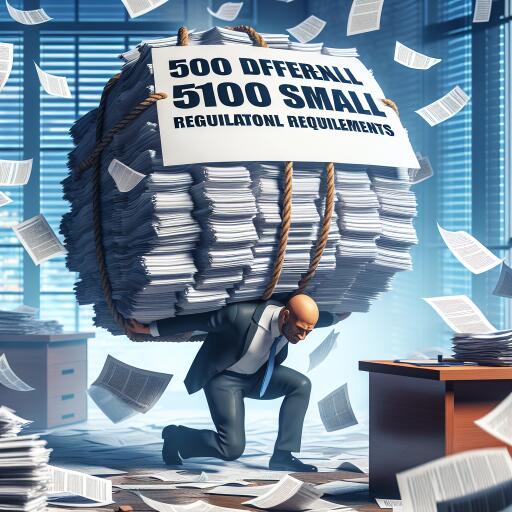
500 micro cuts: Compliance burden weighs heavy on MSMEs that have to adhere to over micro regulations every year
For India’s micro, small and medium enterprises (MSMEs), everyday operations often feel like navigating a thicket of rules. Miss a task as mundane as whitewashing washrooms every four months, varnishing wooden fixtures in a cafeteria, or displaying maternity entitlements on a noticeboard, and the penalty can be severe — even jail time. These are not outliers but part of the dense regulatory routine facing a typical MSME with a single factory in one state.
Across a typical year, such a business must comply with roughly 512 distinct rules on average. Once recurring obligations — monthly provident fund filings, employees’ state insurance submissions, and other cyclical mandates — are added in, the tally can soar to around 1,649. A large chunk of this paperwork sits within labour-related statutes: about 68% of total compliance, much of it tightly embedded and hard to reform. Alarmingly, approximately 40% of the requirements carry criminal provisions, with potential imprisonment ranging from one to three years.
An outdated maze raising costs — and risks
Many of these micro-rules trace their lineage to a very different era, with several provisions echoing the Factories Act of 1948. While they may have once served a purpose, they often fail to reflect today’s workplace realities, automation, or safety technology. The result is a regime that disproportionately hobbles smaller firms — the very enterprises that generate jobs, drive supply chains, and, increasingly, power India’s clean-tech transition.
Owners repeatedly point to the time, money and complexity required to stay on the right side of the law. Compliance teams, external consultants, and specialised software are now routine line items. For some, the monthly bill for labour, finance, taxation, payroll and related requirements can touch about Rs 2 lakh — a heavy burden for a small balance sheet.
Reform push: decriminalisation and simplification
Policymakers have signalled a new round of decriminalisation under the Jan Vishwas 2.0 agenda. The current thrust aims to expand the scope from a few hundred to around 1,355 sections identified for decriminalisation, building on earlier steps. A previously enacted phase removed criminality from 183 provisions spanning 42 laws under 19 departments. There is also discussion around making future amendments apply retrospectively, potentially easing the load on businesses already entangled in ongoing cases.
In parallel, authorities report that more than 40,000 compliances have been pruned or simplified over recent years. Yet, for many MSMEs, the relief feels patchy. Implementation hinges on states — and adoption has been uneven. In some jurisdictions, overlapping inspections by local, state and central bodies continue to replicate the same checks, multiplying paperwork without adding proportionate value.
How heavy is the load on the shop floor?
Consider a small chemical producer operating a single facility in Maharashtra: studies indicate such a unit may face around 635 obligations touching labour, environment, taxation and finance. The redundancy is real — similar permissions are requested repeatedly, and the cadence of filings can be unforgiving. This is a particular challenge for first-time entrepreneurs and family-run firms transitioning from informal to formal operations.
Four labour codes: the big relief lever
The long-awaited consolidation of labour laws into four codes — covering wages, industrial relations, occupational safety and health, and working conditions — could be transformative. If implemented in letter and spirit across states, experts estimate:
- Compliance burden for smaller firms could shrink by 70–80%.
- Criminal provisions linked to routine compliance could fall by about 80%.
- Twenty-nine separate acts would be subsumed, reducing duplication and ambiguity.
Investor-friendly states like Gujarat and Maharashtra still maintain extensive compliance schedules for small enterprises, underlining how important state-level execution will be in making any central reforms bite.
GST and finance: good intentions, practical hurdles
The GST architecture remains another sticking point. While rate rationalisation has been welcomed, MSMEs repeatedly flag the difficulty of utilising accumulated input tax credit — especially when final-product GST rates are lower than those levied on inputs. Faced with criminal exposure for inadvertent filing errors, many smaller firms feel compelled to hire accounting professionals just to reduce risk, adding to fixed costs. For some, the rational choice becomes staying small and semi-informal to avoid triggering a higher regulatory threshold, blunting the intent of recent changes to the MSME definition that were designed to spur growth.
Why this matters for the green economy
MSMEs are the backbone of India’s clean energy and circular economy supply chains — from fabricating solar structures and EV components to recycling materials and maintaining distributed renewable assets. When compliance becomes a tax on time and capital, these firms struggle to retool, digitise or adopt cleaner processes. Streamlined rules, clear digital workflows and fewer criminal triggers would free up resources for technology upgrades, safety investments and energy efficiency — all vital for India’s climate and competitiveness goals.
What would help now
- Fast-track adoption of the four labour codes across states to reduce overlap and ambiguity.
- Unify inspections and filings through a single state portal, with risk-based frequency and no duplication across departments.
- Introduce safe-harbour thresholds for first-time or de minimis errors in tax and labour filings to curb fear-driven costs.
- Mandate periodic “sunset reviews” of legacy micro-rules (e.g., display and whitewashing norms) to align with modern EHS standards.
- Scale low-cost, self-serve compliance tech — akin to simplified income-tax e-filing — to cut routine payroll and tax costs.
- Fix GST input credit mismatches where final goods attract lower rates than inputs, unlocking cash flow for small firms.
As India doubles down on self-reliance in defence, space, renewable energy and semiconductors, MSMEs will carry much of the manufacturing and service load. Reducing the “micro cuts” of compliance — without compromising worker safety or environmental safeguards — is essential. The tools are at hand: decriminalisation where appropriate, consolidation of laws, state-level execution, and technology that makes compliance simple by design. For small businesses, that could mean the difference between treading water and sprinting ahead — and for the green economy, the difference between incremental progress and a genuine step-change.



Leave a Reply