

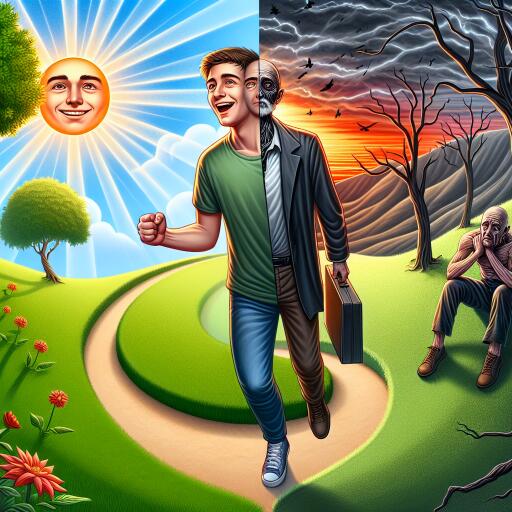
My Introduction and failed life
High in the trans-Himalayan rain shadow, winter draws a hard line across the map. In a district of Ladakh where villages scatter across steep valleys, snowfall can turn roads into memory for nearly half the year. People stock up, families hunker down, and the outside world recedes. Childhoods here are shaped by quiet skies, crisp air, and long months of isolation that teach patience early and resilience by necessity.
This landscape is breathtaking—and exacting. It also frames the choices available to young people. With few advanced schools nearby, many study locally only through the early secondary years before facing a decisive question: stay and accept limited options, or travel hundreds of kilometers to continue an education in a place with very different weather, culture, and pace. One student’s path from Ladakh to the plains of Jammu—roughly 800 kilometers apart—captures that pivot point and the weight it carries.
Between snowbound roots and open roads
At home, winter can shutter access for five to six months. The community is tight-knit, the air is thin, and the horizon is defined by rock and ice. Leaving after the 10th standard feels less like relocation and more like crossing a climatic border. In the plains, the sun sits warmer, the streets are crowded, and expectations run hot. It’s disorienting at first: different dialects, different rhythms, and an educational system geared for competition.
On arrival, uncertainty about dreams is common. Without clear guidance, it’s easy to fall in step with peers. In this story, the choice was medicine. Prepping for a national medical entrance exam offered a socially admired, purpose-filled path—especially resonant for mountain districts where healthcare access is precarious each winter. But the grind is unforgiving. After repeated attempts and mounting pressure, fatigue sets in. The realization grows: this route doesn’t fit. Still, changing course can feel impossible when family hope and financial sacrifice are invested in a single idea.
When the compass points elsewhere
Here’s the quiet truth many hesitate to speak: some minds are drawn not to stethoscopes but to circuits, code, and the architecture of digital systems. Curiosity tilts toward technology and computers. Yet saying “I want to switch” can feel like betrayal—of parents, of a community’s need, and of the self that once tried so hard to belong in another lane. So the struggle stays private. Time passes. Money drains. And a narrative of failure takes root where only misalignment exists.
This isn’t just a personal crisis; it’s a climate-era challenge. Remote regions under climatic strain also sit at the edge of educational access. When snow or landslides cut off roads, learning stalls. Options narrow. Futures are decided by geography as much as by passion. But the same landscape that restricts also reveals: adaptation demands many skills—healthcare, yes, but also data science to map hazards, energy systems for microgrids, and communications tools to keep communities connected through storms.
What the mountains are telling us
From an ecological lens, the Ladakh-to-Jammu journey reflects a broader pattern: young people from climate-fragile zones frequently overfit to a few prestigious tracks because those paths feel “safe.” Yet resilience—in people and in places—depends on diverse talents. Strong regions need doctors and hydrologists, but also GIS analysts, telemedicine engineers, software developers building low-bandwidth tools, and technicians who can harden networks against weather and terrain.
When we widen the idea of success, we widen the route home. Skills in technology can serve the mountains as surely as medicine can—by improving early-warning systems, optimizing transport during winter closures, or designing platforms for distance learning that don’t blink out when the snow arrives.
A path forward—for one student, and many like them
- Name the direction: List what energizes you—problem-solving, tinkering, visualizing data, or building tools. Map those interests to concrete roles that matter in high-altitude settings: remote-sensing support, climate data processing, telemedicine platforms, resilient communications, or clean-energy control systems.
- Build foundations: Focus on core math, basic programming, and open-source tools. Create tiny, tangible projects—a simple app, a data visualization of local snowfall patterns, a map of road closures. Small wins rebuild confidence and show family that a pivot is real, not a retreat.
- Plan the pivot: Set a timeline to stop exam prep and start skill-building. Draft a budget, identify affordable training options, and consider part-time work or tutoring to ease finances. Clarity reduces friction when discussing change at home.
- Have the conversation: Share the practical plan first—skills, milestones, and how they connect to service and stability—before sharing the emotion. Families often fear uncertainty more than new directions.
- Find mentors and peers: Seek guidance from teachers, alumni from mountain regions, or local technologists. Community—online or nearby—keeps momentum when doubt returns.
- Link learning to place: Choose projects that answer local needs. Could you map winter risk zones, prototype a low-cost attendance app for cut-off schools, or model backup power for a clinic? Relevance builds purpose.
- Care for the self that endured: Isolation, exam cycles, and cultural shifts take a toll. Routines, movement, and honest check-ins with a counselor or trusted elder restore capacity. Resilience is a resource; protect it.
From “failed” to formative
Mountains teach that progress is not a straight road; it’s a series of switchbacks. What looks like delay is often alignment in slow motion. In a place where winter seals the passes, patience is not weakness—it’s wisdom. The skills honed by enduring long closures, navigating unfamiliar cities, and starting over are the same skills needed to solve problems in a warming world: adaptability, observation, and the courage to change course.
“Failed life” is a harsh label for a chapter that merely asked better questions. The work now is to choose a path that fits both the person and the place—to turn private doubt into public contribution. In regions where the snow still rules the calendar, the future will belong to those who can interpret the landscape and build tools that help communities thrive despite it. The road may be long, but the horizon is wider than it looks from a single bend.



Leave a Reply