

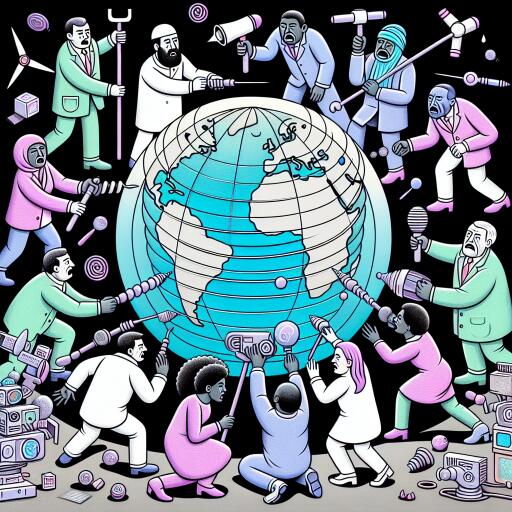
Media’s Psyop Against Climate Scientists
On a single September morning, a strikingly uniform narrative swept through major newsrooms, targeting five researchers behind a U.S. Department of Energy report released in July. The message was airtight: dozens of “experts” had supposedly dismantled the report’s credibility, branding it error-ridden and without merit. The repetition of the same numbers, framing, and verdicts across outlets wasn’t the organic drift of independent reporting; it looked and sounded like a synchronized campaign.
A Chorus in Unison
The storyline hinged on three elements: a tally of critics, the elevation of those signatories as authoritative “climate experts,” and a categorical condemnation of the report. Whether born of a shared press release or simply herd behavior, the effect was indistinguishable—an echo chamber presenting a single reality. When the coverage is this uniform, it stops informing and starts enforcing.
Personalities Over Evidence
The initial salvos weren’t about methods, datasets, or uncertainty ranges. They were about branding. The five authors were swiftly cast as politically aligned operators rather than career scientists. That framing collapses under basic scrutiny. Among the authors are scientists with long track records and deep technical chops: Judith Curry, John Christy, Steven Koonin, Ross McKitrick, and Roy Spencer. Their résumés span satellite temperature records recognized with high-level awards, leadership in federal science agencies, and extensive peer-reviewed work. One served as a senior science official in a Democratic administration—an inconvenient detail for those pushing a partisan caricature.
The authors say they prepared the report independently, without direction from political appointees. That claim received little oxygen in the rush to cast them as a prepackaged “team.” The aim, it seemed, wasn’t to contest analysis; it was to discredit the analysts.
Who Counts as an “Expert”?
While the report’s authors were reduced to a caricature, their critics were elevated as a monolithic panel of climate authorities. Yet a close look at the signatories reveals a spectrum of backgrounds, including many whose specialties sit outside core atmospheric science. That doesn’t negate their views, but it does undercut the easy claim that “the experts” have spoken with one voice. As ever in science, credentials matter—but so do the details of domain expertise, methods, and evidence.
A Review Panel with a Twist
Adding an air of finality, a high-profile scientific body announced a review of the DOE report. Oddly, the appointed chair is a biologist, and only a few members have direct expertise in atmospheric dynamics or climate system physics. That composition doesn’t doom the review, but it complicates the impression—widely promoted in headlines—that an elite climate tribunal is on the case. If the goal is a fair technical assessment, the panel’s makeup should inspire confidence, not questions.
Why Uncertainty Threatens a Narrative
Underlying this uproar is a media economy that thrives on alarm. Disaster headlines draw clicks, pledge drives, and political urgency. Stories of irreversible collapse and unprecedented extremes are the norm; nuance and context often are not. The DOE report, by contrast, foregrounds uncertainty in long-term projections, the capacity for adaptation, and the economic trade-offs of policy choices. It does not deny risks. Rather, it challenges the notion that only one policy path is legitimate or that debate itself is dangerous.
That perspective is intolerable to a narrative architecture built on certainty and crisis. If impacts are heterogeneous, if trends vary regionally, if flood statistics and sea-level trajectories are more complicated than the simplest headlines suggest, then the case for sweeping, one-size-fits-all prescriptions requires a deeper, more honest conversation. It’s far easier to brand dissenting voices as heretical than to engage their arguments.
Beyond the Black Mirror
The result resembles something out of dystopian fiction: screens that don’t reflect the world so much as project a preselected version of it. When coverage moves in lockstep, labels replace evidence, and scientists are reduced to political avatars, journalism’s essential function—helping the public reason through complexity—gives way to narrative enforcement. That’s not scrutiny; it’s choreography.
What Readers Can Do
- Read primary sources where possible. If a report is under fire, consult it or credible summaries of its methods and conclusions.
- Check expertise. Not all “experts” are experts in the same thing; domain relevance matters.
- Look for the methods. Good criticism engages data choices, statistical approaches, and uncertainty—not just labels.
- Separate risk from inevitability. Climate risks are real; the magnitude, timing, and best responses remain areas of legitimate scientific and policy debate.
Climate change deserves rigorous analysis and honest debate, not trial by headline. When the coverage reads like a script, the antidote is simple: slow down, compare claims, and look for the evidence beneath the slogans. The public can handle nuance. The question is whether the media will allow it.



Leave a Reply