

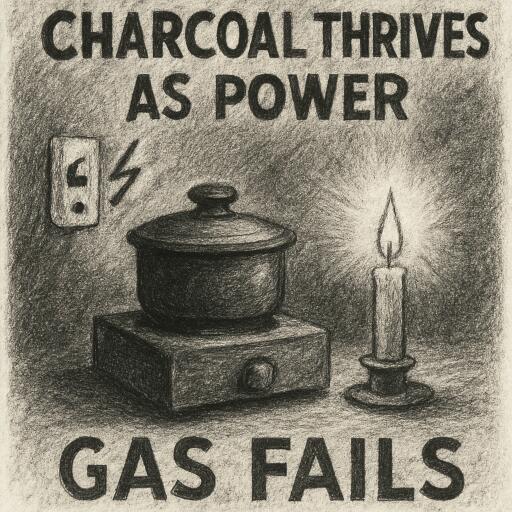
Charcoal thrivesas power, gas fail
Rolling electricity outages and persistent shortages of liquefied petroleum gas (LPG) are reshaping Malawi’s household energy choices—and the forests are set to pay the price. As formal energy options falter, demand for charcoal has surged, pushing prices to new highs and threatening to undo hard-won conservation gains.
In Lilongwe’s Area 50, resident Lackson Shumba has spent weeks shuttling between filling stations, hunting for LPG that never seems to arrive. After nearly a month without a refill, his family has been forced back to charcoal, even as costs bite. “We’ve had no gas for close to three weeks,” he said, describing the grim arithmetic of cooking on a budget when cleaner fuels are simply unavailable.
For charcoal traders, however, the outage economy is a windfall. At Mgona in Lilongwe, vendor Mirriam Kunthochi said a bag now fetches about K70 000—and still moves fast. “Blackouts and the gas shortage have turned the tables. People buy even at these prices,” she said. In Blantyre and Mzuzu, a bag is averaging around K60 000.
Environmental advocates warn the trend is unsustainable. Julius Ngoma of the Civil Society Network on Climate Change said compounding shortfalls in grid power and LPG are accelerating a retreat to wood-based fuels. Clean alternatives remain scarce, out of reach for many, or too costly to sustain without a steady foreign currency supply. “Even as charcoal gets more expensive, households continue to choose it because it’s versatile and accessible,” he noted, adding that setbacks in building reliable markets for cleaner options risk reversing years of progress.
Government officials acknowledge the scale of the challenge. A spokesperson for the Ministry of Natural Resources said charcoal remains widely used nationwide and that work is underway to reduce dependence on it by promoting more affordable alternatives. Yet until the lights stay on and gas deliveries normalize, shifting households away from charcoal will be an uphill battle.
Recent household data from Malawi’s four major cities underscores how entrenched biomass is in urban kitchens. Roughly 8 in 10 households—about 82.8 percent—still cook with biomass, predominantly charcoal, despite rising prices. Rather than abandoning charcoal altogether, many households are “fuel stacking,” combining charcoal with whichever cleaner option—electricity or LPG—is available at a given moment.
The price signals are striking. Average charcoal prices have leapt from about K176 per kilogram in a 2022 baseline to K340/kg and K497/kg in 2024 for charcoal with dust. For higher-grade, dust-free charcoal, averages climbed from roughly K185/kg to K348/kg and K507/kg over the same period. Even at these elevated levels, demand has held up—a stark indicator that when the grid flickers and LPG supplies thin, charcoal becomes the fallback many cannot avoid.
The implications for forests are immediate. Malawi’s woodlands already shoulder the bulk of urban cooking needs, and intensifying harvests for charcoal production threaten to accelerate deforestation, degrade watersheds, and erode biodiversity. As supply chains stretch further from cities, production pressures often shift to more remote or protected areas, compounding environmental damage and raising enforcement risks.
Energy economists point out that price alone rarely triggers a clean-cooking transition. For a decisive shift, households need reliable, affordable, and convenient options that are consistently stocked in local markets. When LPG is unavailable for weeks or the electricity grid can’t support electric stoves at peak times, charcoal’s reliability outweighs its cost.
Several measures could help break the cycle:
- Stabilize supply: Prioritize grid reliability and address LPG import and distribution bottlenecks to restore consumer confidence in cleaner options.
- Lower entry barriers: Expand financing for clean-cooking devices and fuels so households can afford up-front costs and maintain steady access.
- Support alternatives: Encourage locally produced, sustainably sourced fuels and efficient stoves that cut consumption and costs.
- Protect forests: Pair enforcement against illegal charcoal with livelihood support and reforestation to ease pressure on woodlands.
Without a coordinated effort to fix the energy shortfalls and expand practical, clean alternatives, charcoal will continue to fill the gap left by unreliable power and scarce LPG. For families like the Shumbas, that means hard choices at mealtime. For vendors like Kunthochi, it’s a boom. For Malawi’s forests, it could be a breaking point.
The country stands at a crossroads: stabilize modern energy now, or watch charcoal tighten its grip on urban kitchens—and on the remaining forests that sustain them.



Leave a Reply