

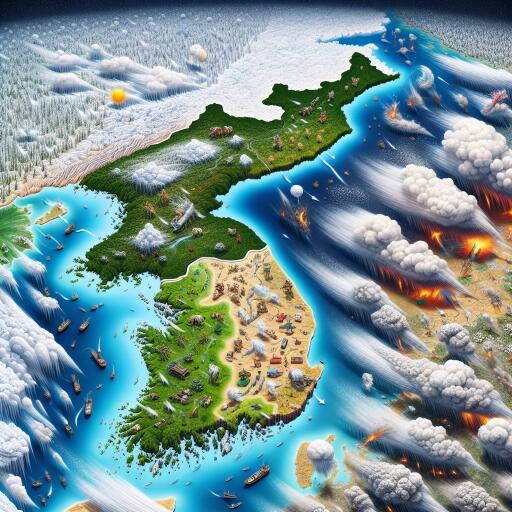
Korean Peninsula Faces Intensified Climate Disasters
From towering wildfires to record heat, sudden deluges, and an early-winter snow jolt, the Korean Peninsula has endured a year that underscores a stark reality: climate hazards are accelerating and compounding. A new long-term assessment warns that the region has crossed into an era where extreme weather is more frequent, more intense, and increasingly disruptive.
Warming outpaces the global trend
An analysis spanning 113 years of observations shows the peninsula’s temperatures rising faster than the global average. Since 1912, the nation’s annual mean temperature has increased by roughly 2.8 degrees Celsius, climbing about 0.21 degrees per decade—and speeding up notably in the 2020s. The average, once 12.0 degrees in the 1910s, reached 13.9 degrees in the 2010s and leapt to 14.8 degrees in the 2020s. In effect, a half-century’s worth of warming has been crammed into about five years.
The recent decade dominates the rankings of hottest years: seven of the ten warmest occurred since 2015. The top three are 2024 (15.4°C), 2023 (14.8°C), and 2021 (14.5°C). Forecasters attribute the surge largely to hotter summers, while winter warming has eased slightly in pace.
Heat waves and tropical nights multiply
High-heat events are expanding. In the 1910s, the country averaged 7.7 heat-wave days and 6.7 tropical nights (when overnight lows stay uncomfortably warm). By the 2010s, those figures rose to 13.3 and 19.7 days, and in the 2020s they climbed again to 16.9 and 28.0 days. Over about 110 years, heat-wave days have more than doubled (2.2 times), while tropical nights have more than quadrupled (4.2 times)—a shift that intensifies health risks, energy demand, and strain on ecosystems.
Fewer rainy days, heavier downpours
Rainfall patterns are also shifting in a way that heightens flooding risk. The number of days with precipitation has declined by about 0.68 days per decade over the past century-plus. Yet total annual precipitation has increased by roughly 17.83 millimeters per decade, and the frequency of hazardous rain has risen: days with heavy rain and days with extreme hourly bursts (over 50 millimeters in an hour) have both trended upward. Fewer rainy days paired with more intense events signal greater odds of flash floods, landslides, and urban drainage failures.
Season boundaries are moving
Recent projections, presented through the national climate information service, sketch a profound reshaping of the calendar by late century. In Seoul, the baseline period (2000–2019) features about 127 summer days and 102 winter days each year. By the late 2080s, summer is expected to stretch to roughly 188 days—about six months—while winter shrinks to around 12 days. Seasonal transitions also shift radically: in one scenario, winter would not begin until mid-January, spring would start before February is out, and summer would run from roughly late April through October.
Across the country, the national average follows the same trajectory. Summer, now about 97 days long, lengthens to around 169 days by the late 2080s; winter, currently about 107 days, contracts to approximately 40 days. This transformation has far-reaching consequences for agriculture, water management, public health, and energy systems.
Extremes intensify: hotter highs, more heat-wave days
In Seoul, annual heat-wave days could jump from 31 at present to about 103.8 in the 2080s and 115.6 in the 2090s—meaning extreme heat on roughly one out of every three days late in the century. The city’s daily temperature ceiling could rise by about 7.9 degrees, from a current peak near 35.9°C to 43.8°C by the late 2080s.
Cold extremes dwindle in parallel. Cold-wave days, around five per year today, are projected to drop to zero from the 2060s onward. Freeze days are expected to decline from 10.3 days in the 2020s to 6.8 in the 2050s, 3.3 in the 2070s, and roughly one day by the 2090s. While fewer cold snaps may reduce some risks, the loss of hard freezes can disrupt ecological cycles, pest control, and water infrastructure designed for historical norms.
Mitigation matters: a different future is still possible
Scenarios with lower greenhouse gas emissions show that some dangers can be curbed. Under a mitigation pathway, tropical nights in Korea are estimated at about 11.7 days around 2025, 23.1 by mid-century, and 39.9 by the 2090s, then easing to approximately 19.3 by 2100. The difference between unchecked emissions and sustained reductions grows larger over time, underscoring the value of aggressive mitigation alongside adaptation.
Adapting to the new normal
Authorities indicate they are strengthening early-warning systems and public alerts for heat waves, tropical nights, and severe rain, supported by expanded climate monitoring and analysis. These upgrades, combined with local actions such as heat-health plans, greener and cooler urban design, improved stormwater capacity, and fire-ready land management, are critical to protect lives and livelihoods as extremes amplify.
The message is unambiguous: climate hazards on the Korean Peninsula are escalating quickly. Acting now to cut emissions while rapidly building resilience offers the clearest path to blunt the worst impacts and safeguard communities in the decades ahead.



Leave a Reply