

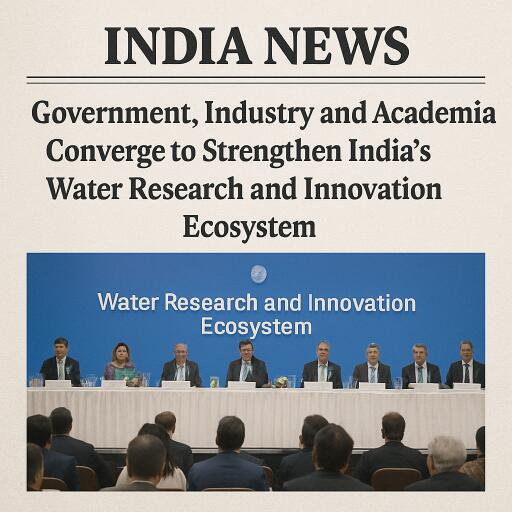
India News | Government, Industry and Academia Converge to Strengthen India’s Water Research and Innovation Ecosystem
India is preparing to bring policymakers, scientists, technology experts, startups and academic institutions onto a single platform for a national workshop focused on water research and innovation. Scheduled to take place in New Delhi, the one-day event is designed to sharpen the country’s approach to sustainable water management by aligning scientific research, public policy and practical deployment.
The workshop will be jointly inaugurated by senior leaders from the water, science and technology, and space sectors, along with top government officials overseeing drinking water, water resources and national missions linked to conservation and resilience. Their presence signals the growing importance of technology-led planning in a country facing rising pressure on rivers, groundwater, urban water systems and climate-sensitive regions.
The central objective of the meeting is to strengthen India’s water research ecosystem by fostering closer collaboration between government departments, research institutions, industry players, startups, technical bodies and communities. Rather than treating water as a sector handled by a single ministry, the event reflects a broader shift toward integrated governance, where satellite monitoring, field science, digital platforms and local participation all play a role.
A key announcement expected during the workshop is the launch of MAHA on Water, short for Mission for Advancement in High-Impact Areas for Water. The initiative is being positioned as a push for advanced research in critical areas such as water resource management, drinking water systems, climate resilience and efficient water use. An open call for research proposals is also expected, inviting institutions and experts to contribute solutions in these priority domains.
This move matters because India’s water challenges are increasingly complex. Variability in rainfall, declining aquifers, growing urban demand, agricultural pressure and the threat of extreme weather events have made traditional management models insufficient. By backing targeted research, the government appears to be trying to shorten the distance between laboratory work and policy action.
Another major step at the event will be a fresh call for startups and micro, small and medium enterprises through the BHARAT-WIN Portal. The aim is to support the development of water-sector products and prototypes, which could include tools for monitoring, treatment, efficiency and conservation. For the innovation ecosystem, this is significant: water technology often struggles to attract the same visibility as fintech or consumer tech, despite its deep relevance to public health, agriculture and climate adaptation.
The workshop is also set to introduce Jal Sanchay Jan Bhagidari: Catch the Rain, a digital platform intended to encourage community-led water conservation. The platform will allow citizens, institutions and local bodies to record and highlight work related to rainwater harvesting, groundwater recharge and broader conservation efforts.
Its purpose goes beyond documentation. By turning local action into visible, shareable data, the platform could help build public participation around water security. That is especially important in a country where long-term resilience often depends not only on major infrastructure, but also on decentralized efforts such as recharge pits, check dams, restored ponds and neighborhood-level harvesting systems.
A notable institutional development expected during the workshop is a memorandum of understanding between the Ministry of Jal Shakti and ISRO. The agreement is intended to deepen the use of satellite-based tools and advanced technological applications for assessing, tracking and managing water resources. Areas of cooperation have already been identified, indicating a practical roadmap rather than a symbolic announcement.
For water governance, space-based technologies are becoming increasingly valuable. Remote sensing can help monitor changes in water bodies, map floodplain inundation, assess watershed health, study river shifts and support planning in drought-prone regions. When combined with on-ground data, such tools can improve both early warning systems and long-term resource planning.
The technical sessions planned for the day reflect this expanded view of water management. Discussions are expected to cover groundwater governance, irrigation practices, river morphology, floodplain mapping, ecological assessments, urban aquifer studies, dam and hydraulic structure safety, climate resilience and the use of remote sensing in decision-making.
Participants will also review the outcomes of water-sector research carried out over more than a decade, with an eye on what has delivered meaningful results and where new priorities should emerge. This stocktaking exercise is likely to influence future public investment and help shape research directions for the next finance cycle.
In addition, the event will host an exhibition of technologies, research findings and implementation models from across the water sector. Research organizations, startups, MSMEs and technical agencies are expected to present solutions that range from digital monitoring systems to practical field interventions. Such exhibits can serve as a bridge between innovation and adoption, especially in a sector where many promising tools fail to scale without institutional backing.
Overall, the workshop represents an effort to build a more connected national water innovation ecosystem—one that links science, public administration, entrepreneurship and citizen participation. In ecological terms, that convergence is increasingly essential. Water security now depends as much on cooperation across institutions as it does on rainfall, reservoirs or rivers themselves.
If the initiatives announced at the event translate into long-term funding, stronger data systems and broader public engagement, the workshop could mark a meaningful step toward more resilient and technology-enabled water governance in India.



Leave a Reply