

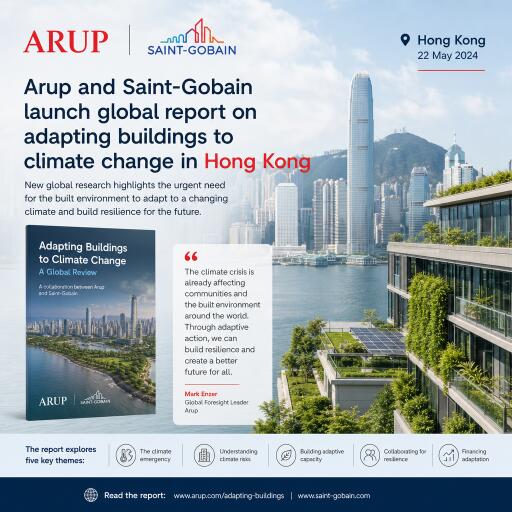
Arup and Saint-Gobain launch global report on adapting buildings to climate change in Hong Kong
Hong Kong has become the latest focal point in a growing global conversation on climate resilience in the built environment. At a gathering of more than 100 developers, architects, engineers and sustainability leaders, Arup and Saint-Gobain unveiled the Asia launch of their joint report, “Adapting Buildings to Climate Change,” alongside a technical seminar examining how artificial intelligence can accelerate climate-smart building design and operations.
The event, supported by leading professional bodies from Hong Kong’s building and sustainability sectors, underscored how collaboration across government, industry and design disciplines is essential to keeping fast-growing climate risks in check. Senior representatives from the city’s climate portfolio and the French diplomatic community attended, signaling a shared intent to harden urban systems against extreme weather and intensifying heat.
Why Asia’s dense cities are on the front line
The climate signals are clear. Between 2000 and 2019, thousands of major climate-related disasters caused trillions of dollars in damages worldwide, a figure expected to rise as heatwaves, floods, storms and cloudbursts become more frequent and severe. Nowhere is the pressure more immediate than in hyper-dense cities like Hong Kong, where development intensity magnifies exposure and vulnerability.
Beyond sea-level and storm threats, overheating is proving a defining risk. Research shared at the launch highlighted how the urban heat island effect can raise local temperatures by as much as 8.5°C compared with outlying areas, increasing health risks and pushing up cooling demand. With a large, aging building stock and more extreme rainfall events, adaptation must advance in lockstep with decarbonisation if cities are to stay both livable and economically competitive.
From risk awareness to practical action
Speakers emphasized a pivot from diagnosing climate hazards to deploying concrete measures that extend the life of assets, cut operating costs and protect occupants. That includes prioritizing passive design and fabric-first strategies, retrofitting for thermal performance and flood resilience, and integrating digital tools to inform decision-making over a building’s entire lifecycle.
Arup’s regional climate leadership noted that adaptation is a present-day necessity, not a far-off concern. The message: combine resilience with emissions reduction and digital intelligence to deliver buildings that are safer in extremes, healthier day to day, and more efficient to run. Saint-Gobain’s regional leadership stressed that no single discipline or product can address climate risks alone; instead, integrated systems and building-science approaches tailored to local conditions offer the most durable results—turning research into real-world performance.
What the report proposes
The report outlines a framework for upgrading buildings to withstand today’s and tomorrow’s climate stressors, structured around three complementary design mindsets:
- Robustness: Hardening assets against shocks through durable materials, reinforced building envelopes, and measures that resist wind, water and debris loads.
- Adaptiveness: Designing with change in mind—modular systems, adjustable shading, and provisions for future retrofits as climate baselines shift.
- Flexibility: Operational strategies that allow buildings to respond dynamically—smart controls, phased upgrades and maintenance regimes guided by data.
Translating these principles into practice, the publication presents families of solutions that can be combined and sequenced across new builds and retrofits, including:
- High-performance thermal envelopes, airtightness improvements and advanced insulation to reduce heat gain and loss.
- Solar protection through external shading, reflective surfaces and glazing strategies to cut peak temperatures and energy use.
- Nature-based and green infrastructure—such as green roofs, permeable surfaces and rain gardens—to temper heat and manage stormwater.
- Enhanced-resilience measures like flood barriers, raised services, wind-resistant facades and impact-rated components.
- Digital and AI-enabled tools to model risk scenarios, optimise operations, and anticipate maintenance before failures occur.
Crucially, the authors argue, adaptation pays back. Proactive investments can limit damage and downtime, protect asset value, reduce insurance exposures, boost occupant health and productivity, and support more resilient neighborhood microclimates—benefits that compound over time.
AI and the new toolkit for resilience
Beyond materials and physical interventions, the seminar explored how digital innovation is reshaping climate-responsive practice. AI-enhanced analytics can integrate climate projections with building performance data, guiding choices from site planning and envelope design to HVAC controls and flood-proofing. Coupled with sensors and digital twins, these tools allow owners and facility managers to shift from reactive fixes to predictive strategies—essential for a city where minutes can matter during heat waves or black-sky events.
Momentum builds from Europe to Asia
Following an earlier European debut, the Hong Kong launch positions Asia Pacific as a key arena for scaling adaptation. The region’s mix of coastal megacities, aging infrastructure and rapid development presents both urgency and opportunity: upgrades to existing stock can deliver immediate gains, while new projects can bake climate resilience into codes, procurement and finance from the outset.
For Hong Kong, where hot nights are more common and extreme rainfall can quickly overwhelm drainage, the pathway is clear: align design practice with updated risk data, accelerate retrofits across public and private portfolios, and foster cross-sector partnerships that blend engineering, materials science and data intelligence. Each building strengthened against heat, wind and water is a step toward a city better prepared for a changed climate.
A call to act across the building lifecycle
The takeaway from the launch: adaptation is no longer optional. By coupling material performance with nature-based solutions and digital insights, the sector can move beyond incremental fixes to systemic resilience. With clear frameworks, practical toolkits and growing alignment among policymakers and practitioners, the blueprint exists. The task now is to apply it—project by project, street by street—so that Hong Kong and cities across Asia can withstand extremes, protect communities and thrive in a warming world.



Leave a Reply