

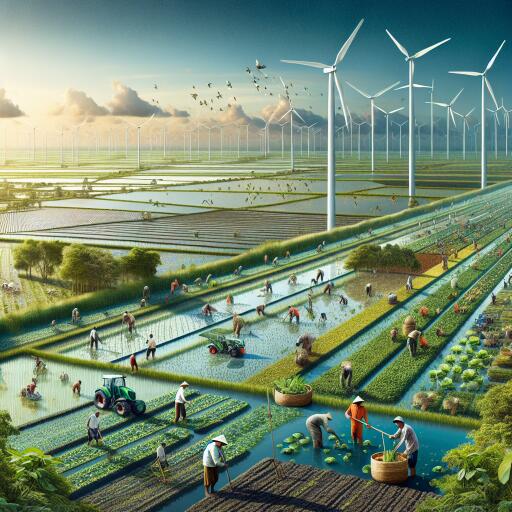
The Fens wetland farming project tests net zero and food security
Across the Cambridgeshire Fens, a new wave of field trials is probing a question at the heart of the UK’s climate transition: can one of the nation’s most productive farming landscapes cut greenhouse gas emissions without sacrificing the food supply it underpins? The Fens wetland farming project is setting out to show that the answer can be yes—if water, soil and crops are managed in a different way.
Stretching across low-lying peatlands, the Fens are famed for rich soils that grow vegetables, cereals and salad crops at scale. That productivity is possible because generations have drained these wetlands. But drainage exposes peat to air, accelerating decomposition that releases carbon dioxide and causes land to sink. The result is a double challenge: significant emissions from agriculture and rising flood risk as the land surface subsides.
The project brings together farmers, scientists and local land managers to test practical measures that reduce emissions and restore wetland function while keeping fields in production. Rather than a single fix, the teams are trialling a “mosaic” approach—wet areas where they make the most sense, drier fields where conventional crops still perform best, and new practices that bridge the gap.
What the trials are testing
- Raising and stabilising water tables: Carefully controlled water levels can slow peat oxidation. Some plots are being re-wetted more often or held wetter for longer after harvest to cut emissions while avoiding waterlogging during key growth stages.
- Creating wetland buffers: Reinstated ditches, scrapes and field-edge wetlands help keep moisture in the landscape, provide wildlife habitat and store water during heavy rain, easing pressure on drainage networks.
- Shifting field management: Lower-disturbance soil practices, reduced compaction, and cover vegetation between crops aim to protect peat surfaces, improve soil structure and moderate emissions.
- Trialling “wet-farming” options: On the wettest ground, the project is exploring crops and biomass that can tolerate higher water tables, opening routes for income that do not depend on deep drainage.
Each technique is being monitored for greenhouse gases, soil moisture, subsidence rates, yields and farm economics. The goal is to learn which combinations reduce emissions most effectively per hectare, how they affect productivity and profitability, and where they fit within real farm operations.
Food security front and center
Any shift in land and water management must protect livelihoods and the national larder. The project focuses on keeping high-performing land productive, while using wetter margins, low-lying fields and drainage corridors to provide climate and nature benefits. By buffering fields with wetlands, maintaining soil health and reducing flood risk, the approach aims to stabilise yields over the long term.
Diversifying farm income is another pillar. Environmental services—such as carbon reductions, water storage and biodiversity gains—can be rewarded through public schemes or private markets. Wet-tolerant crops and biomass also offer new revenue streams on ground that is increasingly difficult to drain.
Why the Fens matter for net zero
Lowland peat is one of the UK’s most carbon-dense soil types, and when drained it becomes a notable source of emissions. Cutting losses from these soils is widely seen as essential for delivering national climate goals. But the Fens are also integral to food production, which means solutions must be precise rather than blunt. The project is designed to generate evidence that can be used to scale up change across similar peat landscapes, balancing climate, food and water priorities.
Water, wildlife and resilience
Re-wetting and restoring fragments of wetland can do more than reduce carbon. Wetter mosaics support pollinators and farmland birds, improve water quality by slowing runoff, and create space to hold stormwater. These benefits can reduce pumping costs and flood damage while enriching the countryside that communities value. The project is documenting these co-benefits alongside the core climate and yield data.
Working with the grain of local farming
Change on this scale depends on collaboration. Farmers are co-designing the trials to fit crop rotations, machinery and drainage realities. Water management boards and local authorities are involved to align field-level work with wider drainage networks and flood strategies. That practical focus—what works in a busy season, what fits a balance sheet—aims to ensure results are not just scientifically robust but operationally credible.
From pilots to practice
Over time, the project will publish maps and guidance on where wetter options deliver the biggest climate wins with the least disruption, and which practices are most cost-effective to adopt first. Early priorities include:
- Targeting the deepest and most emission-prone peat for raised water tables and wetland buffers.
- Protecting productive zones with soil-friendly management and seasonal water controls.
- Building funding stacks that blend public payments with private investment for measurable carbon and nature outcomes.
The UK’s commitment to end its contribution to global warming by mid-century gives clear direction. The Fens wetland farming project offers a grounded pathway to get there without sidelining the farms that feed the country. If successful, it will provide a template other lowland peat regions can adapt—showing that climate action and food security can be cultivated side by side, from field edge to fen.



Leave a Reply