

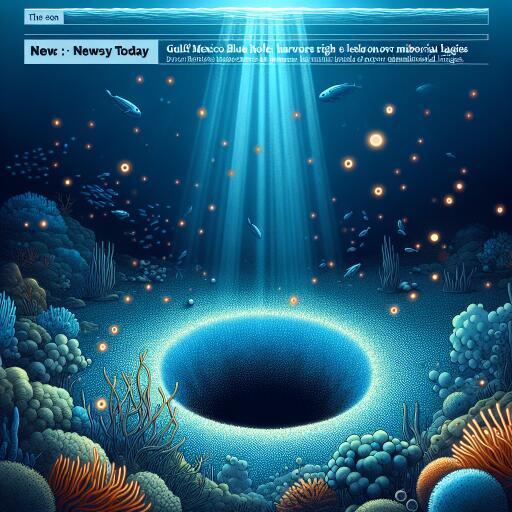
Gulf Of Mexico Blue Hole Harbors High Levels Of Novel Microbial Lineages – Newsy Today
A yawning sinkhole on the seafloor off Florida’s west coast is rewriting what we know about life in oxygen-starved waters. Inside Amberjack Hole, a deep “blue hole” in the Gulf of Mexico, scientists have uncovered dense populations of unfamiliar microbes, including entire lineages rarely seen elsewhere. Their findings point to a hidden engine of nutrient cycling, chemical detoxification, and resilience that thrives in darkness—and may hold clues for life beyond Earth.
Blue Holes: Natural Testbeds for Extreme Life
Blue holes are vertical sinkholes that puncture shallow continental shelves. Beneath their bright rims lies a staircase of chemical layers: surface waters rich in oxygen give way to zones progressively poorer in oxygen and richer in nutrients, metals, and reduced sulfur compounds. Each layer creates a niche, and together they shape self-contained ecosystems that operate very differently from the open ocean. Because these conditions resemble ancient seas and other extreme settings, blue holes serve as living laboratories for studying how microorganisms adapt, cooperate, and exchange energy when oxygen is scarce.
Inside Amberjack Hole
Amberjack Hole sits roughly 30 miles offshore west of Sarasota, Florida. As researchers descended, instruments recorded a steady drop in dissolved oxygen and a rise in nutrients, dissolved iron, and sulfur species. Deeper still, the water transitions from hypoxic to anoxic, a cutoff that redraws the rules of metabolism. In these twilight layers, microbial cells were not just present—they dominated, forming a bustling biosphere hidden from the surface.
Who’s There? A Surge of Rare Microbial Lineages
The team detected strikingly high proportions of Woesearchaeota, a recently described archaeal group that, at peak depths, comprised more than half of the community. Alongside them were bacterial lineages from the Candidate Phyla Radiation (CPR), many of which are known primarily from DNA sequences rather than cultured isolates. These organisms are often streamlined and specialized, hinting at intricate partnerships and nutrient exchanges that allow them to flourish where oxygen vanishes.
How They Thrive: Metabolism Built for the Edge
By reconstructing metagenome-assembled genomes, researchers pieced together the biochemical toolkits that power life inside the hole. The microbes collectively support robust sulfur and nitrogen cycling—two elemental currencies that can replace oxygen as the driver of metabolism. Genes linked to both resistance and respiration of arsenic were also common, pointing to a community capable of coping with, and exploiting, otherwise toxic chemistry.
One gene, previously uncharacterized and associated with a CPR lineage, stood out: it separated microbial communities in low-oxygen waters from those in fully anoxic zones. That split suggests a functional tipping point, where even a whisper of oxygen—or its complete absence—reshapes who lives where and how they extract energy.
Why It Matters: From Deep Time to Deep Space
Oxygen-poor environments like Amberjack Hole mirror conditions that prevailed across large swaths of Earth’s early oceans. Studying how these modern microbes operate can illuminate the evolutionary steps that made complex life possible. The work also feeds into astrobiology: if organisms can thrive on alternative energy pathways in dark, oxygen-depleted waters here, similar strategies might sustain life in subsurface oceans or briny pockets on other worlds.
Closer to home, the metabolic talents cataloged in Amberjack Hole have practical promise. Microbes that detoxify arsenic, shuffle sulfur compounds, or drive nitrogen transformations could inspire new biotechnologies—from remediating polluted waters to designing low-oxygen industrial processes that harness nature’s chemistry instead of costly inputs.
Stable Yet Dynamic: A System Worth Watching
Repeated sampling showed that Amberjack Hole’s chemical layers and microbial fingerprints remain surprisingly consistent over time, suggesting a relatively stable engine humming in the dark. That persistence makes blue holes prime candidates for long-term monitoring, where instruments can track subtle shifts in chemistry and biology across seasons, storms, and heat waves.
Beyond Amberjack: Deeper Dives Ahead
Scientists are extending their exploration to other Gulf of Mexico sinkholes, including a deeper site nicknamed “Green Banana,” where dives have surpassed 400 feet. These expeditions rely on a blend of technology and teamwork: benthic landers for long-duration measurements, remotely operated vehicles for precise sampling, and specialist divers for targeted missions. One lander deployed in these studies weighed more than 270 kilograms, underscoring the logistical challenge of sustained work in such remote, vertical worlds.
Key Takeaways
- Blue holes are stratified, oxygen-poor environments that host dense, specialized microbial communities.
- Amberjack Hole harbors unusually high levels of Woesearchaeota and CPR bacteria, many with streamlined genomes and niche metabolisms.
- Genomic evidence reveals vigorous sulfur and nitrogen cycling, along with arsenic resistance and respiration.
- A previously unknown gene linked to CPR lineages helps distinguish communities in low-oxygen versus no-oxygen waters.
- Insights from these systems inform astrobiology, environmental remediation, and low-oxygen bioprocess design.
As exploration continues, blue holes are emerging as keystones for understanding how life endures when oxygen fades—a window into our planet’s past and a guide to the limits of habitability elsewhere.



Leave a Reply