

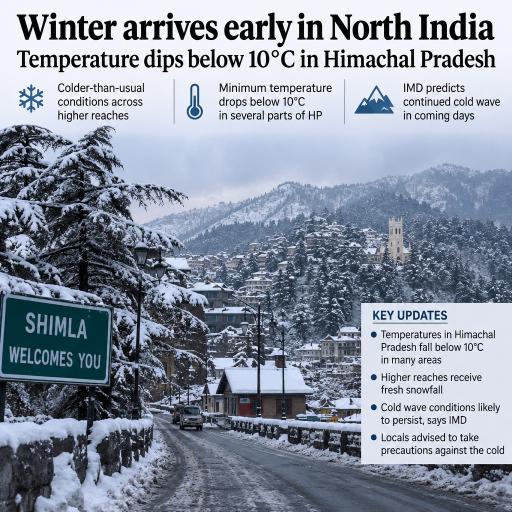
Winter arrives early in North India, temperature dips below 10°C in Himachal Pradesh
An early-season chill has settled over northern India, bringing freezing nights to parts of Himachal Pradesh and unusually cool October conditions to Delhi. Mountain communities are already experiencing temperatures associated with winter, while colder air is beginning to spread across the northern plains.
On October 27, Delhi’s Safdarjung weather station recorded a minimum temperature of 15.3°C, about 1.9°C below the seasonal average. It was the capital’s coldest October night in three years and only slightly higher than the 15.2°C observed on the same date in 2023.
Sub-zero conditions in Himachal Pradesh
The sharpest cold was reported in Himachal Pradesh’s high-altitude districts. Kukumseri fell to -2.1°C, making it the coldest monitored location in the state. Tabo recorded 0.2°C, while Keylong registered 0.3°C.
Temperatures remained below 10°C across several other stations. Kalpa recorded 3.6°C, followed by Manali at 5.9°C, Bajaura at 7.2°C and Seobagh at 7.5°C. Bhuntar dropped to 8°C, Solan to 9°C, Kufri to 9.6°C and Sundernagar to 9.8°C. Shimla was slightly warmer, with a minimum of 10.2°C.
>
Although the readings point to increasingly wintry conditions, temperatures at many Himachal Pradesh stations changed little during the preceding 24 hours and generally remained close to their usual levels for this time of year. High-elevation valleys typically cool sooner than the plains because thinner, drier air and clear skies allow heat to escape rapidly overnight.
Weather expected to turn unsettled
Dry conditions are expected across much of Himachal Pradesh on October 27 and 28. From October 29, however, scattered weather activity could develop, with isolated thunderstorms and lightning possible through October 30.
The change is linked to western disturbances moving across northwest India. One circulation has formed near northern Haryana, while another upper-level weather system is expected to influence the wider region. Intermittent rain or snow may affect isolated parts of Himachal Pradesh between October 31 and November 2, depending on local altitude and temperature.
Western disturbances are an important source of cold-season precipitation in the western Himalayas. They can replenish snow and water reserves, but sudden shifts in weather may also create hazards for mountain travel, farming and livestock.
A preview of winter, not a climate trend by itself
The current cold spell offers a clear preview of the approaching winter, particularly in Himalayan areas where freezing temperatures have already arrived. However, a few unusually cold nights do not alone indicate a broader climate pattern. Long-term climate change is assessed using temperature and precipitation records collected over decades, even as short-lived cold spells continue to occur within an overall warming climate.
Residents and visitors in higher reaches should prepare for frost, rapidly changing visibility and potentially slippery roads as the next weather system approaches. Delhi and other northern plains are also likely to experience cooler mornings as seasonal temperatures continue their downward transition toward winter.



Leave a Reply