

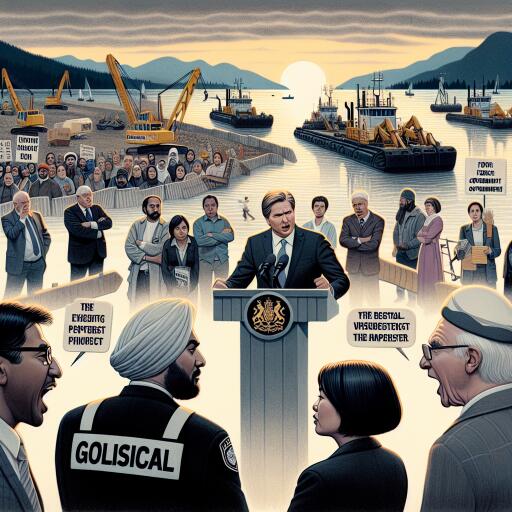
B.C., Federal Government Support Dredging Vancouver’s Burrard Inlet, Others Opposed
The discussion surrounding the dredging and deepening of Vancouver’s Burrard Inlet has reignited, with British Columbia’s energy minister expressing support for the initiative. The endeavor aims to facilitate the navigation of fully loaded oil tankers, despite mounting concerns from environmental groups, experts, and Indigenous communities.
Prime Minister Mark Carney floated the proposal, hoping to boost the capacity of tankers transporting oil from the Trans Mountain pipeline to global markets. The expanded TMX pipeline, operational since 2024, prompts calls for further enhancement to diversify Canada’s energy export outlets.
Energy Minister Adrian Dix, in a recent interview, conveyed his conditional backing of the project, provided it aligns with environmental and consultative prerequisites, particularly with First Nations.
“It’s a federal initiative that would streamline port traffic and optimize utilization,” Dix stated, noting that currently, the risk of grounding prevents full loading of tankers.
This stance marks a shift from the 2017 opposition by the provincial government, then led by Premier John Horgan, who promised to oppose the pipeline’s expansion using all available means. However, the Supreme Court of Canada’s 2020 ruling curtailed provincial challenges, emphasizing constitutional boundaries on interference with interprovincial projects.
The potential dredging of Burrard Inlet aims to accommodate fully loaded Aframax-class tankers beneath Vancouver’s Second Narrows Bridge, following their departure from the Westridge Marine Terminal at Burnaby. This terminal serves as the terminus of the 1,180-kilometre pipeline originating near Edmonton.
These tankers, significant in size, often load to just 80% capacity to navigate Port Metro Vancouver’s constraints. The dredging proposal, however, has sparked alarm over possible ecological repercussions.
Juan José Alava, a principal investigator at the University of B.C., emphasizes the critical need for thorough examination of the dredging’s ecological impacts. Living near the inlet, Alava notes its average shallow depth of 21 metres, posing potential short and long-term ecological threats.
Dredging activity could increase water turbidity by suspending solids, consequently disrupting phytoplankton production, which serves as a fundamental component of the area’s food chain. This could reverberate throughout the ecosystem, affecting fish, mammals, and larger predators like whales.
Further, the proposal may impede salmon spawning and unleash trapped pollutants from the seabed, posing additional ecological risks.
Engineering expert Enda Murphy points out the challenge of quantifying the amount and financial implications of material to be dredged without detailed information. Although compared to the Fraser River operations, this project might appear less substantial, it still presents significant environmental concerns, including the release of long-held pollutants.
Additionally, future dredging must evaluate impacts on shoreline stability and marine traffic disruptions. Murphy highlights the importance of rigorous assessments and engagement with local communities and Indigenous groups in ongoing dialogues.
The Tslei-Waututh First Nation, an essential stakeholder located near Burrard Inlet, emphasizes the cultural and ecological importance of these waters. Chief Jen Thomas conveyed her community’s serious reservations about any project that threatens their historical and spiritual ties to the region.
“A proposal to disturb the seabed, integral to our identity, raises profound concerns,” Chief Thomas stated. The Tsleil-Waututh Nation is committed to active involvement once a formal proposal is presented.
Consultation with Indigenous communities remains pivotal, given their constitutionally protected rights and titles over affected lands and waters. Chief Thomas reminds stakeholders of the Tsleil-Waututh’s governmental standing in these matters.
The proposal’s proponents argue for its economic merits, citing underutilized tanker capabilities and the need for capitalizing on investments made in the pipeline infrastructure.
Energy Minister Dix reiterated the project’s purely federal nature, distancing the provincial government from primary responsibility and highlighting national interests. The Prime Minister previously identified similar projects as strategic to Canada’s resource and infrastructure growth.
Opposition voices, including interim BC Greens leader Jeremy Valeriote, stress the necessity for comprehensive environmental assessments and thorough public examination before proceeding with such impactful measures.
Valeriote focuses on the cruciality of transparent engagements with the Tsleil-Waututh First Nation, demanding clarity on the proposal’s rationale and implications as discussions advance.
While the project remains in the conceptual phase, it punctuates broader discussions about Canada’s energy policy trajectory and the balance between economic progress and environmental stewardship.
The provincial government, having consulted the Tsleil-Waututh First Nation already, acknowledges the importance of continued dialogue as projects of this nature unfold.
As this conversation develops, the need for a unified approach in addressing ecological, cultural, and economic interests becomes paramount in safeguarding the future of Burrard Inlet and its surrounding communities.



Leave a Reply