

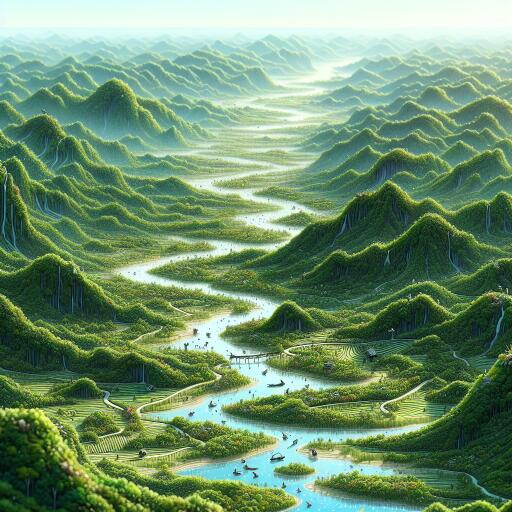
Exploring “miniature world” of Pu Huong Biosphere Reserve
In a quiet corner of Quy Hop, in Vietnam’s central Nghe An province, sits a compact museum that distills an entire landscape into a single, walkable experience. Founded in 2008 within the Pu Huong Nature Reserve, this center preserves and interprets the area’s rare genetic resources—an archive of life that doubles as a classroom, a lab, and a window into one of the country’s most diverse ecosystems.
A miniature world under one roof
The museum is organized into three distinct areas, each designed to reveal a different layer of the reserve’s complexity. A tradition hall features a 3D model that maps terrain and geomorphology, helping visitors visualize how geology, hydrology, and forests knit together to sustain wildlife. A second gallery presents some 150 zoological specimens, while a botanical section showcases more than 500 plant samples, highlighting both the commonplace and the rare.
Many items arrived through a grassroots pipeline: local residents voluntarily contributed finds, and field researchers collected specimens from both core and buffer zones during systematic surveys. Today, the bulk of these materials has been digitized and cataloged, with preventive treatments applied to guard against mold and organic decay. The result is a growing database that supports conservation decisions, education programs, and future research.
Beyond curating its own archive, the museum is strengthening ties with universities and research organizations at home and abroad. These collaborations aim to expand scientific study and, critically, to introduce the reserve’s story to a broader audience.
A hotspot of life in numbers
Pu Huong spans nearly 46,500 hectares and shelters an impressive concentration of wildlife: close to 570 animal species and more than 1,800 plant species have been recorded. Many are globally or nationally threatened—69 animal and 76 plant species feature in Vietnam’s Red Data Book, while 51 animal and 15 plant species appear on the IUCN Red List. Dozens are also regulated under CITES. This biological wealth helps explain why Pu Huong is one of three special-use forests forming the core of the Western Nghe An Biosphere Reserve, recognized by UNESCO in 2007.
From research center to living classroom
Since 2023, the museum has been reimagined as an open natural and cultural space. It now serves as a hub for both scientists and visitors, making complex ecological knowledge tangible to the public without compromising research standards.
In 2025, the reserve launched a pilot that links museum tours with hands-on learning in a 10-hectare botanical garden at the periphery of the site. Divided into nine sub-zones, the garden is designed for fifth-grade students in local schools. The program blends guided exploration with simple field techniques and observation tasks, giving children a formative understanding of how forests function and why they matter. By rooting conservation awareness in experience rather than abstraction, the initiative builds the next generation’s literacy in biodiversity.
Challenges behind the glass
Turning a biodiverse landscape into a durable, accessible collection is labor-intensive—and vulnerable to the elements. The museum still lacks essential environmental controls such as climate-stable cabinets and humidity regulation, and its team is stretched thin across specialized tasks. These constraints make long-term preservation difficult, especially for delicate organic materials.
To address this, the reserve plans to invest in standard storage infrastructure, expand specialist training, and formalize procedures for handling and archiving specimens. Digital tools will continue to play a central role in cataloging and monitoring, while partnerships with research institutions are expected to bring both technical expertise and funding. Such steps are not merely operational; they determine whether the museum can safeguard knowledge for decades to come.
Why these collections matter
Conservation doesn’t happen only in forests; it also happens in well-run collections that preserve evidence, reveal patterns, and inspire action. Biodiversity museums like the one at Pu Huong are now integral to modern scientific and educational infrastructures. They curate the story of life—biodiversity, geology, and ecological change—and translate it for students, policymakers, and travelers alike.
Experts in wildlife conservation emphasize that when science, education, and tourism intersect in an ethically designed space, the effect is catalytic. Museums become open knowledge hubs that connect local communities with global concerns and connect global audiences with local realities. In that sense, Pu Huong’s museum is more than a repository: it is a bridge between a living forest and the people who will decide its future.
Step inside, and the reserve’s “miniature world” becomes a clear, compelling case for why biodiversity matters—and how careful stewardship, collaboration, and technology can keep this story alive.



Leave a Reply