

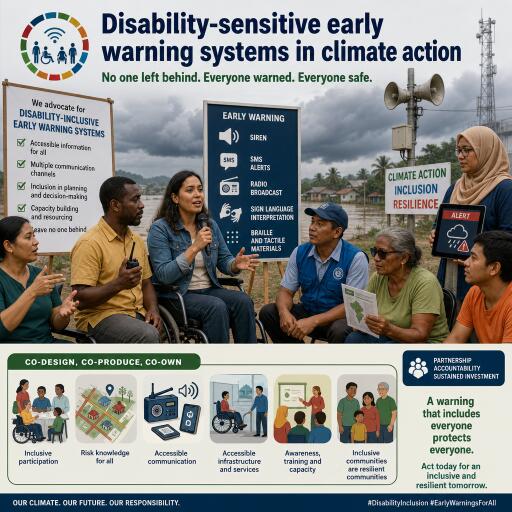
Stakeholders advocate disability-sensitive early warning systems in climate action
Communities across Nigeria are calling for early warning systems that are accessible to people with disabilities, warning that climate hazards—from flash floods to prolonged heatwaves—are compounding existing barriers to safety, mobility, and vital information.
At a forum in Abuja convened by Inclusive Friends Association (IFA), participants urged federal and state authorities to embed disability inclusion into climate governance and emergency preparedness. They pressed for clear guidelines on accessible communication, evacuation protocols, and relief distribution, alongside the systematic collection of disability-disaggregated data to inform policy and measure progress.
Closing the gaps in risk communication and response
Speakers underscored that millions of Nigerians with disabilities remain largely excluded from climate strategies and disaster risk management plans. This absence leaves people at heightened risk when warnings fail to reach them in formats they can use, shelters are physically inaccessible, or evacuation support overlooks mobility, sensory, or cognitive needs.
Examples shared at the forum illustrated the stakes: wheelchair users stranded by floodwaters lacking accessible transport; blind and low-vision residents losing mobility aids in chaotic evacuations; and people with albinism facing acute danger during extreme heat without tailored heat-health guidance. Participants cautioned that labeling people with disabilities as a generic “vulnerable group” often erases these specific realities, resulting in one-size-fits-all interventions that miss those who need help most.
From policy on paper to inclusion in practice
While national climate policies reference vulnerable populations and gender equity, participants said they provide little practical direction on disability inclusion. IFA’s programme team explained that a new Disability-Inclusive Climate Action initiative aims to identify policy blind spots, strengthen implementation, and support the development of a national guideline that embeds disability considerations across climate risk reduction, adaptation, and recovery.
Climate justice advocates added that Nigeria’s policy framework is broad but underfunded and inconsistently implemented. Inclusion and financing are the weakest links, they noted, calling for a shift from symbolic consultation to meaningful participation—ensuring people with disabilities and their representative organizations help design, implement, and monitor climate policies and programmes.
Accessible early warning systems save lives
Participants emphasized that early warning systems must be multimodal and accessible by default. That means alerts delivered through diverse channels—SMS, radio, TV captions, sign language on broadcast and digital platforms, sirens paired with strobe lights, community messengers, and easy-to-read and tactile formats—so that no one is left behind when hazards escalate.
A representative of a deaf women’s organization described how flood-affected communities in Niger State often missed alerts because sign language and other accessible channels were not used during emergencies. Authorities were urged to deploy sign language interpreters and ensure emergency information is consistently conveyed through accessible systems, not only during crises but also in preparedness campaigns and drills.
What inclusive climate action should look like
- Design early warning systems with universal access: provide messages in multiple formats (audio, text, captioned video, sign language, pictograms, easy-to-read, and tactile materials), and pair audible sirens with visual and vibration-based cues.
- Plan evacuations that account for mobility, sensory, and cognitive needs: accessible transportation, trained support personnel, wayfinding aids, and shelters with ramps, handrails, accessible sanitation, and cooled spaces during heatwaves.
- Protect continuity of assistive technology: procedures for securing and replacing mobility aids, hearing devices, white canes, medications, and batteries during displacement.
- Gather disability-disaggregated data: integrate standardized questions into climate risk assessments, disaster loss reporting, and relief registries to inform equitable resource allocation.
- Invest in training: build the capacity of emergency responders, community volunteers, and local officials on disability inclusion and respectful communication.
- Fund inclusion: earmark resources for accessible infrastructure, interpreters, community outreach, and the participation of organizations of persons with disabilities in decision-making.
- Monitor and learn: co-create indicators with disability groups to track whether alerts reach intended audiences and whether response measures are effective.
Centering lived experience in decision-making
Organizers stressed that people with disabilities must be involved at every stage—from risk mapping and policy design to drills and after-action reviews. Representatives from civil society highlighted that meaningful participation leads to more precise, cost-effective interventions and reduces losses during climate shocks.
As extreme weather becomes more frequent and intense, the forum’s message was unequivocal: climate resilience cannot be achieved if early warning and response systems are not designed for everyone. Building inclusive, well-funded, and accountable systems will protect lives now and lay the groundwork for equitable adaptation in the years ahead.



Leave a Reply