

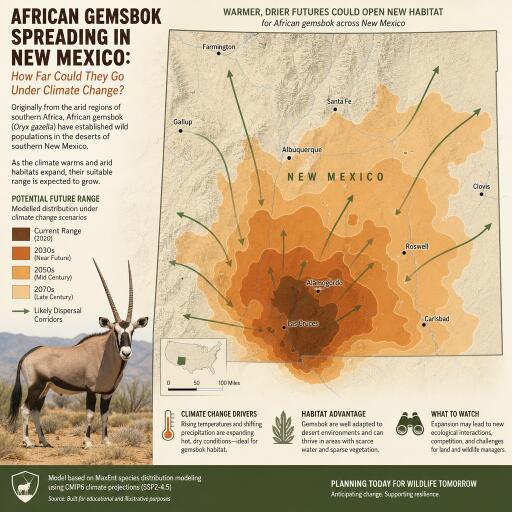
African Gemsbok Spreading In New Mexico: How Far Could They Go Under Climate Change?
Sixty years after African gemsbok were released in New Mexico as a game species, their story has shifted from novelty to ecological test case. The large antelopes have already pushed more than 100 kilometers beyond their original release sites, and new climate-driven habitat models suggest their North American footprint could grow dramatically by century’s end. If the Southwest continues to warm and dry, suitable range for this desert specialist may link up across vast swaths of the interior West, raising urgent questions for wildlife managers, ranchers, and conservationists.
From desert icon to desert invader
Native to the Kalahari, gemsbok are built for extremes. They can meet their water needs from plants, tolerate searing heat, and persist on coarse, low-quality forage. Adults can weigh more than 200 kilograms, yet they rarely need to drink. In the American Southwest, they also face comparatively few effective predators; lions and hyenas are half a world away, and local carnivores seldom suppress their numbers. As aridity intensifies, these traits become a competitive advantage over native ungulates and livestock.
That advantage is already visible on the ground. Herds in New Mexico now occupy desert grasslands, shrublands, and dune systems where pronghorn and cattle also feed. During severe droughts—when ranchers remove cattle to prevent overgrazing—gemsbok can continue browsing hardy shrubs and tough grasses, risking deeper damage to rangelands that are already stressed by heat and water scarcity.
Modeling tomorrow’s range
To understand where gemsbok might head next, recent work used presence-only species distribution modeling (Maxent) informed by community wildlife observations. By relating gemsbok sightings to factors such as temperature seasonality, precipitation, vegetation cover, terrain ruggedness, and human footprint, the models estimate where conditions are favorable now and how that envelope might shift under late-century climate scenarios.
The picture that emerges is striking. Isolated pockets of suitable habitat—today scattered across parts of New Mexico and adjacent deserts—are projected to merge into larger, more connected zones by 2100. Pathways open up across western Texas, western New Mexico, and into Arizona, with suitable conditions also appearing in parts of California’s desert country and, in some scenarios, portions of the Great Basin and northern Intermountain West. Some model runs even indicate potential suitability reaching into southern Washington and Montana, reflecting the creation of climatic “islands” that resemble the gemsbok’s arid homeland.
These projections carry caveats. Presence-only models depend on where people look for and report animals, which can bias results. Climate futures also vary. Still, the broad trend—more contiguous arid and semi-arid habitat under warming—points in the same direction: expanding opportunity for a water-wise antelope to move.
Ripple effects on wildlife, ranching, and rangelands
As ranges overlap, gemsbok may intensify competition for forage with pronghorn, bison on conservation lands, and cattle on working rangelands. Their ability to switch to poorer-quality browse during drought could leave native species nutritionally pinched at the very moments they are most stressed. If herds grow unchecked, chronic grazing pressure could slow grassland recovery, exacerbate dust, and undermine habitat restoration investments.
Health risks add another layer. Wild gemsbok in the region have tested positive for pathogens of concern to other hoofed animals, including malignant catarrhal fever, bovine respiratory syncytial virus, and parainfluenza-3. While transmission dynamics are not fully understood, regular surveillance and biosecurity around shared water points, mineral licks, and feed sites would be prudent to reduce cross-species spread.
Managing a moving target
Managing gemsbok in a changing climate is complicated by mixed values: some stakeholders prize them as a huntable big game species, while others see rising ecological and economic costs. A pragmatic approach centers on prevention, early action, and adaptive management:
- Map likely dispersal corridors and “pinch points” and prioritize early detection and rapid response where new herds are first establishing.
- Use targeted removals, strategic fencing, or exclosures to protect sensitive springs, restoration sites, and critical forage during drought.
- Align hunting seasons and quotas with population objectives, adjusting annually based on recruitment, drought severity, and rangeland condition.
- Coordinate across state lines, federal lands, and tribal nations to share data, standardize surveillance, and avoid simply shifting the problem next door.
- Expand disease monitoring of gemsbok and sympatric wildlife, and reinforce livestock vaccination and biosecurity to lower spillover risks.
- Integrate range monitoring—soil stability, plant cover, and forage quality—into trigger points for management action.
What to watch next
Key indicators over the next decade will include the pace of northwestern and western dispersal, calf survival and herd growth rates during multi-year droughts, predator interactions, and how often managers must remove cattle from degraded pastures. Community science reports, trail camera networks, and roadkill data can provide early warning of new fronts, especially in western Texas, Arizona’s desert margins, and the Mojave–Great Basin transition.
Ultimately, the gemsbok’s trajectory is a climate story as much as an invasive species story. As the Southwest edges toward a hotter, drier norm, a Kalahari-adapted antelope finds more places to thrive. Whether those gains come at the expense of native wildlife and working rangelands will depend on timely, coordinated action—before scattered oases of suitability fuse into a continuous highway for expansion.



Leave a Reply