

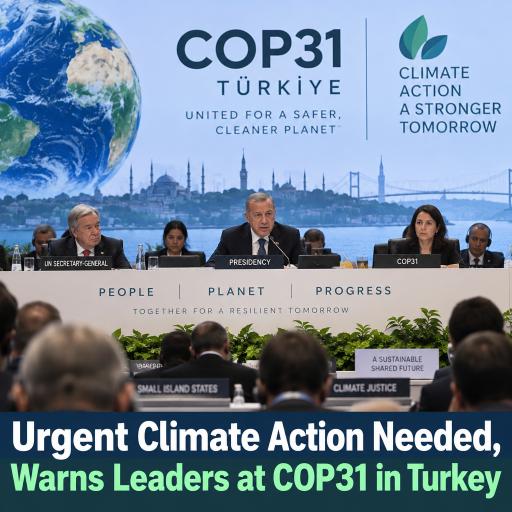
Urgent Climate Action Needed, Warns Leaders at COP31 in Turkey
World leaders gathered at COP31 in Turkey have delivered an increasingly urgent message: governments must turn climate promises into immediate, measurable action as rising temperatures threaten communities, ecosystems and entire nations.
Marshall Islands President Hilda Heine warned that continued inaction could permanently transform life on Earth. Drawing attention to damaged coral reefs and rising seas across her island nation, she said exceeding the Paris Agreement’s goal of limiting warming to 1.5°C would have devastating consequences for vulnerable countries.
For low-lying island states, the climate crisis is already an existential emergency. Sea-level rise, coastal erosion, saltwater intrusion and deteriorating marine habitats are undermining homes, food supplies and local economies. Heine argued that approving additional coal, oil and gas developments would further endanger countries that have contributed little to global emissions.
Current commitments remain insufficient
Barbados Prime Minister Mia Mottley criticised the limited progress made since the Paris climate accord was adopted in 2015. Even if governments deliver all their existing commitments, projections indicate that global temperatures could still rise by approximately 2.6°C above pre-industrial levels.
Such warming would sharply increase the likelihood of extreme heat, destructive flooding, drought, crop failures and ecosystem collapse. Scientists have also warned that every fraction of a degree matters, particularly for regions with limited resources to adapt.
United Nations Secretary-General António Guterres directed strong criticism at the fossil fuel industry, accusing major companies of delaying the energy transition and weakening public understanding of climate science. He called for a rapid move away from fossil fuels and proposed taxing exceptional industry profits to help finance recovery and adaptation in countries suffering the worst climate impacts.
Pressure grows on summit hosts
The conference is being hosted by Turkey with Australia playing a leading role in the proceedings. Turkish President Recep Tayyip Erdoğan urged delegates to replace declarations with practical policies, warning that every delay increases both the human risks and the eventual financial cost of responding to climate change.
However, environmental campaigners questioned that message following Turkey’s announcement of new oil discoveries. The apparent contradiction reflects one of the central tensions at COP31: many governments support international climate goals while continuing to expand fossil fuel production at home.
Australian Prime Minister Anthony Albanese described the gathering as an important moment for international cooperation. His address nevertheless attracted criticism for failing to directly confront the role of coal, oil and gas in driving global warming.
A decisive test for international cooperation
Representatives from 91 countries are participating, although the absence of the presidents of the United States and China has raised concerns about the level of political momentum behind the negotiations. As two of the world’s largest emitters, their countries remain central to any effective global strategy.
Climate researchers say emissions are still not falling quickly enough to preserve a credible pathway to 1.5°C. The possibility of temporarily exceeding that threshold is growing, bringing heightened risks for coral reefs, polar ice, forests and densely populated coastal regions.
The negotiations must now confront difficult questions over fossil fuel phase-outs, climate finance and assistance for countries facing unavoidable losses. Developing nations are demanding fair access to funding, technology and clean energy infrastructure, while communities already experiencing disasters need faster support.
COP31 therefore represents more than another round of diplomatic talks. Its outcome will help determine whether governments can collectively accelerate renewable energy, improve resilience and protect those least responsible for the crisis. Leaders repeatedly stressed that decisions taken now will shape living conditions for generations—and that further delay will make a safer future harder and more expensive to secure.



Leave a Reply