

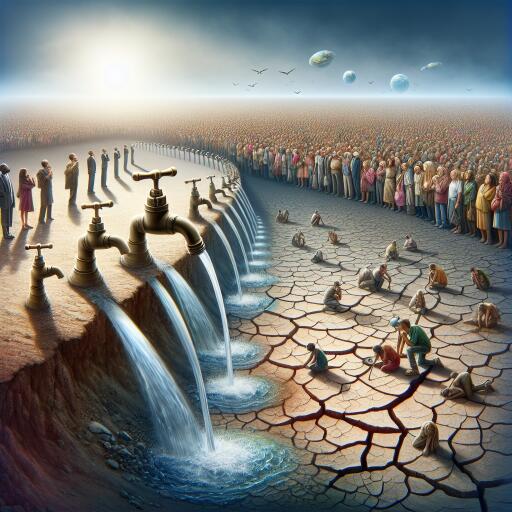
Human over breeding is running water taps out, but “no one will try to solve the problem, until they have no water to drink.” | Ernst v. EnCana Corporation
“Day zero” is often blamed on climate alone. But the taps don’t run dry only because the sky withholds rain. They fail because our demand has outpaced what rivers, reservoirs, aquifers, and ecosystems can sustainably provide. We’ve treated population growth and consumption as taboo topics, and then feign surprise when the faucet coughs air.
What “day zero” really means
Day zero is the moment when a city or region can no longer guarantee piped water to homes and businesses. It arrives through a collision of forces: prolonged heat and drought, dwindling rivers and shrinking reservoirs, overpumped aquifers, and surging demand from swelling populations, thirsty agriculture, and water-intensive industries. Climate change amplifies the hydrological swings—longer dry spells, more erratic rains—while mismanagement and leakage bleed away precious supplies.
In some regions, these extremes are no longer distant forecasts. Areas of western North America, the Mediterranean, southern Africa, parts of Asia, and Australia are already flirting with unprecedented scarcity. Cape Town and Chennai have shown how quickly large cities can tip into crisis; others—from Tehran and Kabul to Mexico City and Los Angeles—walk a narrowing tightrope.
Demand is the accelerant
Two forces define water stress: how much arrives, and how much we take. While warming alters the first, the second is unequivocally under our control. Population growth, urban expansion, and rising consumption stack pressure onto infrastructure designed for a smaller, cooler, less volatile world.
Leaky distribution systems, often losing a fifth or more of the water they carry, quietly drain reservoirs. Agriculture, the biggest user, concentrates risk through high-water crops planted in arid basins. Then come industries—semiconductor fabrication, data centers, and others—sited in already stressed regions because of tax breaks or proximity to customers, not because water is abundant.
Fossil energy operations compound the strain. Some extraction methods require large volumes of fresh water, and a substantial share is never returned to local circulation. Wells may be re-stimulated multiple times, locking in recurring demand and long-term disposal burdens. Each of these choices chisels away at the buffer between security and shortage.
The politics of pretending
We have a cultural habit of treating water scarcity as a temporary inconvenience, fixed by the next storm or a new pipeline. Decision-makers delay hard choices until the emergency sirens wail. Meanwhile, frank discussion about family size and resource demand remains delicate, even though empowered, voluntary choices about reproductive health, education, and economic security consistently lead to smaller families and far lower resource pressure over time.
None of this is about blame. It is about recognizing that rapid demand growth on a finite, warming planet is a recipe for dry taps. Every avoided liter of loss, every crop shifted, every appliance or chip fab designed to use water once and recirculate it many times, buys resilience.
What can be done now
- Fix the leaks first: Prioritize “non-revenue water” losses with aggressive find-and-fix programs, pressure management, and continuous monitoring. It’s the fastest, cheapest new supply.
- Price water to protect people and curb waste: Provide a lifeline block of low-cost water for basic needs, then escalate rates for discretionary and high-volume use.
- Measure what matters: Universal metering, real-time dashboards, and transparent city- and basin-level water accounts to guide policy and public behavior.
- Manage aquifers as savings accounts: Cap withdrawals to sustainable yields, license and monitor wells, invest in managed aquifer recharge using treated wastewater and stormwater, and crack down on illegal pumping.
- Transform agriculture: Shift to crops and varieties suited to local climates; scale drip and deficit irrigation; improve soil moisture retention; expand safe reuse of treated wastewater; and compensate farmers for fallowing during drought.
- Site industry where water exists—and make it circular: Direct new high-water facilities to wetter regions; set basin-specific water-use standards; mandate reuse and zero- or near-zero liquid discharge; and pause approvals in overdrawn watersheds.
- Protect environmental flows: Guarantee minimum river and wetland flows that keep ecosystems functioning and water quality within bounds.
- Plan before panic: Adopt drought playbooks with clear trigger points for phased restrictions, along with robust public communication and support for vulnerable communities.
- Cut planet-warming pollution: Rapidly replace fossil fuels with clean energy to temper extremes in the water cycle, while restoring wetlands and forests that regulate runoff and recharge.
- Use desalination judiciously: Where needed, power it with renewables, prioritize brine management, and remember that conservation and reuse usually deliver more water at lower cost and impact.
The demand question we keep dodging
Long-term water security ultimately hinges on how many of us there are and how much each of us uses. Voluntary, rights-based investments—universal access to reproductive healthcare, girls’ education, and social protections that reduce economic pressure for larger families—reliably lower fertility rates without coercion. Urban planning that favors compact neighborhoods and efficient infrastructure further shrinks per-capita demand.
Day zero is not a meteor strike; it’s a human-made threshold. We cross it through a thousand avoidable cuts—policies that reward waste, projects that ignore local hydrology, and a refusal to speak plainly about population and consumption. The warning is already flowing from cracked reservoirs and sinking aquifers. We can act now, or we can wait for the silence of an empty tap to end the debate.



Leave a Reply