

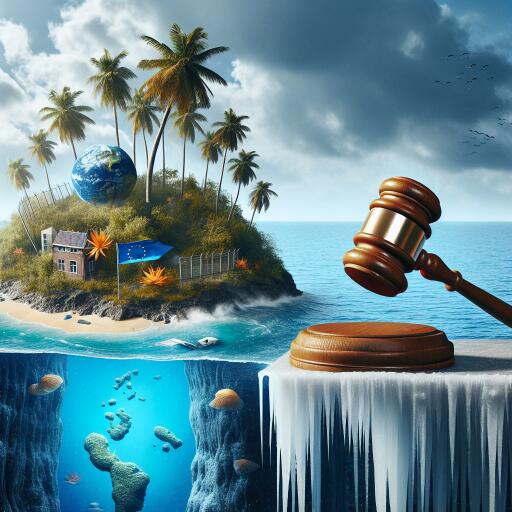
Caribbean Island Wins Groundbreaking Climate Lawsuit Against the Netherlands – EnviroLink Network
In a decision poised to reverberate far beyond the Caribbean, the island of Bonaire has prevailed in a climate lawsuit against the Netherlands, marking a watershed moment for climate justice. The case, brought by a small tropical territory against the European state that governs it, asserts that failing to prevent foreseeable climate harms violates fundamental human rights—a claim the court has now recognized.
Human rights at the center of climate responsibility
The court accepted the core premise that unchecked warming infringes on the rights of people living in places acutely exposed to rising seas, intensifying storms, and ecosystem collapse. Bonaire’s argument was grounded in a stark reality: communities that contribute the least to global emissions are among the first to face existential threats. In tropical regions like the southern Caribbean, scientific assessments project temperature increases approaching 6 degrees Fahrenheit by the end of the century without swift, far-reaching emissions cuts—an escalation with life-altering consequences for health, water security, infrastructure, and livelihoods.
By framing climate change as a rights-based issue rather than a purely environmental or economic one, the ruling underscores a growing legal consensus: governments have enforceable duties to protect those under their jurisdiction from foreseeable, preventable climate impacts. That obligation, the court signaled, does not dissolve with distance. Even when a territory lies across an ocean, its residents are entitled to protection and preparedness commensurate with the risks they face.
Why a small island’s case carries global weight
Bonaire’s victory establishes a powerful precedent: a tropical territory can hold its European administrator accountable for inadequate climate action. For island communities living with saltwater intrusion, eroding coastlines, coral reef decline, and more frequent costly storms, the decision validates long-standing calls for stronger adaptation and faster emissions cuts by wealthy nations. It recognizes the asymmetry at the heart of the crisis—where those least responsible bear the heaviest burdens—and translates that moral imbalance into legal obligations.
Island governments and civil society groups around the world are likely to study this judgment closely. It offers a legal pathway for other vulnerable territories and nations to assert their rights to protection, resilience funding, and robust emissions-reduction commitments. While each jurisdiction differs, the underlying principle—that climate inaction can breach human rights—now carries greater judicial weight.
A roadmap for courts—and governments
The ruling arrives amid a surge of climate litigation on every continent, with judges increasingly asked to weigh scientific evidence against constitutional and human rights guarantees. Courts have started to recognize that failing to anticipate and address well-documented climate risks can be unlawful. Bonaire’s case adds momentum to this trend and could influence how future courts consider heat risk, sea-level rise, and the cascading impacts of ecosystem loss on food, water, housing, and cultural heritage.
For policymakers, the implications are clear. Strategies that merely acknowledge climate threats without concrete, near-term measures to prevent or minimize harm may no longer withstand legal scrutiny. Governments responsible for distant territories—especially those historically shaped by colonial relationships—face heightened expectations to finance adaptation, harden infrastructure, protect nature-based defenses such as coral reefs and mangroves, and accelerate emissions reductions in line with scientific thresholds.
What this means for people on the front lines
Beyond legal doctrine, the decision speaks to the daily reality of islanders coping with warming seas and intensifying extremes. It signals that the courts can be a venue for communities seeking accountability and tangible protections—seawalls where appropriate, restored reefs and wetlands where they offer better value, updated building codes, early-warning systems, and plans to safeguard freshwater supplies. It also reinforces a deeper principle: the rights to life, health, housing, and culture do not end at the shoreline.
A turning point—if action follows
Bonaire’s success is both a legal milestone and a call to accelerate delivery. Precedent matters, but outcomes on the ground—where homes are rebuilt, ecosystems are restored, and emissions finally fall—are what will determine whether this judgment changes lives. If governments respond with ambition equal to the science, the decision could be remembered as a pivot point: the moment when the gap between climate promises and protections began to close for those standing in harm’s way.



Leave a Reply