

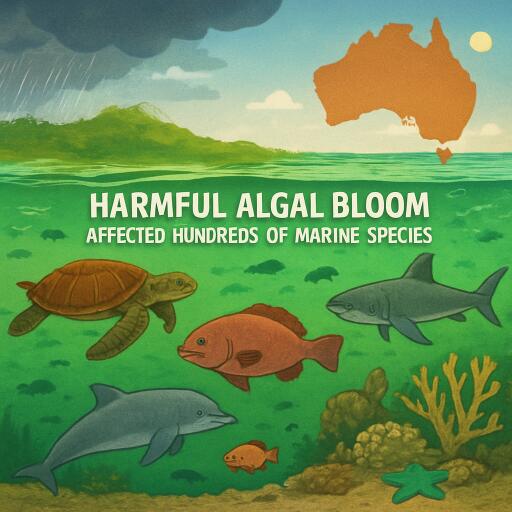
Australia’s harmful algal bloom affected hundreds of marine species, as scientists point to floodwater, upwelling and record ocean heat
A vast harmful algal bloom along South Australia’s coast has been linked to an unusual convergence of environmental pressures, with scientists concluding that flood-driven nutrient runoff, intense ocean upwelling and exceptionally warm seas combined to trigger the event.
After more than a year of investigation, researchers say the outbreak was not the result of a newly introduced organism. Instead, it appears a naturally occurring microscopic alga already present in local waters found the perfect conditions to expand into a large-scale ecological crisis.
How a common microbe became a major threat
The bloom was associated with algae from the Karenia group, including Karenia cristata, a species now understood to produce powerful toxins harmful to marine animals. Under normal conditions, these microorganisms are part of ocean ecosystems. But when temperature, nutrients and water movement align, their numbers can surge and toxic blooms can form.
Laboratory work by Australian researchers found this species to be exceptionally dangerous, with toxic effects appearing even at relatively low concentrations. That helps explain why the bloom had such a broad impact once it spread through coastal waters.
Three environmental triggers behind the bloom
Scientists identified three main drivers.
The first was floodwater from the 2023 River Murray event. Large floods wash nutrients such as nitrogen and phosphorus off the land and into the sea. Those compounds can boost marine productivity, but in excess they also act as fuel for fast-growing algae. Investigators found this nutrient enrichment was especially important in areas such as Waitpinga, where bloom activity was detected early.
The second factor was unusually strong coastal upwelling during 2023 and 2024. Upwelling occurs when deeper water rises to the surface, bringing additional nutrients from below. In moderation, this process supports productive marine food webs. In this case, it appears to have added another nutrient pulse to already enriched coastal waters.
The third driver was extreme ocean warmth. Southern Australia experienced a marine heatwave, and the elevated sea temperatures likely accelerated algal growth and helped the bloom persist. Warm water can reshape marine ecosystems in subtle ways, changing competition between species and altering how quickly microscopic organisms reproduce.
Researchers say it was the combination of these forces, rather than any single factor alone, that created ideal bloom conditions.
Damage across marine life
The consequences were severe. More than 400 marine species were affected, according to official assessments. The toll included fish, sharks, rays, molluscs, seahorses and many other forms of sea life. Birds and marine mammals were also reported stranded or washed ashore during the event.
The scale of the damage points to how potent toxic algae can be once they spread through food webs and nearshore habitats. Some species may have been harmed directly by toxins in the water, while others were affected through oxygen depletion or disruption to prey availability.
Beyond wildlife losses, the bloom also hit coastal economies. Fishing, aquaculture and tourism all faced disruption as marine conditions deteriorated, underlining how environmental shocks can rapidly become social and economic ones as well.
Why the event matters beyond one coastline
For marine scientists, the South Australian bloom is more than an isolated incident. It is a warning sign of how climate stress and changing land-sea interactions can combine to magnify natural biological processes.
Algae like Karenia are not unusual in themselves. What is changing is the backdrop: warmer oceans, shifting rainfall patterns, stronger extremes and altered nutrient delivery from flood events. When these pressures overlap, common organisms can become agents of major ecological disruption.
This pattern is increasingly important in a warming world. Marine heatwaves are becoming more frequent and intense, while heavy rainfall and flood events can move larger nutrient loads from catchments to coastal waters. At the same time, ocean circulation changes may influence where blooms form and how long they last.
Push for better monitoring and early warning
Researchers say the outbreak highlights the need for more predictive monitoring systems. While the science has clarified the main ingredients behind the bloom, important questions remain about how warming, nutrients and ocean dynamics interact in real time.
Improved surveillance could help authorities detect dangerous shifts earlier, giving fisheries, aquaculture operators and coastal communities more time to respond. Efforts are also underway in South Australia to strengthen research capacity focused on harmful algal blooms and their ecological effects.
The broader lesson is clear: harmful blooms are no longer just a seasonal marine hazard. Under intensifying climate and environmental pressure, they may become a more regular feature of coastal life unless monitoring, forecasting and ecosystem management improve.



Leave a Reply