

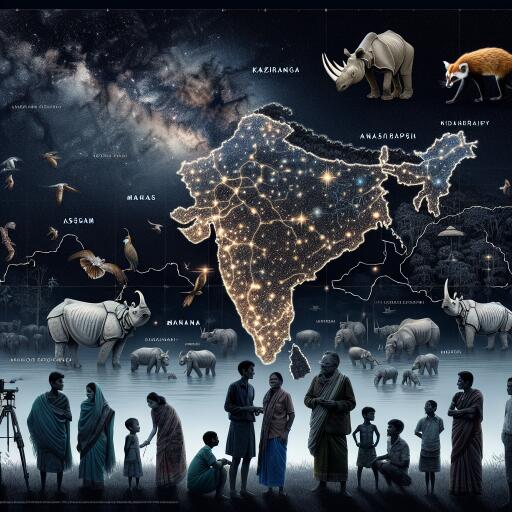
Kaziranga, Manas emerge as front-runners in Assam’s dark sky mission
Assam is gearing up to protect its nocturnal landscapes with an ambitious plan to establish certified dark sky parks and reserves—an effort designed to curb light pollution, spur astro-tourism, and safeguard wildlife that thrives under natural darkness. After an in-principle nod from the State Cabinet, officials have completed preliminary assessments across eight candidate locations, with Kaziranga and Manas National Parks, along with Dima Hasao, emerging as leading contenders.
Why it matters
Artificial light at night is rising worldwide, eroding star visibility and disrupting the behavior of nocturnal species, from owls and leopards to pollinating moths and bats. Reducing skyglow not only restores celestial visibility for stargazers and researchers, it also protects critical ecological processes and lowers energy use. For Assam, rich in biodiversity and scenic landscapes, this initiative blends environmental protection with innovation-led tourism.
Where the skies stay darkest
Preliminary sky quality analyses point strongly toward three sites. Kaziranga National Park registered approximately 94.62 percent of its landscape under near-pristine night conditions, followed by Manas at 92.51 percent and Dima Hasao at 87.05 percent. These findings—based on radiance stability and low artificial illumination—place the trio at the core of Assam’s proposed dark sky network.
What a dark sky park means
Dark sky parks are protected areas where outdoor lighting is managed to preserve natural night conditions. International exemplars show that careful lighting design can support both conservation and astro-tourism, enabling safe visitor experiences while minimizing impacts on wildlife. Officials note that Assam’s candidate sites already demonstrate favorable baselines, creating an opportunity to build a program that pairs astronomy-friendly infrastructure with habitat protection.
Policy and technology roadmap
The effort will coordinate multiple departments—science and technology, tourism, forest, power, and panchayat and rural development. Planned measures include:
- Retrofitting public lighting with fully shielded, downward-focused LEDs and warmer color temperatures.
- Deploying smart controls—dimming, motion-sensing, and timed curfews—especially in buffer zones.
- Community outreach to promote responsible lighting at homes, lodges, and roadside facilities.
- Strict zero-light protocols in core conservation areas, along with regulated night-time eco-tourism such as guided sky-viewing sessions.
Officials intend to study established models in India, including the Pench Tiger Reserve dark sky project in Maharashtra and the Hanle Dark Sky Reserve in Ladakh. Collaboration with the Indian Institute of Astrophysics is also under discussion to strengthen visitor experiences, build local capacity, and support data-driven monitoring.
Pressure points and early fixes
Not all surveyed areas fared equally. Sites such as Majuli, Pobitora, and parts of Dibru-Saikhowa and Orang show advancing skyglow linked to settlement growth, tourism infrastructure, and industrial lighting. Experts advise early intervention to prevent long-term degradation, including:
- Shielding and lumen caps for outdoor fixtures to eliminate upward light spill.
- Stricter zoning around sensitive habitats and migratory routes.
- Audits of commercial and hospitality lighting with tailored retrofit plans.
- Seasonal lighting guidelines during critical breeding, nesting, or migration periods.
Toward certification
The government plans to form an advisory committee and draft a lighting management plan aligned with international dark sky standards—an essential step for global recognition. The pathway, expected to take one to three years, includes baseline inventories of existing lighting, targeted retrofits, and multi-season sky quality monitoring. Training programs for local guides, accommodation providers, and park staff will support consistent practices across tourism and conservation operations.
Ecology meets astro-tourism
By tackling light pollution, Assam aims to unlock multiple benefits: healthier nocturnal ecosystems, reduced energy waste, safer and more sustainable tourism after dark, and new income streams for local communities through stargazing experiences. If implemented effectively, the initiative could turn the State into a regional hub for night-sky conservation and celestial tourism—anchored by the exceptional darkness of Kaziranga, Manas, and Dima Hasao.
Ultimately, the success of Assam’s dark sky mission will hinge on coordinated governance, evidence-based lighting design, and strong community participation. With the right mix of policy, technology, and public engagement, the State’s most iconic landscapes could soon be known not only for their wildlife, but also for some of the clearest night skies in South Asia.



Leave a Reply