

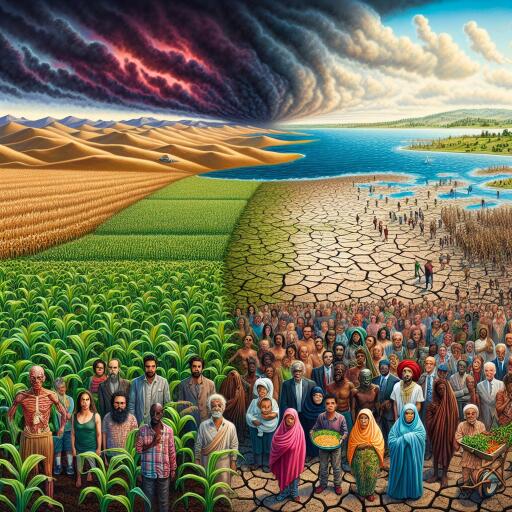
Climate change could expose 1.1 billion people to hunger by 2100 (but there’s good news too) – AI modelling study
Hunger is already surging. In 2025, more than 295 million people worldwide struggled to access enough food as conflict, displacement, extreme weather and economic shocks collided. New modelling now warns the risk could escalate dramatically by century’s end unless the world slashes greenhouse gas emissions and strengthens the systems that put food on people’s plates.
An artificial intelligence model developed to isolate the influence of climate change projects that, under a high-emissions future, more than 1.1 billion people alive today and yet to be born will experience at least one episode of severe food insecurity by 2100. Strikingly, the analysis suggests over 600 million of those exposed would be children.
What the model found
The modelling draws on long-term patterns in temperature and rainfall alongside country-level demographic and economic projections. Unlike many traditional forecasts, it does not rely on detailed assumptions about household incomes, food prices or policies—factors that are both hard to measure across all regions and highly uncertain over decades. Instead, it focuses on how climate signals align with documented food crises and then projects those relationships into plausible futures.
The results are sobering:
- Global exposure to severe food insecurity has accelerated, rising from around 50 million people in 2011 to nearly 150 million by 2020.
- In a high-emissions pathway, the cumulative number of people who will live through at least one severe food crisis surpasses 1.16 billion by 2100.
- Children face disproportionate risk: more than 600 million are projected to encounter their first crisis before age five, and over 200 million during their first year of life.
Where the burden falls
The heaviest toll is expected in regions already navigating climate extremes and structural vulnerabilities. Africa and Asia dominate future hotspots, with particularly intense exposure in the Horn of Africa and the Sahel. Under a high-emissions trajectory, the model estimates that in 2099 alone more than 170 million people in Africa could be pushed into crisis—comparable to the combined populations of several major European countries today.
These hotspots are not small, isolated pockets. The analysis suggests they could merge into expansive zones stretching across eastern and central Africa, where compounding climate stress, rapid population growth and limited safety nets converge.
The good news: policy choices matter
The modelling also highlights a powerful counterfactual: swift decarbonisation and a transition toward sustainable development could more than halve exposure. Under such a path, the average number of people experiencing food crises each year could fall by over 50%—from roughly 89 million (2005–2015 average) to around 42 million by 2090–2100.
For Africa, the potential gains are especially significant. If conflict declines, fossil fuel use is curtailed, and climate adaptation scales up, the continent’s exposure could drop rapidly after mid-century. In this scenario, Africa’s room to improve outcomes appears larger than Asia’s, given the sizable reductions possible through mitigation and peacebuilding.
Why children are so exposed
Demographics magnify the risk. Many of the regions where climate impacts are intensifying also have youthful, fast-growing populations. That means a larger share of the people who will face tomorrow’s food crises have not yet been born—and many will be in their earliest, most vulnerable years when shocks hit. Early-life food insecurity has lifelong consequences, from stunting and impaired cognitive development to heightened susceptibility to disease.
Preparing food systems for a hotter, harsher world
The findings reinforce a crucial point: averting hunger is not solely about producing more calories. Climate-resilient food security depends on:
- Diversified, shock-resistant supply chains that can withstand droughts, floods and heatwaves.
- Early warning systems and social protection that reach people before crises peak.
- Investment in water management, climate-smart agriculture and locally adapted seed systems.
- Conflict prevention and peacebuilding, which are essential for stable access to land, markets and assistance.
- Inclusive participation—especially of women, smallholder farmers and Indigenous communities—in food governance and adaptation planning.
A narrowing window
Climate change is a risk multiplier. It does not act in isolation, but it can turn existing fragilities into full-blown emergencies. The modelling makes clear that today’s policy choices will determine whether hundreds of millions face severe hunger—or whether that future is decisively averted.
Rapid emissions cuts, coupled with equitable development and conflict reduction, could spare up to 780 million people from severe food crises by the end of the century. The alternative—inaction or half measures—would lock in avoidable suffering on a staggering scale.
Time is short, but the path is clear: decarbonise quickly, build resilient and fair food systems, and invest in peace and adaptation. Doing so can help ensure that tomorrow’s children inherit a world where food security is not a privilege, but a right.



Leave a Reply