

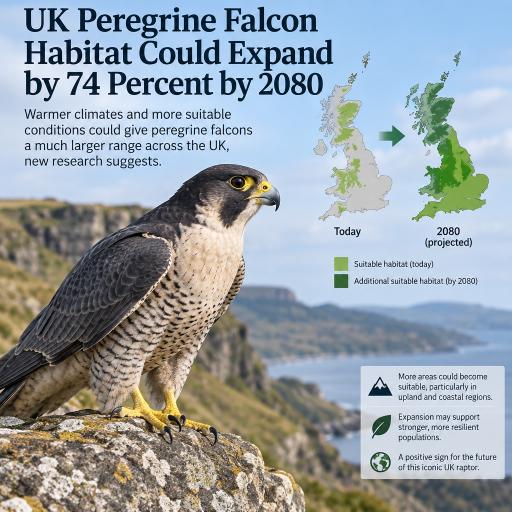
UK Peregrine Falcon Habitat Could Expand by 74 Percent by 2080
Climate change could significantly enlarge the area of the United Kingdom offering suitable conditions for peregrine falcons, according to new ecological modeling. Under a high-emissions scenario, potentially viable territory for the species may increase by almost 74 percent by 2080.
The findings do not necessarily mean peregrine numbers will rise at the same rate. Climate suitability is only one factor shaping bird populations, while prey availability, nesting sites, disease, habitat quality and human activity will continue to determine whether the falcons can occupy newly favorable areas.
A changing landscape for Britain’s fastest bird
Peregrine falcons are highly adaptable predators found on coastal cliffs, upland crags and, increasingly, tall urban structures. The UK currently supports an estimated 1,750 to 1,800 breeding pairs, but the population has faced substantial pressure in recent decades.
Monitoring estimates suggest the breeding population fell by 57 percent between 1995 and 2024. Illegal killing, reduced prey availability and outbreaks of avian influenza are among the threats associated with that decline.
Researchers assessed future habitat suitability for 16 raptor species breeding in the UK. Their models incorporated 14 environmental variables, including temperature, rainfall, elevation and the proportion of different land-cover types. Projections were then calculated using a moderate emissions pathway and a much higher emissions pathway.
Peregrine habitat was estimated at approximately 110,257 square kilometres under present conditions. In the moderate scenario, suitable territory could reach about 155,000 square kilometres by 2060, an increase of 40.6 percent. Under the high-emissions pathway, it could expand to 191,319 square kilometres by 2080—73.5 percent above the current estimate.
Some raptors could gain while others retreat
Hen harriers were also projected to benefit from shifting environmental conditions. Their suitable area could grow from around 74,835 square kilometres today to 96,025 square kilometres by 2060 in the moderate scenario. By 2080, the high-emissions projection places the total at approximately 105,553 square kilometres, representing a 41 percent increase.
Smaller gains were projected for golden eagles, little owls, long-eared owls, barn owls and marsh harriers. Common buzzards, sparrowhawks and tawny owls showed comparatively little change across the modeled scenarios.
Other birds of prey face a markedly different future. Suitable conditions for short-eared owls, red kites, merlins and goshawks could contract as Britain’s climate changes. The results illustrate how warming may reorganize raptor communities rather than producing a uniform benefit or loss.
White-tailed eagle habitat at particular risk
The most severe projected decline concerns the white-tailed eagle. The model estimated that around 2,306 square kilometres are currently environmentally suitable for the species. That area could fall to 444 square kilometres by 2060 under the moderate pathway, a reduction of more than 80 percent.
By 2080, a high-emissions future could leave only 65 square kilometres of suitable territory—97.2 percent less than today. Such a sharp contraction could complicate ongoing efforts to restore this large eagle to parts of its former British range.
Suitable climate does not guarantee recovery
Britain’s raptors have already experienced major human-driven changes. During the 20th century, persistent agricultural pesticides accumulated through food chains and caused widespread reproductive failure among predatory birds. Restrictions on these chemicals helped many species recover, but modern pressures remain.
Expanded climatic suitability for peregrines will have limited value if birds continue to be shot, trapped or poisoned, or if nesting and feeding habitats deteriorate. Collisions with energy infrastructure may create additional risks, particularly where new developments overlap with flight paths and hunting territories.
Conservation planning will therefore need to look beyond maps of future climate. Protecting nesting areas, maintaining healthy prey populations and connecting fragmented habitats could help raptors adjust as suitable zones move. Wind turbines and power lines will also require careful siting and mitigation to reduce avoidable deaths.
The projections present peregrine falcons as a possible beneficiary of Britain’s changing climate, but the broader picture is more complex. Even as one species gains potential territory, another may lose nearly all of it. Cutting greenhouse gas emissions while addressing persecution, disease and habitat degradation will be essential if the UK is to retain a diverse community of birds of prey.



Leave a Reply