

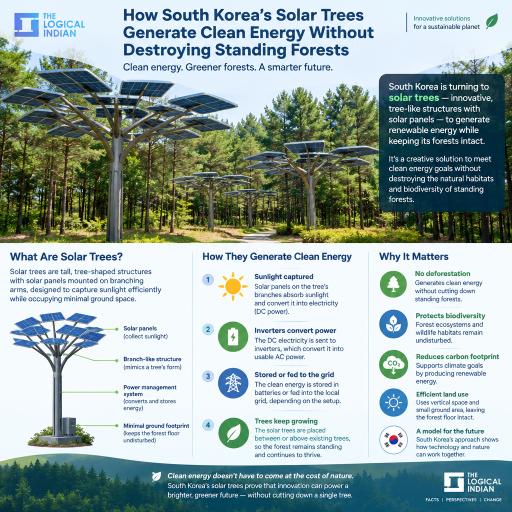
How South Korea Solar Trees Generate Clean Energy Without Destroying Standing Forests
As countries speed up their shift to renewable energy, solar power is expanding across landscapes that are often already under ecological pressure. One of the biggest challenges is land use. Large solar farms need wide, open spaces, and in heavily forested or mountainous regions, that can mean cutting trees, disturbing wildlife habitat, and weakening natural carbon storage.
In South Korea, where usable flat land is limited and forests cover much of the terrain, this conflict has become especially visible. Conventional solar installations on slopes and hills have raised concerns because they can require significant forest clearance. That creates an uncomfortable paradox: producing low-carbon electricity by damaging ecosystems that already help fight climate change.
To address this problem, researchers have been exploring a different kind of solar design known as the “solar tree.” Instead of spreading panels across cleared ground, this concept lifts photovoltaic modules onto tall vertical structures shaped in a branching pattern. The idea is to generate electricity above or around existing woodland rather than replacing it.
A Solar Structure Inspired by Nature
Solar trees are designed to imitate some of the spatial logic of real trees. Rather than forming one wide, flat blanket over the land, the panels are arranged on elevated supports at different angles. This allows sunlight to be captured from multiple directions while leaving much of the ground below undisturbed.
That design matters in forested environments. Traditional ground-mounted systems usually require clearing vegetation to prevent shading and to make way for roads, foundations, and maintenance access. A vertical or elevated setup can reduce that burden by minimizing the footprint at ground level and allowing the surrounding canopy and understory to remain largely intact.
What the Research Found
Using detailed 3D modeling and satellite-based landscape analysis of mountainous areas, South Korean researchers compared standard solar farms with carefully spaced solar tree layouts. The simulated results showed a major difference in environmental impact.
Conventional solar arrays installed on sloped, wooded terrain were associated with extensive biomass loss because trees had to be removed across most of the site. By contrast, the solar tree approach preserved nearly all of the surrounding forest cover in the modeled scenarios.
What makes this especially notable is that the cleaner land-use profile did not come with a dramatic energy penalty. Because elevated panels can be positioned at several tilt angles and are less constrained by row-to-row shading on the ground, projected electricity output remained broadly competitive with more familiar flat-panel systems.
Why Keeping Forests Standing Matters
The environmental value of this idea goes well beyond appearances. Forests are not empty land waiting for development. They absorb carbon dioxide, stabilize steep soils, reduce erosion, regulate water flows, and provide habitat for plants and animals. In places vulnerable to intense rain and landslides, removing tree cover can trigger long-term consequences that stretch far beyond the footprint of a power project.
By keeping forests in place, elevated solar systems may offer a rare dual benefit: energy generation and ecosystem protection in the same landscape. Sunlight and rainfall can still reach much of the forest floor, which helps maintain natural vegetation and ecological processes under and around the structures.
This could be especially important for countries and regions where land is scarce, forests are ecologically sensitive, and the pressure to expand renewable energy is rising quickly.
A Model for Land-Constrained Regions
South Korea’s experiment with solar trees highlights a broader global issue. The energy transition is not only about replacing fossil fuels; it is also about deciding how new infrastructure fits into already stressed environments. Mountainous nations, island territories, and densely populated countries often face difficult trade-offs between energy security, food production, biodiversity, and forest conservation.
In that context, elevated solar systems present an alternative worth watching. They may be particularly useful in hilly districts, peri-urban green zones, transport corridors, or degraded sites where preserving existing vegetation is a priority. Rather than treating nature as an obstacle to energy development, this approach tries to design around it.
The Challenges Ahead
Despite the promise, solar trees are not a simple drop-in replacement for standard solar farms. Building tall, stable support structures in rugged landscapes requires stronger engineering and likely higher upfront costs. Wind resistance, structural safety, installation logistics, and long-term maintenance all become more complex when panels are lifted high above the ground.
There are also ecological questions still to answer. Even if forests remain standing, construction activity can disturb wildlife, compact soils, or alter local microclimates. Researchers will need field trials to understand how these systems perform outside simulations and how forest vegetation responds over time to changes in light and access.
Maintenance may also be more demanding than with low-mounted solar arrays. Specialized equipment and careful operational planning would be needed to inspect, clean, and repair panels without causing unnecessary damage to the surrounding ecosystem.
Rethinking “Green” Infrastructure
The significance of solar trees lies in the message behind the technology. Clean energy cannot be judged only by the electricity it produces. A project may be low-carbon in operation yet still impose heavy ecological costs if it destroys forests, fragments habitats, or destabilizes landscapes during construction.
South Korea’s solar tree concept suggests that renewable infrastructure can be designed with more ecological intelligence. If further testing supports the early findings, this model could help demonstrate how countries can add solar capacity without sacrificing some of their most valuable natural assets.
As climate goals grow more urgent, solutions that combine decarbonization with land conservation will become increasingly important. Solar trees may not solve every siting problem, but they offer a compelling example of how technology can adapt to nature instead of forcing nature to adapt to technology.



Leave a Reply