

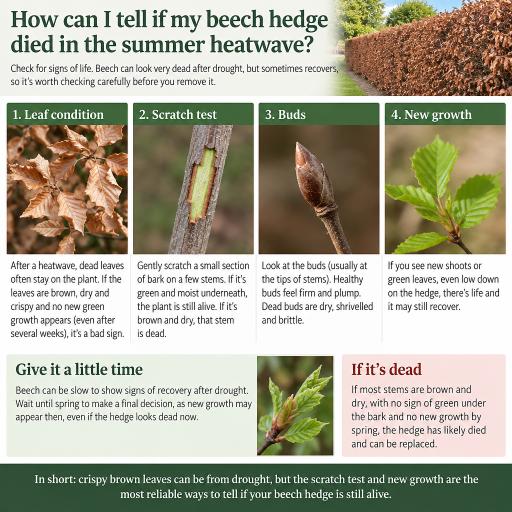
How can I tell if my beech hedge died in the summer heatwave?
Newly planted beech hedges are particularly vulnerable to hot, dry weather. Bare-root plants have limited time to rebuild their root systems before producing leaves, so an early heatwave can cause severe water stress even when gardeners irrigate regularly.
Climate change is making spring conditions less predictable, with warmer temperatures and longer dry spells narrowing the period in which bare-root hedging can establish safely. However, a beech plant that looks lifeless is not necessarily dead. Some stressed plants remain dormant or lose their leaves to conserve moisture before recovering.
How to check whether a beech plant is alive
Examine each plant individually rather than judging the hedge as a whole. Use the following checks:
- Scratch the bark: Gently scrape a very small area of bark on a young stem with a fingernail. Green, moist tissue underneath indicates that the plant is still alive. Brown, grey or dry tissue may mean that section has died. Repeat the test lower down the stem before deciding to remove the plant.
- Test the branches: Living twigs usually bend slightly, while dead ones are dry and snap easily. Check several branches because the upper growth may have died while the base remains viable.
- Look for buds: Healthy buds should feel firm. Shrunken, brittle buds and completely grey stems are warning signs.
- Check stability: A plant that rocks noticeably in the soil may not have developed new roots. Gently tug it rather than pulling hard. If it lifts out easily and has no fine, pale roots, it is unlikely to recover.
If there is green tissue near the base, leave the plant in place and give it more time. Remove dead upper branches with clean secateurs, cutting back to healthy wood. Beech can sometimes produce new shoots from lower buds after drought damage.
When should dead plants be replaced?
Replace failed plants while they are dormant, generally from late autumn to early spring, provided the ground is not frozen, flooded or unusually dry. Planting during cool, moist conditions reduces water loss and gives roots time to develop before warmer weather returns.
Where increasingly erratic springs are common, autumn planting can offer an advantage because the soil is usually still warm enough for some root growth while rainfall is more dependable. Avoid planting immediately before a forecast warm or dry period.
Choose smaller replacement plants
Large specimens may offer instant height, but their reduced root systems can struggle to support substantial top growth. Younger bare-root beech plants measuring approximately 60–90cm often establish more reliably and can catch up with larger plants within a few growing seasons.
For a single-row hedge, allow about three plants per metre. A denser double row can use roughly five plants per metre, arranged in a staggered pattern with around 30cm between neighbouring plants. Match the existing layout so the repaired section develops evenly.
Planting replacements safely
- Keep bare roots cool, shaded and covered until planting. Never allow them to dry out.
- Soak the roots in water immediately before planting, but do not leave them submerged for an extended period.
- Remove weeds and grass around the planting position, as they compete strongly for moisture.
- Use a garden fork and work carefully near surviving plants to avoid severing their young roots.
- Set each replacement at the same depth at which it previously grew. A change in colour on the stem often marks the original soil level.
- Spread the roots naturally, refill the hole and firm the soil gently to remove large air pockets.
- Water thoroughly after planting.
Helping the hedge survive future heat
Apply a layer of organic mulch around the plants to conserve moisture, suppress weeds and moderate soil temperature. Keep mulch a few centimetres away from the stems to reduce the risk of rot.
During dry periods, water slowly and deeply rather than giving frequent light sprinklings. Deep watering encourages roots to grow down into cooler soil. Check moisture below the surface before irrigating, as the top layer can appear dry while the root zone remains damp. Continue monitoring the hedge closely during its first two growing seasons, when it is least resilient to drought.



Leave a Reply