

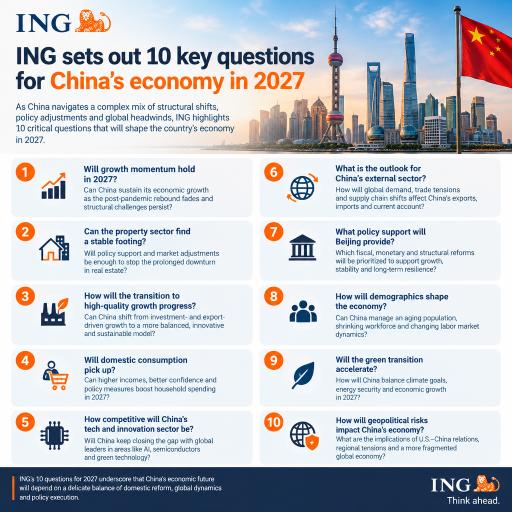
ING sets out 10 key questions for China’s economy in 2027
China is heading into 2027 with its technology industries and export sector still providing momentum, while weak household spending and a prolonged property adjustment weigh on the broader economy. ING projects gross domestic product growth of about 4.5% for the year.
The outlook can be framed around 10 major questions covering Beijing’s growth ambitions, international trade, domestic demand, property, inflation, fiscal and monetary policy, the yuan, government bonds, artificial intelligence and the country’s longer-term economic transformation.
1. Will Beijing adopt a lower growth target?
China’s official objective could be set near 4.5%, following a target range of 4.5% to 5% in 2026. Such a move would acknowledge structural constraints while leaving room for policies designed to stabilize activity rather than deliver a large stimulus-led expansion.
2. Can exports remain a reliable engine?
Exports are expected to record high-single-digit growth, helped by international demand for technology products and advanced manufacturing. However, the sector remains exposed to renewed friction with the United States and the European Union, particularly over industrial subsidies, market access and China’s expanding trade surplus.
3. When will household consumption improve?
Domestic spending remains one of the economy’s clearest weaknesses. Retail sales rose only 1.1% over the first nine months of 2026, amid cautious consumer sentiment and limited wage growth. A moderate recovery is possible in 2027, but a sustained rebound will depend on stronger incomes and greater household confidence.
4. Is inflation set to return?
Consumer inflation is forecast to reach approximately 1.1% in 2027. Although this would represent an improvement, it would remain subdued by international standards and reflect the continuing imbalance between China’s strong production capacity and softer domestic demand.
5. Has the property downturn reached its final stage?
The decline in real estate activity may become less severe, but a rapid recovery appears unlikely. Unsold housing inventories, restrained investment and cautious buyers will continue to limit construction and related industries. The property market’s reduced contribution also leaves policymakers searching for new sources of growth.
6. How much fiscal support will be available?
China could set its fiscal deficit target at close to 4% of GDP. Government spending is likely to focus on economic stabilization, strategic industries and infrastructure, although policymakers will need to balance stimulus against concerns about local-government debt and inefficient investment.
7. Will monetary policy become more supportive?
The People’s Bank of China is expected to reduce interest rates by 10 basis points. This modest cut would provide additional support without signaling aggressive monetary easing, which could increase financial risks or create unwanted pressure on capital flows.
8. Can the yuan continue to strengthen?
ING forecasts that the yuan will appreciate to 6.50 against the US dollar by the end of 2027. The path is unlikely to be smooth, however, with trade disputes, global interest-rate expectations and changes in investor sentiment potentially producing greater currency volatility.
9. What lies ahead for government bonds?
Chinese sovereign debt may face selling pressure if confidence in economic growth improves and investors shift toward riskier assets. The yield on the benchmark 10-year government bond is projected to rise to 1.9%.
10. Will artificial intelligence create more opportunities than disruption?
Investment in artificial intelligence has reinforced China’s manufacturing capabilities and supported technology exports. Automation may nevertheless reduce the availability of entry-level positions, creating a difficult policy challenge as the country seeks both higher productivity and sufficient employment for younger workers.
Clean technology advances, but demand remains the missing link
China continues to make substantial progress in advanced manufacturing, digitalization and renewable energy. Its strength in solar power equipment, batteries, electric vehicles and other low-carbon technologies places the country at the center of the global energy transition.
Yet industrial success has not produced an equivalent rise in household consumption. Strengthening domestic demand will therefore be crucial in 2027—not only for economic stability, but also for reducing dependence on overseas markets as China’s trade surplus attracts closer scrutiny from major trading partners.



Leave a Reply