

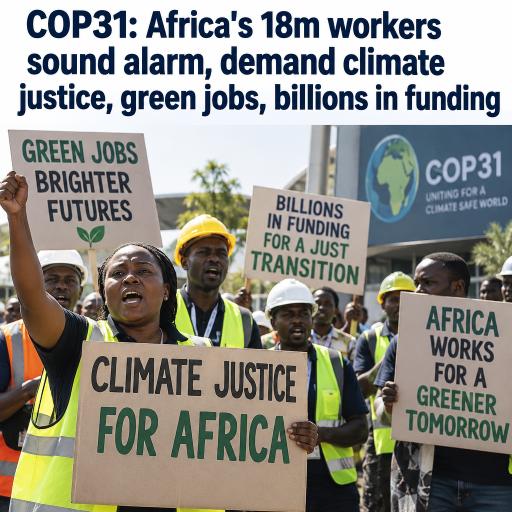
COP31: Africa’s 18m workers sound alarm, demand climate justice, green jobs, billions in funding
African trade unions are pressing world leaders to ensure the continent’s shift to a low-carbon economy delivers reliable electricity, secure employment and economic development rather than debt, job losses and a new wave of resource exploitation.
Ahead of COP31, the Africa Regional Organisation of the International Trade Union Confederation (ITUC-Africa), which represents about 18 million organised workers across 52 countries, has set out five priorities for a worker-centred energy transition.
Its central message is that cutting greenhouse gas emissions cannot be separated from labour rights, social protection and the fair distribution of costs and benefits. Workers and affected communities, it argues, must help shape climate policies instead of being consulted only after major decisions have been taken.
Electricity as a development right
The unions want universal access to affordable, dependable and clean electricity to be treated as a public responsibility. Governments are being urged to reinforce public utilities, modernise power infrastructure and involve workers and communities in decisions concerning tariffs, investment and service delivery.
They also warn against financing arrangements that leave governments and taxpayers carrying most of the risk while private investors receive guaranteed returns. Energy reform, the organisation says, should improve public welfare and productive capacity rather than deepen inequality.
Climate finance without another debt crisis
Climate funding is another major concern. ITUC-Africa is calling on wealthier nations to provide new, predictable and sufficient support, with an emphasis on grants and highly concessional public finance. African countries should not have to borrow heavily to confront a climate emergency they contributed relatively little to creating.
The labour movement also wants the Loss and Damage Fund to receive adequate resources and to deliver assistance directly to countries and communities facing floods, droughts, extreme heat, coastal erosion and other climate-related harms.
Additional resources could be raised through debt relief, progressive taxation and windfall levies on exceptional profits in extractive industries. Stronger efforts to curb tax avoidance and illicit financial flows are also considered essential for financing climate programmes and public services.
No worker left behind
As economies reduce their dependence on fossil fuels, unions are demanding binding protections for people employed in industries likely to be restructured, downsized or closed. They want COP31 to strengthen international just-transition arrangements and provide countries with finance, technical assistance and institutional support.
Proposed safeguards include assessments of how climate policies will affect employment, alongside retraining, skills development, redeployment and job or income guarantees. Governments should also provide universal social protection and enforce occupational health and safety standards throughout emerging green industries.
Women, young people, migrants and informal workers may face disproportionate risks and therefore require targeted protection. Trade unions insist that affected workers must have a formal role in negotiations over industrial closures and economic restructuring.
Turning green resources into African industries
The global expansion of renewable energy could support a new era of African industrialisation, but only if countries move beyond exporting unprocessed minerals. The unions are seeking investment in local mineral processing, renewable-energy components, research, manufacturing and technical skills.
Technology transfer and greater African participation in higher-value supply chains are also central to the demands. Projects involving renewable power and critical minerals should create decent local jobs while meeting strict environmental and labour standards.
Without such measures, the green economy could reproduce an old pattern in which raw materials leave the continent while much of the wealth, technology and industrial activity is generated elsewhere. Climate action, the unions argue, must change that model rather than simply rebrand it.
A permanent seat for labour
ITUC-Africa is seeking institutionalised trade union representation in national energy planning, climate-finance oversight, regulatory bodies, just-transition commissions and African delegations to COP31.
This participation should go beyond occasional public consultations. Labour representatives want meaningful influence over decisions that determine jobs, investment, industrial policy and the future of local economies.
The organisation has also proposed a structured engagement process involving trade unions, the African Union and regional economic blocs. Such a mechanism would help incorporate workers’ priorities into continent-wide climate and energy strategies.
Ultimately, the unions want governments and international partners to replace broad declarations with funded commitments that have clear deadlines and measurable outcomes. For Africa’s workers, a credible transition must expand electricity access, generate secure employment, protect incomes and advance economic justice—with communities helping to direct the transformation rather than having it imposed on them.



Leave a Reply