

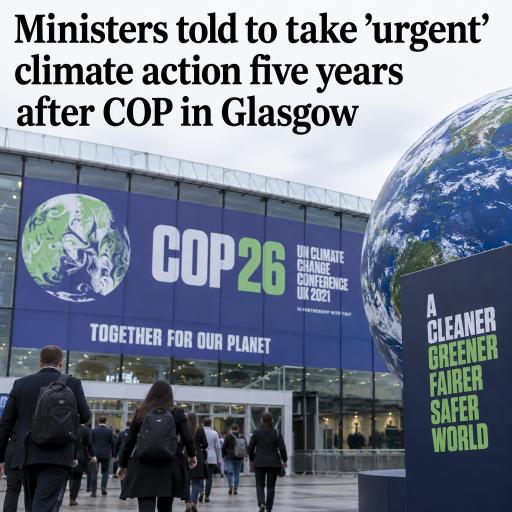
Ministers told to take ‘urgent’ climate action five years after COP in Glasgow
Scottish ministers are facing renewed calls to accelerate the transition away from fossil fuels, five years after Glasgow hosted the COP26 climate summit.
As international negotiations resume at the latest United Nations climate conference in Turkey, environmental campaigners are questioning whether the commitments and political momentum generated in Glasgow have produced sufficient change.
COP26 brought world leaders, climate activists and environmental organisations to Scotland in 2021. The gathering was presented as a defining opportunity to strengthen global efforts to cut greenhouse gas emissions and limit rising temperatures.
Since then, Scotland has endured periods of exceptional heat, destructive flooding, prolonged dry weather and increasingly serious wildfires. WWF Scotland argues that these events demonstrate how climate disruption is already affecting communities, public services, businesses and household finances.
The organisation has warned that progress on reducing emissions is losing momentum. While some parts of the economy are cutting their climate impact, improvements have reportedly slowed in certain sectors and stalled in others.
WWF Scotland director Lang Banks said the country must confront its continuing dependence on oil and gas while investing more rapidly in clean energy, energy-efficient homes and environmental restoration.
“The impacts of climate change are no longer something to worry about in the future — they’re here and now and hitting us all in the pocket,” he said.
Extreme weather increases pressure for action
A series of damaging weather events has intensified concern about Scotland’s preparedness for a changing climate. Storm Babet caused severe flooding in Angus and north-east Scotland in 2023, while Storm Éowyn brought a rare red weather warning in January 2025. Gusts exceeding 100mph were recorded in some locations.
In 2025, a wildfire on Dava Moor burned for four days and affected an estimated 29,225 acres across the Highlands and Moray. It was classified as the United Kingdom’s first officially recorded “megafire”.
Scotland then experienced its driest January-to-April period in more than six decades during 2026. A summer wildfire in the Cairngorms prompted evacuations near Glenmore and Loch Morlich, affecting homes, businesses and visitor accommodation.
Campaigners say such emergencies underline the need to reduce emissions while also strengthening resilience to heat, drought, fire and flooding.
Budget measures sought
Attention is now turning to the Scottish Budget, where ministers are being urged to provide practical and sustained financial support for climate action.
Proposed priorities include helping households replace expensive gas and oil heating, improving insulation and making homes warmer and more energy efficient. These measures could lower emissions while protecting residents from volatile energy costs.
WWF Scotland is also seeking stronger assistance for farmers to adopt practices that protect soils, wildlife and water while supporting a secure food system. In addition, it wants long-term funding for restoring damaged habitats and preparing communities for worsening climate hazards.
Banks described these policies as essential investments rather than optional spending, arguing that Scotland’s future prosperity, security and public wellbeing depend on action being taken now.
Government highlights mitigation and adaptation
The Scottish Government acknowledged that climate change is already causing serious harm, pointing to recent wildfires as evidence of the growing threat.
It said its strategy has two central aims: adapting Scotland to changes caused by historic emissions and continuing to lower current emissions to prevent even greater damage in the future. Ministers maintain that the country’s climate and adaptation plans contain policies intended to advance both objectives.
The government also said Scotland continues to participate in international discussions on climate change and biodiversity. Its priorities include securing investment, promoting climate justice and increasing recognition of the role that regional and devolved governments can play.
Scottish representatives have additionally supported international work on financial assistance for places suffering irreversible climate damage, debt justice and improved access to climate funding.
Campaigners, however, insist that international advocacy must be matched by faster delivery at home. Five years after Glasgow became the centre of global climate diplomacy, they say the lasting value of COP26 will ultimately be judged by emissions cuts, warmer homes, restored ecosystems and communities better protected from extreme weather.



Leave a Reply