

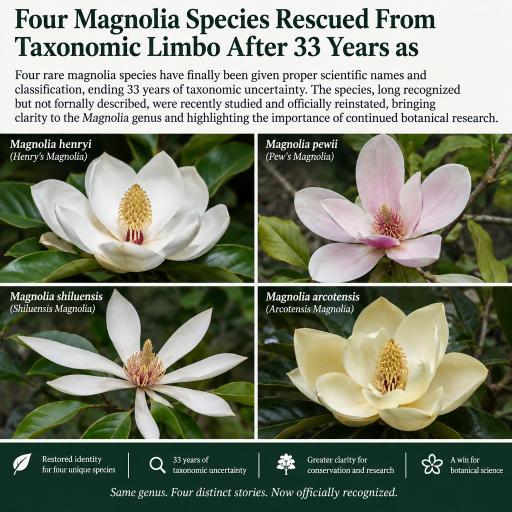
Four Magnolia Species Rescued From Taxonomic Limbo After 33 Years as Synonyms
For more than three decades, four rare magnolia relatives from Asia were effectively erased from view by a taxonomic decision that treated them as the same species. Now, a fresh re-examination of preserved specimens and historical records has restored these plants as distinct species, a correction that could reshape urgent conservation efforts for some of the region’s most vulnerable trees.
The species had long been folded into a single name linked to a tree from Myanmar. That merger, made in the early 1990s, went largely unchallenged for years. But a detailed comparison of museum and herbarium material has now shown that the four plants differ so clearly in structure, size, and habitat that they cannot reasonably be regarded as one and the same.
The revised study returns the species to separate standing and places them within the modern genus Magnolia, reflecting current classification of the magnolia family. The reinstated trees are now recognized as Magnolia pachycarpa, Magnolia tignifera, Magnolia uniflora, and Magnolia magnificentia, the last of these receiving a new name because its former one could not legally be reused under botanical naming rules.
A long-standing mistake with serious consequences
The original decision to merge these trees under one species name had sweeping effects. Once they were treated as synonyms rather than valid species, they largely disappeared from scientific and conservation attention. In practical terms, that meant no one was assessing each one separately in the wild, even though their populations, ranges, and ecological needs may be very different.
Taxonomic revisions are normal in botany, but this case appears especially damaging because some of the synonymies were made without clear explanation. The recent reassessment found that several key traits had been overlooked or misread. In one case, a comparison had relied on floral characters from a species whose flowers were never properly documented in the first place.
This matters because taxonomy is not just about labels. Species names guide conservation listings, seed banking, botanic garden collections, and even genetic research. If a rare tree is hidden under the wrong name, it can be missed entirely by protection programs.
How the species were separated again
Researchers revisited specimens preserved in herbaria and libraries across several countries, comparing leaf shape, hairiness of twigs and flower stalks, fruit structure, number of floral parts, and elevation records. These details may sound minor, but in plant science they are often decisive.
One of the restored species, now called Magnolia magnificentia, stands apart through a suite of consistent features, including hairy branchlets and reproductive structures, differently shaped leaves, more numerous leaf veins, and differences in ovule counts. It also appears to grow at higher elevations than the Myanmar species it had been confused with.
Magnolia pachycarpa is another striking example. It is a very large tree that can reach around 40 meters in height, with thick, leathery leaves and a fruiting structure unlike that of the species it was once lumped with. The true Myanmar tree is smaller, bears different floral arrangements, and has fruits with a different number of carpels.
Magnolia tignifera can be distinguished by its hairy young twigs, layered tepals, and woolly fruiting stalks. Magnolia uniflora, known only from an old historical collection, is described as a giant tree with strongly scented flowers borne singly at the tip of a branchlet.
Why one species needed a new name
Three of the restored plants could simply be transferred into Magnolia while keeping their old species epithets. But the species once known as Michelia magnifica faced a naming obstacle: the combination Magnolia magnifica had already been used for a fossil plant long ago. Under the rules of botanical nomenclature, duplicate names are not allowed, so a replacement was necessary. The chosen new name, Magnolia magnificentia, preserves the sense of grandeur associated with the original.
Conservation assessments may now need rewriting
The taxonomic confusion has likely distorted conservation planning for years. What had been treated as one endangered species actually appears to be several separate lineages, each with its own distribution and level of risk. That means previous Red List-style assessments may have combined unrelated populations under a single label.
This is especially troubling because the true Myanmar species may not even occur in some Chinese sites where it had been reported. If so, plants counted under that name in China could belong to other species entirely. In biodiversity terms, that changes everything: range size, population estimates, rarity, and extinction risk all depend on correct identification.
The findings also raise questions about past genetic studies. Trees growing in botanical collections under one name may in fact represent a different species, while wild trees sampled elsewhere may include multiple species or even hybrids. If specimens are misidentified, molecular analyses can produce misleading evolutionary conclusions.
Trees on the brink
The picture that emerges is alarming. Magnolia magnificentia is thought to survive as only a tiny wild population near its original locality in western Yunnan, and there are concerns that it may already have disappeared from some known sites. Reports have also suggested poor seed production and weak germination.
Magnolia pachycarpa appears to persist in southeastern Yunnan, but field surveys have found only a handful of mature trees. Magnolia tignifera is known from northern Vietnam and may also occur in parts of Yunnan. The most mysterious of the group, Magnolia uniflora, is known only from a collection made in the 19th century and may already be extinct in the wild.
The restoration of these species is therefore more than a taxonomic housekeeping exercise. It is a warning that hidden biodiversity can slip toward extinction when scientific names conceal rather than reveal biological reality.
A broader lesson for biodiversity science
This case highlights a wider problem in conservation biology: when species are incorrectly merged, their ecological identity vanishes. That can mask local endemism, bury small populations within broader estimates, and postpone emergency action until it is too late.
For magnolias, a plant group already under heavy pressure from habitat loss and fragmentation, accurate taxonomy is essential. The rediscovery of these four species as distinct entities may be the first step toward targeted surveys, proper threat assessments, and, with luck, recovery plans.
After 33 years in taxonomic shadow, these trees have their names back. The pressing question now is whether enough of them remain in forests and living collections to secure their future.



Leave a Reply