

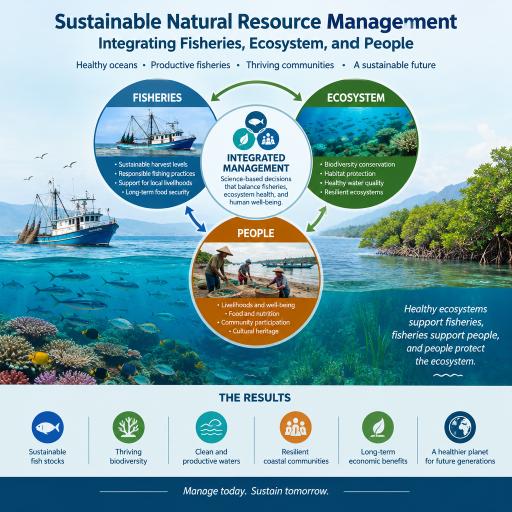
Sustainable Natural Resource Management: Integrating Fisheries, Ecosystem
Managing nature as if forests, rivers, fisheries, soils, and biodiversity were separate problems is becoming increasingly risky. As climate pressures intensify and ecosystems lose resilience, experts are pushing for a more connected model—one that treats natural resources as parts of a single living system rather than isolated assets to be regulated one by one.
This shift reflects a growing reality: older management models were built for slower, more predictable environmental change. Today, governments and communities face overlapping crises, from depleted fish stocks and polluted waterways to habitat loss, extreme weather, and rising demand for food, energy, and raw materials. In that context, fragmented decision-making is no longer enough.
Why integrated resource management matters
Natural resources fall into two broad groups. Renewable resources—such as freshwater, forests, wind, and solar energy—can recover over time if use remains within ecological limits. Non-renewable resources, including fossil fuels and mineral reserves, are finite and far slower to replace. But beyond these categories lies another essential asset: biodiversity. Species, habitats, and ecological interactions support pollination, soil fertility, climate regulation, and clean water, making biodiversity central to both environmental stability and human wellbeing.
An integrated approach recognizes that these systems are interconnected. Damage to wetlands can hurt fisheries. Soil degradation can reduce agricultural productivity and increase runoff into rivers. Deforestation can weaken rainfall patterns, intensify flooding, and reduce carbon storage. When policy treats each issue separately, the result is often inefficiency, conflict, or unintended harm elsewhere.
Ecosystem health is more than conservation
Healthy ecosystems are not simply untouched landscapes. They are systems capable of maintaining structure, function, and resilience over time. That means continuing to produce food, filter water, cycle nutrients, capture carbon, and support diverse life even when facing shocks such as drought, storms, warming seas, or human pressure.
Resilience has become a key concept in this debate. An ecosystem may absorb stress up to a point, but beyond certain thresholds it can shift into a degraded state that is difficult to reverse. A fishery can collapse. A coral reef can lose its living structure. A forest can become scrubland. Understanding where those tipping points lie is crucial for sustainable management.
The costs of ecological decline
The drivers of degradation are familiar: overfishing, deforestation, pollution, habitat fragmentation, groundwater depletion, and poorly managed extraction of minerals and other resources. Climate change magnifies all of them.
The consequences reach well beyond nature itself. Environmental decline can reduce food security, undermine livelihoods, increase disaster risk, spread invasive species, and deepen water scarcity. It can also fuel migration, social tension, and economic losses, especially in communities that depend directly on land, forests, or coastal resources. Cultural ties to landscapes may also be weakened when ecosystems deteriorate or access is lost.
Three principles for sustainable use
A modern resource strategy rests on three simple but demanding principles.
- Renewability: use renewable resources at a pace that allows them to regenerate.
- Equity: ensure access and benefits are shared fairly, especially for Indigenous peoples, small-scale fishers, and marginalized communities.
- Efficiency: reduce waste and get more value from every unit of water, energy, land, and material used.
When these principles guide policy, the benefits can extend from stronger local economies to healthier ecosystems. Sustainable fisheries, more careful forestry, ecosystem restoration, and better land management can all improve long-term productivity while lowering environmental risk.
Technology is changing the toolbox
One of the most important developments in resource management is the rise of real-time environmental intelligence. Satellite imagery, remote sensing, field sensors, drones, and geographic information systems now allow scientists and agencies to observe changes in forests, coastlines, water quality, and land use far more quickly than in the past.
Artificial intelligence and machine learning add another layer. These tools can process large environmental datasets, detect patterns, forecast ecological stress, and help model likely outcomes under different policy choices. In practice, that may mean earlier warnings for fishery decline, better estimates of drought impacts, or faster detection of invasive species and habitat loss.
Still, technology alone is not a solution. Data and algorithms are only as useful as the institutions acting on them. Without transparent governance and local participation, high-tech monitoring can miss social realities on the ground.
From top-down control to shared governance
A more durable model of resource management includes communities directly in monitoring and decision-making. Local fishers, farmers, and land stewards often hold practical knowledge that complements scientific data. When they are involved in setting rules and reviewing outcomes, compliance tends to improve and policies are more likely to reflect ecological and social conditions.
This participatory model is especially important in coastal and marine systems. Protected areas, habitat restoration, and fishery recovery plans work best when communities see clear benefits and have a real role in management rather than serving as passive recipients of regulation.
A new adaptive framework
An emerging policy vision brings several ideas together into one adaptive system. At its core is the view that ecosystems are dynamic, not fixed, and that governance must be flexible enough to respond as conditions change.
This framework typically includes five linked elements:
- Resilience-based planning to identify ecological thresholds before collapse occurs.
- AI-enabled analysis to improve forecasting and detect change earlier.
- Continuous monitoring through satellites, sensors, and field observations.
- Participatory governance involving communities and multiple stakeholders.
- Policy feedback loops so regulations can be updated quickly as new evidence emerges.
The critical insight is that these parts depend on one another. Monitoring without action changes little. Policy without current data becomes outdated. AI without social inclusion can overlook local priorities and vulnerabilities. Effective management comes from connecting the pieces into a system that can learn and adapt.
What comes next
Future progress will depend on better measurement of ecosystem resilience, stronger valuation of ecosystem services, and more practical strategies for climate adaptation. That includes climate-resilient fisheries, drought-tolerant farming systems, cleaner production methods, improved recycling, and circular economy models that reduce resource waste.
There is also growing interest in nature-based solutions, such as wetland restoration, mangrove recovery, watershed protection, and habitat rehabilitation. These approaches can deliver multiple benefits at once: carbon storage, biodiversity recovery, flood protection, and livelihood support.
The central message is clear. Sustainable natural resource management can no longer rely on isolated policies for separate sectors. Fisheries, forests, water, biodiversity, and climate resilience must be managed as connected parts of one socio-ecological system. The more rapidly the planet changes, the more essential that integrated approach becomes.



Leave a Reply