

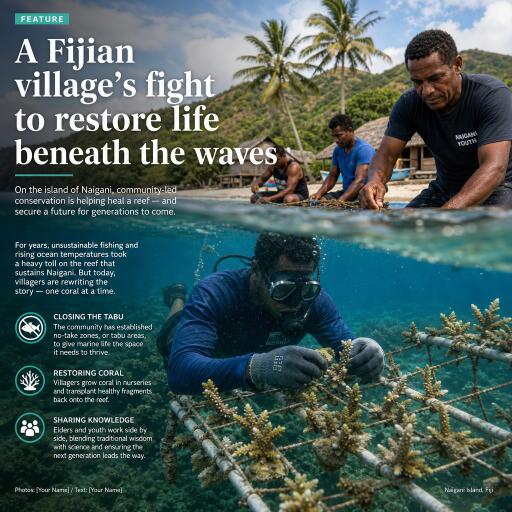
Feature: A Fijian village’s fight to restore life beneath the waves
Off Fiji’s western coastline, a battered reef is stirring back to life. What was once a pale, broken seascape is regaining color and pulse, and with it, the livelihoods and cultural rhythms of a small coastal community.
In Naidiri, a village of 147 people, a decade of patient, homegrown effort has turned despair into determination. Nearly 10 kilometers of degraded reef are rebounding, becoming a living case study in how local stewardship can buffer a warming world.
The revival arrives as Fiji charts a national course for safeguarding its reefs. During climate meetings held in the country ahead of COP31, officials unveiled the first National Action Plan for Coral Reef Conservation for 2026–2031. Fiji’s reefs, spanning more than 6,000 square kilometers, underpin island economies, harbor extraordinary biodiversity, and blunt storm waves before they slam ashore. As the environment ministry’s permanent secretary, Sivendra Michael, has emphasized, maintaining these ecosystems is as much about food security and safety as it is about nature.
When the ocean turned white
Villagers remember the subtle signals of change. In the 1990s, fishers began to feel the warmth of the sea creep upward, pushing familiar species into deeper or cooler waters. A decade ago, a fierce El Niño layered on top of global heating brought catastrophe: within months, more than 70 percent of Naidiri’s nearby corals bleached. The living city beneath the waves dimmed to an eerie chalk-white, and many colonies died. Catches shrank. With the reef weakened, storm surges bit harder into the shoreline. Elders warned that without action, the community’s future could wash away with the next run of bad seasons.
Rebuilding, coral by coral
In early 2020, fishers, elders, and youth formed a volunteer restoration team. They chose sheltered pockets of water to establish coral nurseries, gathering surviving colonies that appeared more tolerant of heat stress. Fragments were carefully cut, grown on ropes or frames, then transplanted back onto scarred reef patches. The work demanded meticulous attention and many boat trips, often in stubborn currents that could snap delicate fragments or smother them under drifting algae.
Progress was fragile. A brief marine heatwave in late 2021 triggered fresh bleaching and wiped out much of what had been replanted. The setback could have ended the project. Instead, the team doubled down. Women tracked water temperatures and logged growth rates. Elders passed on traditional knowledge about seasonal winds and spawning cycles. Younger divers spent long hours underwater clearing algae, fixing broken fragments, and checking for disease. As project lead Manoa Duwai put it to neighbors, this would be “a marathon run beneath the tide,” not a quick fix.
Signs of a comeback
By 2023, the reef’s pulse quickened. In the nurseries, a new generation of corals survived seasonal warm spells. On the restoration sites, color returned. Butterflyfish began to flit across the latticework of branching corals, damselfish tucked into growing thickets, and groupers lingered where shadows and structure re-emerged. With more live coral came rougher, more complex reef surfaces that absorbed wave energy, easing the punch of storms. Fish catches slowly improved, not to bounty, but to something steadier—and far more hopeful.
An underwater survey in 2025 brought the clearest signal yet: live coral cover had climbed back to a healthy level. For residents who had watched the reef fade into a skeletal plain, seeing fish weave through vibrant colonies felt like witnessing a culture regain its voice.
From village reef to global conversation
Naidiri’s experience has not remained local. Duwai and fellow volunteers have shared methods and lessons with communities and experts abroad, from the Pacific and Africa to North America and Europe. In late 2025, the Naidiri Marine Biodiversity Park—created and managed by the villagers—was honored with an innovation award at a global blue economy gathering, recognizing the project’s blend of traditional stewardship and practical restoration science.
This year, as climate talks convened in Fiji ahead of COP31, Naidiri’s reef became a touchstone. The story underscores that climate action is not only negotiated in conference halls; it is also measured in careful knots tied on nursery ropes, in the data jotted down tide after tide, and in the quiet courage of communities refusing to let their coastlines slip away. Pacific leaders noted that islanders, long on the front lines of warming seas, are already delivering solutions that speak more eloquently than any communiqué.
The road ahead
Fiji’s new reef action plan offers a framework to scale what Naidiri has demonstrated: protect what remains, revive what’s damaged, and knit science with local knowledge. Restoration is no substitute for cutting global emissions, but it buys time for ecosystems and people to adapt. In Naidiri, that time is now filled with the sounds of hammers on boats, laughter on the beach after dives, and the soft crackle of a reef coming back to life. The village’s fight is not finished, but the tide, at last, seems to be turning in their favor.



Leave a Reply