

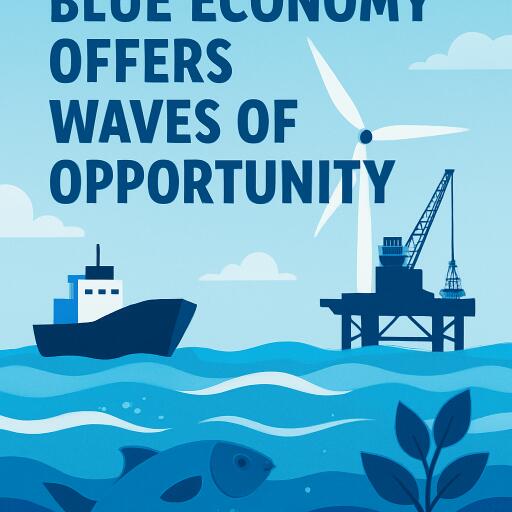
Blue economy offers waves of opportunity
For centuries, the ocean has shaped India’s trade routes, cultures and security outlook. Today, with 11,098 kilometres of coastline, rich marine ecosystems and a strategic perch in the Indian Ocean, the country’s maritime domain is emerging as a powerful engine of growth. As India charts a course toward a developed economy by 2047, the blue economy stands out as a platform to unite livelihoods, climate resilience and innovation.
From coast to core of development
The blue economy is not just about what happens offshore; it is about people, ideas and public value. It can secure better incomes for fishers and coastal families, spark new businesses, bolster food and energy security, and harness science to shield communities from climate shocks. National planners have placed the ocean economy among the country’s foremost growth streams, with a focus on pairing enterprise with environmental responsibility.
Turning challenges into catalysts
Marine pollution, habitat loss and a warming, acidifying ocean are intensifying pressure on coastal and ocean resources. Yet these risks can drive innovation. With faster technology development, startup participation and mission-driven capital, India can scale new sectors that both create jobs and protect ecosystems:
- Offshore renewables, including wind, wave and tidal energy, to accelerate the clean-energy transition and green port operations.
- Advanced aquaculture and sustainable fisheries with traceability, cold chains and habitat-friendly practices to improve nutrition and incomes.
- Marine biotechnology for bio-based products, pharmaceuticals and enzymes, alongside desalination and ocean energy research.
- Ocean data and digital services using satellites, sensors and AI for forecasting, route optimisation, disaster warning and climate services.
- Responsible coastal and island tourism that centres local stewardship and safeguards biodiversity.
- Deep-sea research and technologies with strict environmental safeguards and transparent oversight.
Science to policy, policy to people
India is building the scientific and institutional architecture to convert ocean knowledge into public benefit. Flagship initiatives in deep-ocean exploration, marine spatial planning, ocean observation and high-resolution forecasting are strengthening safety, planning and productivity. Digital platforms and early-warning systems now deliver fisheries advisories, storm alerts and shoreline-management guidance that protect lives, assets and livelihoods.
Homegrown capabilities in exploration systems, marine bioprocessing, desalination and ocean energy are expanding pathways to resource security and technological self-reliance. The payoff is tangible: more resilient coasts, smarter fleet operations, and communities better prepared for cyclones, storm surges and erosion.
Speed, scale and credible pipelines
The next leap demands integrated ocean governance, tighter coordination across agencies and states, and rigorous project pipelines backed by open data and measurable outcomes. Investment in blue sectors is expected to swell from roughly Rs 3.9 lakh crore in 2015–2025 to nearly Rs 25.8 lakh crore in 2026–2035, signalling a historic window for climate-resilient growth.
To turn capital into impact, the focus must fall on blended finance, green bonds, outcome-based partnerships and responsible private investment. Transparent implementation, robust monitoring and community co-ownership are essential. Coastal residents should remain decision-makers and primary beneficiaries, not bystanders, in this transformation.
Ports, logistics and energy reimagined
Legacy maritime sectors are being reinvented: ports deploy automation and digital twins; fleets transition to cleaner fuels such as green methanol, with pilots in hydrogen and electrified coastal vessels; logistics platforms cut congestion and emissions. These upgrades translate into more competitive trade, lower carbon footprints and safer operations—while opening the door for Indian manufacturers and service providers to build world-class maritime solutions.
Careers, startups and the coastal classroom
New frontiers are taking shape at the intersection of ecology and engineering: offshore wind arrays, tidal pilots, marine robotics and autonomous vessels, AI for ocean monitoring, aquaculture tech, green maritime systems, and blue-carbon restoration of mangroves and seagrasses. Each field unlocks opportunities for entrepreneurs, engineers, ecologists and skilled workers.
Now is the time to cultivate skills in ocean engineering, data science, climate finance and marine ecology; to incubate ventures; and to convert lab insights into scalable products. Universities, labs, industry and fisher cooperatives can serve as living testbeds. Practical innovations are within reach—smart nets that reduce bycatch, low-emission fishing craft and cold chains, resilient ports with nature-based defenses, open ocean-data platforms, bio-based materials and ethical approaches to exploring the deep sea without compromising fragile ecosystems.
A pact with the ocean
For the blue economy to thrive, growth and guardianship must advance together. Circular strategies for marine plastics, restoration of coastal habitats, strong environmental standards and the polluter-pays principle can anchor sustainable expansion. Done well, this agenda will reinforce food and energy security, lower disaster risk and consolidate India’s maritime leadership across the Indian Ocean region.
The horizon is wide—and the clock is ticking. With science guiding policy, enterprise delivering innovation and communities sharing the gains, India’s ocean can power a just, resilient and globally competitive future on the voyage to 2047.



Leave a Reply