

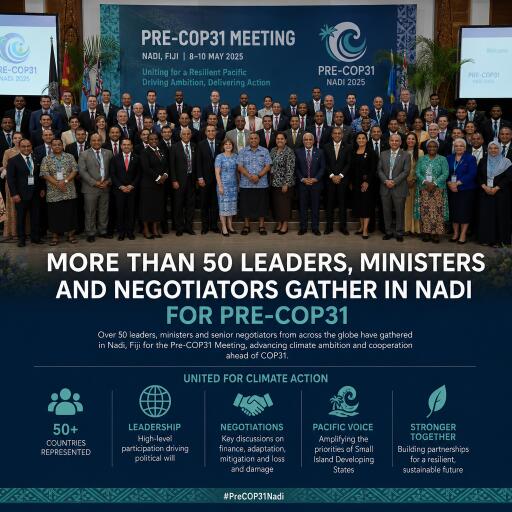
More than 50 leaders, Ministers and negotiators gather in Nadi for Pre-COP31
Nadi has become a hub for climate diplomacy as Ministers, negotiators and experts from over 50 countries convene for Pacific Pre-COP31, a pivotal gathering to align priorities ahead of next month’s UN climate conference in Antalya. Co-hosted by Fiji and Australia, with a special Leaders’ segment held in Tuvalu, the meeting places Pacific realities and solutions at the heart of global climate negotiations—where the stakes are as tangible as eroding shorelines and salt-tainted wells.
Pacific leaders opened the week with a direct appeal: commitments must translate into delivery. Fiji’s Prime Minister, Sitiveni Rabuka, underscored that inaction is a choice—one that deepens harm already experienced in homes, villages and coastal ecosystems. He framed climate change not only as a scientific and economic crisis but as a moral test: every fraction of a degree of additional warming compounds losses that can’t simply be undone.
Faith leaders amplified that message. Archbishop Peter Loy Chong cautioned against celebrating Pacific “resilience” while approving new fossil fuel projects, calling such praise a moral alibi for delay. He urged rapid emissions cuts, direct and grant-based finance, and genuine inclusion of communities most affected by climate breakdown.
The science driving these pleas is unambiguous across the Pacific. Climate advocates note that overshooting 1.5°C—even temporarily—would push species and native forests toward irreversible decline, intensify mass coral bleaching and displace communities. Warmer waters are already reordering marine food webs, with fish stocks moving and traditional fishing grounds at risk of vanishing from living memory. The Pacific’s long-standing message—1.5 to stay alive—remains a line in the sand.
On the ground, the impacts are compounding. In Dramasi, Tavua, women rise at 2 a.m. to climb over hills in search of water before livestock muddy scarce sources by day. They shoulder long days of caregiving, food preparation and market gardening, only to find parched creeks and failing harvests. In nearby Korovou, the loss of mangroves and pollution has forced crab-gatherers to wade further and longer in cold water, with mounting health concerns. And in Nadi’s Nawajikuma settlement, families brace for floods that arrive with little warning as rivers bite into their banks; residents have called for proper drainage and river protection to keep children and elders safe during evacuations.
Women leaders and peacebuilders working across these communities warn that climate stress doesn’t stop at physical damage. It is driving food insecurity, deepening poverty and exacerbating gender-based violence. Their demand: a just phase-out of fossil fuels; climate finance that reaches households and villages—not in years, but now; and gender-responsive policies that center the expertise and leadership of women and gender-diverse people in climate decisions.
Legal clarity is also reshaping the conversation. Youth advocates emphasize that the recent advisory opinion of the International Court of Justice strengthens the case that states have duties to prevent significant climate harm—and that remedies are due when they fail. They argue that every nationally determined contribution and national adaptation plan should be stress-tested against this legal benchmark, with lived experience—especially of women, young people and marginalized groups—treated as evidence, not anecdotes.
Finance and delivery are the week’s proving ground. Fiji announced a US$10 million commitment to the Pacific Resilience Facility over five years—an investment designed by and for the region to fund practical adaptation. Australia welcomed the move and pledged AU$3 million for climate-resilient infrastructure across several Pacific countries, alongside AU$1 million for solar systems in Fiji’s remote and maritime schools to reduce diesel dependence and energy costs. Fiji’s Environment and Climate Change Minister Lynda Tabuya framed these steps as proof that Pacific nations are investing in their own future while urging global partners to scale up support.
At the policy level, momentum in clean energy is building: renewables now generate a growing share of global electricity and are the cheapest new power option in many markets. Pacific leaders want COP31 to convert that trajectory into real-time delivery—grid upgrades, storage, and accessible finance—to put fossil fuels on a managed decline and keep households lit and livelihoods secure from blackouts and price spikes.
Ministers and negotiators this week are working across four core pillars that define the Pacific’s agenda for Antalya:
- Keep 1.5°C within reach through accelerated emissions cuts and a rapid, just energy transition.
- Open the taps on climate finance—simplified, direct and grant-based—for the communities that need it most.
- Elevate the ocean–climate nexus, from safeguarding blue carbon ecosystems to securing sustainable livelihoods.
- Amplify Pacific leadership so frontline experiences shape global rules, not the other way around.
Australia’s Climate Change and Energy Minister Chris Bowen said the region’s perspectives must resonate more strongly inside UN climate negotiations and pledged to keep Pacific Ministers closely involved throughout COP31. Türkiye’s COP31 Presidency has signaled a focus on practical outcomes—from electrification to resilient cities and oceans—underpinned by finance that matches urgency.
If there is a single refrain in Nadi, it is this: applause will not hold back the sea. The Pacific has spelled out the pathway—keep 1.5°C alive, invest in resilience and nature, and move money at the speed of need. With communities already bailing water before dawn and relocating homes by dusk, Pre-COP31 is a final test of resolve before the world meets in Antalya. The region arrives with stories, science and solutions; now it is calling for delivery.



Leave a Reply